


Democratic Progressive Party (DPP) presidential candidate Tsai Ing-wen (蔡英文) yesterday criticized President Ma Ying-jeou (馬英九) and Chinese Nationalist Party (KMT) presidential candidate Eric Chu (朱立倫) over their criticisms of her.
Ma during a news conference on Friday about his recent meeting with Chinese President Xi Jinping (習近平) accused the DPP legislative caucus of dodging its responsibility to keep the executive branch checked since it objected the KMT motion to invite Ma to brief the legislature about his meeting with Xi.
“The key point is that the Ma-Xi meeting was completely opaque before it happened. The people did not know what they would be talking about and how they would talk about it. Even the legislative speaker said he did not know the details,” Tsai said when responding to media queries at a campaign event in Keelung. “For such reasons, the people now distrust the KMT government, and the fundamental cause of this is that there is not an established procedure for it.”
Tsai said there is not an established mechanism on what a president should do before meeting with their Chinese counterpart, and the president did not respect the public’s and the legislature’s right to know.
It would not be a successful meeting if a national leader meets with their counterpart without the trust and support of their own people, Tsai said, adding that it is perhaps time for everyone to sit down and talk about how to create a procedure for such meetings.
Tsai also rebutted Ma’s statement that she also once supported the so-called “1992 consensus” — an agreement that the KMT claims was reached in 1992 that both sides of the Taiwan Strait recognize that there is only “one China,” but with each side having its own interpretation of what “China” means.
Although Ma, the KMT and the China all insist the “1992 consensus” is the basis for cross-strait exchanges, former Mainland Affairs Council minister Su Chi (蘇起) admitted he had made up the term in 2000.
“President Ma not only fails to clarify his own stance, but also twists the stance of others,” Tsai said. “The responsibility of a national leader is to defend its people’s right to decide the nation’s future, and should allow as many options as possible for the people.”
Instead, what Ma has been doing is limiting the people’s options, Tsai said.
Tsai also condemned Chu, who is currently in the US, for launching an attack on the opposition party, instead of working to expand the nation’s international space.

LOUD AND PROUD Taiwan might have taken a drubbing against Australia and Japan, but you might not know it from the enthusiasm and numbers of the fans Taiwan might not be expected to win the World Baseball Classic (WBC) but their fans are making their presence felt in Tokyo, with tens of thousands decked out in the team’s blue, blowing horns and singing songs. Taiwanese fans have packed out the Tokyo Dome for all three of their games so far and even threatened to drown out home team supporters when their team played Japan on Friday. They blew trumpets, chanted for their favorite players and had their own cheerleading squad who dance on a stage during the game. The team struggled to match that exuberance on the field, with
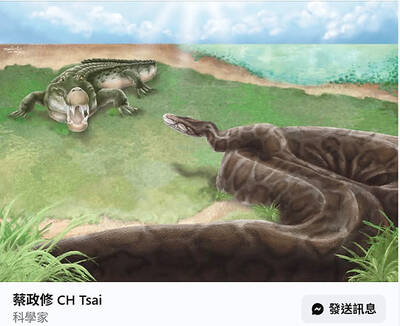
Taiwanese paleontologists have discovered fossil evidence that pythons up to 4m long inhabited Taiwan during the Pleistocene epoch, reporting their findings in the international scientific journal Historical Biology. National Taiwan University (NTU) Institute of Ecology and Evolutionary Biology associate professor Tsai Cheng-hsiu (蔡政修) led the team that discovered the largest snake fossil ever found in Taiwan. The single trunk vertebra was discovered in Tainan at the Chiting Formation, dated to between 400,000 and 800,000 years ago in the Middle Pleistocene, the paper said. The area also produced Taiwan’s first avian fossil, as well as crocodile, mammoth, saber-toothed cat and rhinoceros fossils, it said. Discoveries

Taiwanese paleontologists have discovered fossil evidence that pythons up to 4m long inhabited Taiwan during the Pleistocene epoch, reporting their findings in the international scientific journal Historical Biology. National Taiwan University (NTU) Institute of Ecology and Evolutionary Biology associate professor Tsai Cheng-hsiu (蔡政修) led the team that discovered the largest snake fossil ever found in Taiwan. A single trunk vertebra was discovered in Tainan at the Chiting Formation, dated to between 800,000 to 400,000 years ago in the Middle Pleistocene, the paper said. The area also produced Taiwan’s first avian fossil, as well as crocodile, mammoth, sabre-toothed cat and rhinoceros fossils, it said. Discoveries
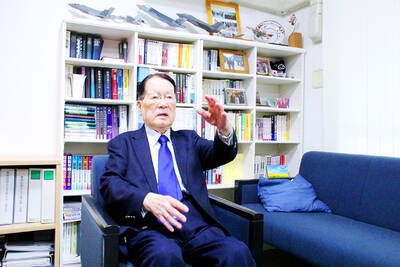
Whether Japan would help defend Taiwan in case of a cross-strait conflict would depend on the US and the extent to which Japan would be allowed to act under the US-Japan Security Treaty, former Japanese minister of defense Satoshi Morimoto said. As China has not given up on the idea of invading Taiwan by force, to what extent Japan could support US military action would hinge on Washington’s intention and its negotiation with Tokyo, Morimoto said in an interview with the Liberty Times (sister paper of the Taipei Times) yesterday. There has to be sufficient mutual recognition of how Japan could provide


 RSS
RSS