


Senior US officials on Friday said that Chinese Nationalist Party (KMT) presidential candidate Eric Chu (朱立倫) and Democratic Progressive Party (DPP) presidential candidate Tsai Ing-wen (蔡英文) had been given exactly the same reception in Washington.
“We do not play favorites,” Assistant Secretary of State for East Asia Daniel Russel said.
Russell was addressing a Foreign Press Center briefing on US President Barack Obama’s upcoming trip to the G20 summit in Turkey, as well as Malaysia and the Philippines.
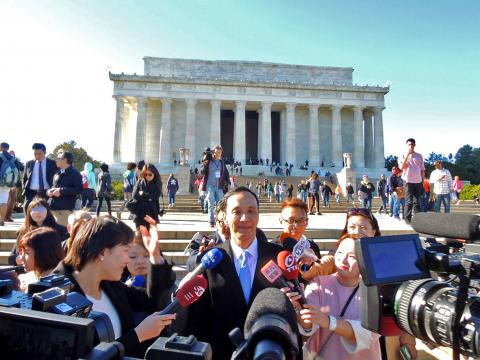
Photo: Shih Hsiao-kuang, Taipei Times
Speaking as Chu ended his two-day visit to Washington, Russel was adamant that the two Taiwanese presidential candidates were treated equally.
Russel said that conversations he had with Chu during his visit had focused on policy.
“We have an open door to major political actors on Taiwan and want to underscore that contrary to speculation in the Taiwan press, the entry for both representatives from the KMT and the DPP was of equal access with even-handed treatment,” he said.
He said that the US did not back political parties, but that it did care about policies.
“These visits have created an opportunity for us to consult, confer and discuss policy issues with the head of the KMT and DPP,” Russel said.
He said that the US has strong unofficial ties with Taiwan based on “our deep respect for Taiwan’s democracy” and on the US’ interest and stake in Taiwan’s security.
Russel said the focus of conversation with both candidates was in the context of the “one China” policy, and how stability across the Taiwan Strait could be maintained and tensions reduced.
National Security Council Senior Director for Asian Affairs Daniel Kritenbrink, supporting everything that Russel had said, added that Washington welcomed the recent meeting between President Ma Ying-jeou (馬英九) and Chinese President Xi Jinping (習近平).
“We also welcome the historic improvement we have seen in cross-strait relations over the last several years,” he said.
Kritenbrink said the US has a deep and abiding interest in peace and stability in the Taiwan Strait and that was the focus of its interest. He said the US supported the building of ties between China and Taiwan to reduce tensions and increase stability “on the basis of dignity and respect.”
Kritenbrink said that the US welcomed the further development of cross-strait relations and would maintain its “one China” policy based on the three communiques and the Taiwan Relations Act.
Asked if the US was “surprised” by the Ma-Xi meeting, he refused to comment, except to say the US welcomed steps that promoted cross-strait relations in a manner that was acceptable to both sides of the Strait.
On Chu, Kritenbrink said: “We welcomed Chairman Chu’s visit and our conversations with him were productive. We received Chairman Chu in exactly the same way that we received presidential candidate Tsai Ing-wen. We met both candidates at exactly the same level.”
Before leaving Washington for New York and San Francisco, Chu met with think tank experts at the Brookings Institution and with the editorial board of the Washington Post.
Before entering the closed-door Brookings meeting, Chu spoke briefly to Taiwanese reporters and criticized the DPP.
“Has the DPP finally turned a new page in its dealing with mainland China?” he asked. “My answer is ‘hardly.’”
He said there was a major difference between the DPP’s treatment of cross-strait relations and the KMT’s.
“The DPP engages in wishful thinking vis-a-vis cross-strait relations — the DPP offers a policy goal of maintaining the ‘status quo’ which people agree upon, but the DPP shirks the responsibility of providing a workable formula to achieve that goal,” he said.
Chu said Ma had done an “excellent job” in designing policy that helped maintain the “status quo,” but had neglected one aspect of the “complicated and complex” nature of cross-strait relations.
“If elected president, I will make up for what he left out — cultivating a domestic base for a grand strategy that can secure peace,” he said.

LOUD AND PROUD Taiwan might have taken a drubbing against Australia and Japan, but you might not know it from the enthusiasm and numbers of the fans Taiwan might not be expected to win the World Baseball Classic (WBC) but their fans are making their presence felt in Tokyo, with tens of thousands decked out in the team’s blue, blowing horns and singing songs. Taiwanese fans have packed out the Tokyo Dome for all three of their games so far and even threatened to drown out home team supporters when their team played Japan on Friday. They blew trumpets, chanted for their favorite players and had their own cheerleading squad who dance on a stage during the game. The team struggled to match that exuberance on the field, with
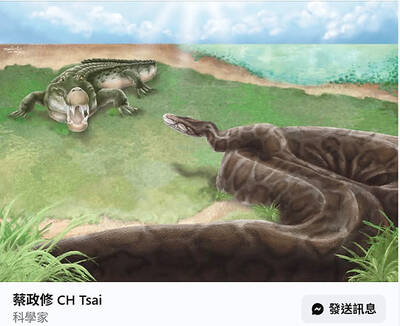
Taiwanese paleontologists have discovered fossil evidence that pythons up to 4m long inhabited Taiwan during the Pleistocene epoch, reporting their findings in the international scientific journal Historical Biology. National Taiwan University (NTU) Institute of Ecology and Evolutionary Biology associate professor Tsai Cheng-hsiu (蔡政修) led the team that discovered the largest snake fossil ever found in Taiwan. The single trunk vertebra was discovered in Tainan at the Chiting Formation, dated to between 400,000 and 800,000 years ago in the Middle Pleistocene, the paper said. The area also produced Taiwan’s first avian fossil, as well as crocodile, mammoth, saber-toothed cat and rhinoceros fossils, it said. Discoveries

Taiwanese paleontologists have discovered fossil evidence that pythons up to 4m long inhabited Taiwan during the Pleistocene epoch, reporting their findings in the international scientific journal Historical Biology. National Taiwan University (NTU) Institute of Ecology and Evolutionary Biology associate professor Tsai Cheng-hsiu (蔡政修) led the team that discovered the largest snake fossil ever found in Taiwan. A single trunk vertebra was discovered in Tainan at the Chiting Formation, dated to between 800,000 to 400,000 years ago in the Middle Pleistocene, the paper said. The area also produced Taiwan’s first avian fossil, as well as crocodile, mammoth, sabre-toothed cat and rhinoceros fossils, it said. Discoveries
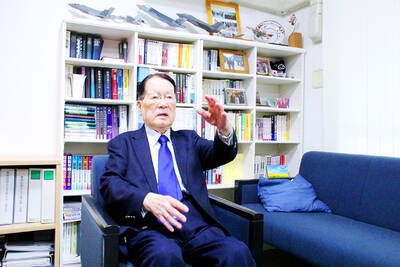
Whether Japan would help defend Taiwan in case of a cross-strait conflict would depend on the US and the extent to which Japan would be allowed to act under the US-Japan Security Treaty, former Japanese minister of defense Satoshi Morimoto said. As China has not given up on the idea of invading Taiwan by force, to what extent Japan could support US military action would hinge on Washington’s intention and its negotiation with Tokyo, Morimoto said in an interview with the Liberty Times (sister paper of the Taipei Times) yesterday. There has to be sufficient mutual recognition of how Japan could provide


 RSS
RSS