


Special forces units assigned to provide protection for presidential candidates were launched by the National Security Bureau (NSB) yesterday, with the team members demonstrating firearms training, martial arts skills and high-tech telecommunication devices.
The three teams of 55 special forces members each were last week assigned to personal protection duties for the three major parties’ presidential and vice presidential candidates.
They were commissioned at the bureau-administered Special Service Command Center yesterday morning.
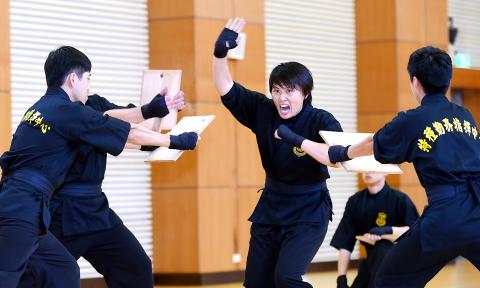
Photo: Chang Chia-ming, Taipei Times
NSB Director-General Yang Kuo-chiang (楊國強) presided over the ceremony, with top officials from the Central Election Commission, Ministry of National Defense, National Police Agency, Military Police Command and representatives from the political parties in attendance.
In his address, Yang told the special forces units to give their utmost to fulfill their security duties as personal bodyguards for the candidates in the run-up to the Jan. 16 election, while abiding by the principles of strict discipline, political impartiality and upholding secrecy.
Yang said four special forces teams have been put into service, one each for the three major political parties and one team in reserve on the possibility of another party entering the race.
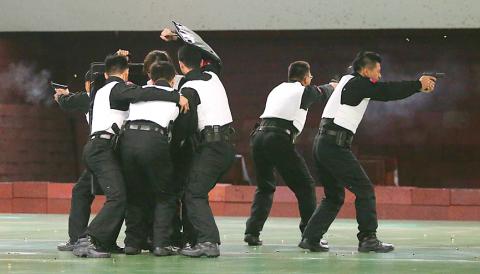
Photo: provided by the Association of Taiwan Journalists
Bureau officials said there are six female members in each team — an increase from three in the past — to provide more complete protection for female candidates, as well as for wives of male candidates.
The presidential candidates for three parties have been named: Chinese Nationalist Party (KMT) Chairman Eric Chu (朱立倫), Democratic Progressive Party Chairperson Tsai Ing-wen (蔡英文) and People First Party Chairman James Soong (宋楚瑜).
The special forces teams demonstrated use of Austrian-made Glock pistols, the primary sidearm they are to carry, and locally produced T91 rifles.
Support units presented their equipment and outlined their roles to provide high-tech telecommunication systems, anti-wiretapping and anti-phone-interception devices, sniffer dog teams for detecting explosives, anti-sniper combat teams and special units to guard against poisoning and biological attacks.
A new weapon put into service this year is a combination of a “net-shooting device” and a stun gun, which is produced by the Armament Bureau’s 205th Arsenal in Kaohsiung.
An NSB officer demonstrated its use in a live demonstration, ensnaring a volunteer in a 3m by 3m soft mesh net and halting his advance.
The net can deliver up to 35,000 volts in electric charge to incapacitate a target.
There were demonstrations by snipers, as well as bodyguard teams showing crowd control techniques, including subduing an attacker carrying weapons and protection provided for motorcades.
A preclearance service to facilitate entry for people traveling to select airports in Japan would be available from Thursday next week to Feb. 25 at Taiwan Taoyuan International Airport, Taoyuan International Airport Corp (TIAC) said on Tuesday. The service was first made available to Taiwanese travelers throughout the winter vacation of 2024 and during the Lunar New Year holiday. In addition to flights to the Japanese cities of Hakodate, Asahikawa, Akita, Sendai, Niigata, Okayama, Takamatsu, Kumamoto and Kagoshima, the service would be available to travelers to Kobe and Oita. The service can be accessed by passengers of 15 flight routes operated by

GIVE AND TAKE: Blood demand continues to rise each year, while fewer young donors are available due to the nation’s falling birthrate, a doctor said Blood donors can redeem points earned from donations to obtain limited edition Formosan black bear travel mugs, the Kaohsiung Blood Center said yesterday, as it announced a goal of stocking 20,000 units of blood prior to the Lunar New Year. The last month of the lunar year is National Blood Donation Month, when local centers seek to stockpile blood for use during the Lunar New Year holiday. The blood demand in southern Taiwan — including Tainan and Kaohsiung, as well as Chiayi, Pingtung, Penghu and Taitung counties — is about 2,000 units per day, the center said. The donation campaign aims to boost
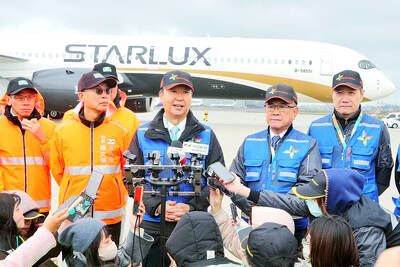
ENHANCING EFFICIENCY: The apron can accommodate 16 airplanes overnight at Taoyuan airport while work on the third runway continues, the transport minister said A new temporary overnight parking apron at Taiwan Taoyuan International Airport is to start operating on Friday next week to boost operational efficiency while the third runway is being constructed, the Ministry of Transportation and Communications said yesterday. The apron — one of the crucial projects in the construction of the third runway — can accommodate 16 aircraft overnight at the nation’s largest international airport, Minister of Transportation and Communications Chen Shih-kai (陳世凱) told reporters while inspecting the new facility yesterday morning. Aside from providing the airport operator with greater flexibility in aircraft parking during the third runway construction,
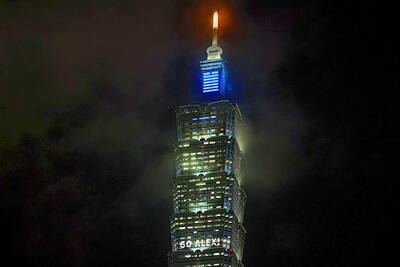
American climber Alex Honnold is to attempt a free climb of Taipei 101 today at 9am, with traffic closures around the skyscraper. To accommodate the climb attempt and filming, the Taipei Department of Transportation said traffic controls would be enforced around the Taipei 101 area. If weather conditions delay the climb, the restrictions would be pushed back to tomorrow. Traffic controls would be in place today from 7am to 11am around the Taipei 101 area, the department said. Songzhi Road would be fully closed in both directions between Songlian Road and Xinyi Road Sec 5, it said, adding that bidirectional traffic controls would


 RSS
RSS