


For any journalist, the opportunity to record and witness an event that is set to go down in history, such as the historic summit between the two leaders across the Taiwan Strait on Saturday, is without a doubt exhilarating.
However, as the day unfolded, the thrill was quickly overtaken by frustration and a sense that Taiwan was being unfairly treated as a result of its government’s negligence to uphold the rights of Taiwanese journalists and insist on equal treatment with their Chinese peers.
It was sad to see President Ma Ying-jeou’s (馬英九) lack of sophistication and dignity in an international setting, a shame that reduces the prestige of Taiwan as a whole.
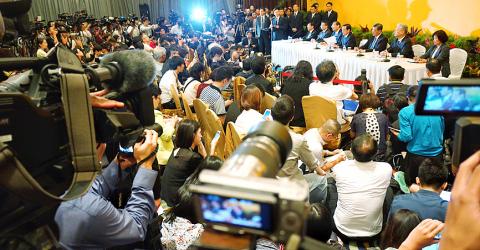
Photo: Liu Hsin-de, Taipei Times
The meeting between Ma and Chinese President Xi Jinping (習近平) took place in Singapore at the Shangri-la Hotel. According to the run-down of the summit made available the day before, it was slated to begin at 3pm, with Ma and Xi first exchanging a handshake for the camera before having a one hour talk behind closed doors, which the media were allowed to attend for the first five-minute opening remarks delivered by the two leaders.
The summit was then followed by a press conference held by China’s Taiwan Affairs Office Minister Zhang Zhijun (張志軍) before a separate news conference presided over by Ma.
While the Ma-Xi meeting took place on perceived neutral ground, it is clear from the start that China was comfortable enough in the setting to be able to enjoy a home advantage.
A number of media outlets, in a bid to be among the first to get into the venue and therefore secure optimal filming and photography positions for the historic moment, began the day on Saturday by lining up at the metal detectors set up at the meeting entrance.
In the case of a photo journalist from the Chinese-language Liberty Times’ (the Taipei Times’ sister paper), he managed to be the first in the line at one of the metal-detector gates by beginning to line up at 4am. By the time security checks began at 1pm, however, Taiwanese media were dumbfounded to see a number of journalists from media outlets in China had already got in well ahead and had their equipment positioned in the first row.
While the Chinese press corps were already in possession of the required press passes early on Saturday morning, Taiwanese media did not get theirs until noon, which were distributed by a Mainland Affairs Council staffer in a corner of the hotel.
The Taiwanese reporters’ initial press passes, which were dated by the Republic of China’s calendar year of 104, had also later been replaced with ones using the Gregorian calendar.
Reporters were also shooed out of the closed-door venue by a member of the Chinese delegation before Ma had finished making his opening remarks.
Some might dismiss these as trivial matters; yet what lies at the core of these seemingly inconsequential episodes is a total lack of respect.
It is worth noting that while the Ma-Xi meeting drew hordes of international media, the presentation of the summit itself was at odds with international norms. For example, no announcement of any sort, not even introductory background music, was made to announce Ma and Xi’s arrival at the venue; the two simply entered from opposite sides of the room quietly before walking to the center and standing against a plain yellow background, a color associated with China’s oft-touted yan huang zisun (炎黃子孫, descendants of emperors Yan and Huang).
The conventional practice of having a simultaneous English interpreter present at international press conferences was also missing from both Zhang and Ma’s events.
The apparent lack of proper etiquette for an international event of the kind did not at all dim China’s awe-inspiring national presence at the post-meeting press conference held by Zhang, who throughout the event more-or-less just rquoted what Xi had said during the closed-door talks.
The mood was solemn and dignified, and the air was redolent with Chinese nationalism.
Xi came prepared. While tactically woven in language seeking to appeal to Taiwanese hearts with words such as “both sides of the Strait are brothers who are joined by flesh even if their bones are broken,” and “we are family of a blood thicker than water.”
On the other hand, he also uttered firm and uncompromising rhetoric such as: “Both sides of the Strait belong to one China,” adding that he is “anti-Taiwan independence,” and that “without a common ground, there would be stormy sea and terrifying waves.”
In short, Xi successfully got his points across to a room full of international media that “both sides of the Taiwan Strait belong to the same ‘one China.’”
Taiwan’s press conference, although convened by Ma, paled in comparison — both in substance and in the ability to command Taiwan’s national presence and dignity.
Instead of demonstrating a level of class befitting his status and standing as president, Ma came across more like a middle-ranking official.
Ma might have deliberately tried to light up the conference by occasionally slipping in whacky remarks to make the atmosphere seem more relaxed; however, failing to inject the conference with wit, humor or savvy, Ma simply came across as a buffoon.
Ma might aim to look like a gentleman in his kind and polite attitude toward Xi, but the effect is quite the opposite. Being diplomatic, does not mean Taiwan has to surrender its dignity. Not to the mention the fact that when it comes to Beijing, being polite just plays into its hands.
With more than 500 journalists from the international media present, Saturday’s press conference would have been the ideal opportunity for Ma to make Taiwan’s concerns heard.
However, Ma tacitly acquiesced to China’s bullying, did not speak of Taiwan’s struggle to become a legitimate member of the international community, and all the while seemingly cultivated the misconception among members of the international media that Taiwan acquiesces to China’s “greater China” imperialism is disappointing to say the least.
Self-respect gains respect. If Taiwan’s own president does not speak up and make known the nation’s struggles, how does Taiwan expect the international media to understand its predicament and lend it support.
Ma wasted a golden opportunity to make Taiwan more internationally visible and to draw the world’s attention to the concerns of Taiwanese.

NATIONAL SECURITY: Authorities are working to confirm the identities of the military personnel involved and investigating possible illegal conduct and regulatory violations Authorities are probing possible national security implications after Kinmen police and immigration officers on Sunday found a Chinese woman allegedly posing as a tourist while engaging in prostitution involving more than 10 military personnel. The woman, surnamed Chen (陳), has since been deported, authorities said, adding that investigators are still working to confirm the identities of those implicated, as the records only listed code names and aliases. The case stemmed from a report received by the Kinmen District Prosecutors’ Office on Friday last week from the Jinhu Precinct of the Kinmen County Police Bureau. On Sunday, police, along with the National Immigration

GLOBALGIVING: ‘ Caving to external pressure is not acceptable for an organization that has cultivated justice reform and human rights for 30 years,’ one NGO said A slew of non-government organizations (NGOs) have withdrawn from the GlobalGiving fundraising platform after it announced it would use “Chinese Taipei” instead of “Taiwan” from next month. The Taiwan Good Rice Association wrote on Facebook on Friday that it was informed on April 28 via a teleconference call of the change, which was made because the platform wanted to operate in China. Taiwan Good Rice is to terminate all cooperative relationships with GlobalGiving in response to the platform’s “unilateral and non-negotiable” decision to remove references to Taiwan, the NGO said. “Taiwan is in the official name of Taiwan Good Rice Association and the

HEAVY WEATHER: Typhoon Jangmi is due to crash straight into the Ryukyus as airlines look to shift flights to larger aircraft or cancel flights to Okinawa entirely Taiwan’s international air carriers announced flight adjustments over the weekend as Typhoon Jangmi is forecast to hit the Ryukyu Islands today and tomorrow. The Central Weather Administration (CWA) upgraded Jangmi from a tropical storm to a typhoon at 8am yesterday, with the eye located 580km south of Naha city. It was moving north at 19kph. Today, China Airlines’ CI-120, CI-121, CI-122 and CI-123 flights between Taoyuan and Naha, Okinawa, have been canceled as well as CI-132 and CI-133 between Kaohsiung and Naha. EVA Air’s BR-112, BR-113, BR-186 and BR-185 flights between Taoyuan and Naha are also canceled. Low-cost carrier Tigerair Taiwan canceled IT-230,

Chinese Nationalist Party (KMT) Chairwoman Cheng Li-wun (鄭麗文) yesterday briefed her party’s Central Standing Committee regarding her scheduled visit to the US between Monday next week and June 16, saying that her purpose would be to persuade the US that the Republic of China (ROC) Constitution was a “one China” constitution that would foster stable and peaceful cross-strait relations. The ROC Constitution is the most important defense for all Taiwanese citizens, as it upholds our democracy and has contributed to our robust economy, which aligns with international and US interests, she said. “We would not be troublemakers and drag the US under,”


 RSS
RSS