


What brought former Academia Sinica researcher Huang Kuo-chang (黃國昌) and award-winning screenwriter and author Neil Peng (馮光遠) to devote themselves to politics, especially when the former had once sworn never to be affiliated with any political party and the latter had assigned himself the role of political adviser?
Both are running for legislative seats under New Power Party (NPP) banner.
Huang, elected NPP executive chairman in September, is poised to register his candidacy for New Taipei City’s 12th constituency, which includes Sijhih (汐止), Jinshan (金山), Wanli (萬里), Rueifang (瑞芳), Pingsi (平溪), Shuangsi (雙溪) and Gongliao (貢寮) districts.
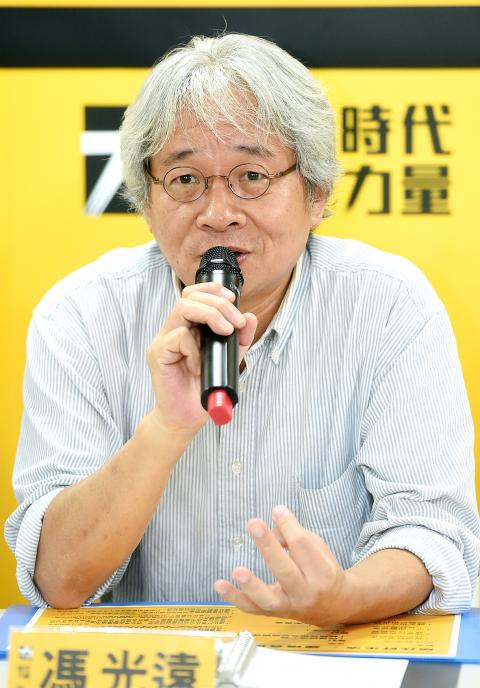
Photo: Chien Jung-fong, Taipei Times
Huang said he was mainly inspired by civil movements in 2013.
“The multiple events in the latter half of 2013 highlighted the presence of a new power in the Legislative Yuan, one representing progress, while more young people were willing to stand up and place themselves on the line,” he said.
Huang said he initially hoped to foster such a presence, but did not consider himself a part of it.
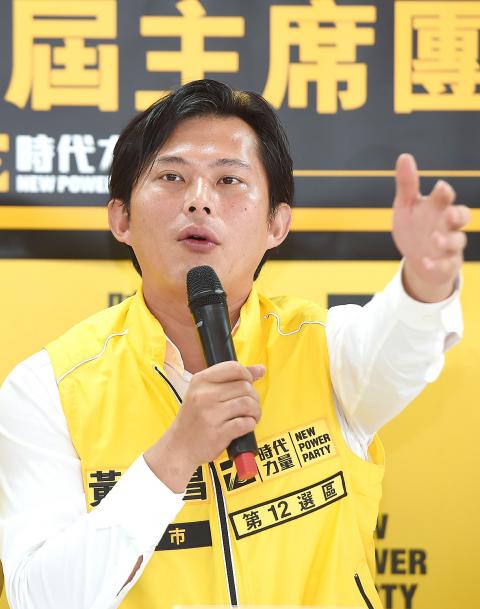
Photo: Liao Chen-hui, Taipei Times
However, he felt that his choice to remain in the background became more difficult as time passed.
Huang said friends suggested he make a bid for the legislative seat in Jhonghe District (中和) to unseat Chinese Nationalist Party (KMT) Legislator Chang Ching-chung (張慶忠).
However, Huang said that he only had Sijhih — the town where he grew up — in mind, as he wants to focus on rural development issues, especially in his hometown, if he is elected.
The campaign trail is a constant learning process during which he has learned many new things and has been forced reflect on others, he said.
It is a constant process of adjustment, Huang said, pointing to the supporters of the main political camps as an example.
“The distinction between pan-blue and pan-green supporters is less than I imagined. Both simply want someone who would be able to solve their problems,” Huang said. “I hope to be that person.”
If elected, Huang promised to focus on returning political power to the people, changing the Referendum Act (公民投票法), and amending the Civil Servants Election and Recall Act (公職人員選舉罷免法).
Peng said his desire to run for a legislative seat stemmed from his wish to maintain the momentum gained in trying to realize his ideals and dreams.
Peng reflected on his attempt to run for Taipei mayor last year.
“That attempt was essentially a one-man campaign, but I felt I displayed the sort of attitude from which a politician should view things,” Peng said.
It also taught him to appreciate the importance of a team, he added.
“Once I make a decision, I pursue it with everything I’ve got,” Peng said, adding that this personality formed the drive behind the writing of the book Wedding Feast (囍宴) and writing for the troupe Gei Wo Bao Bao (給我報報) for the past two decades.
He added that it was this attitude that drove him to attend many events that sought to recall lawmakers — especially the KMT’s Wu Yu-sheng (吳育昇) — who Peng felt were going against the will of the public.
‘YOUNG AT HEART’
“Even being hospitalized due to a minor stroke has not stopped me,” Peng said, adding that he treated recall events as part of his rehabilitation program. “I might be old in age, but I’m still young at heart.”
Looking to campaign for the legislative seat in New Taipei City’s first constituency, which includes Tamsui (淡水), Bali (八里), Shihmen (石門), Sanjhih (三芝), Linkou (林口) and Taishan (泰山) districts, Peng said he hopes to have a dramatic effect on the political landscape nationwide.
While most people suggested that he contest Taipei’s Daan District (大安), which is where he lives, Peng said he made a name for himself trying to have Wu recalled, and his ultimate goal is to see Wu removed from office.
Peng said he has always been “a firm believer that the concept of social rank is nonsense and neither the political elite nor intellectuals should be entitled to feel as if they are better than others.”
“I am a simple commoner, one who wears sneakers and never dress shoes,” Peng said.
“I browse stalls and visit traditional markets,” he said, adding that he mingles with the public and can be approached at any time.
Peng said his contempt over politicians’ inability to evaluate themselves honestly began when he was young.
“The saddest sight I have ever seen was an older person holding an umbrella for an office director at the Presidential Office Building,” he said.
Bristling with indignation at the sight, he said it made him think: “Who does [the director] think he is to degrade another human being in such a way?”
Peng said his criticism of “the elite” is due to his intolerance of how people are degraded by Taiwanese politics.
A lawmaker has a different role from a city councilor and should concentrate on drafting legislation to improve the nation, he said.
“If [a lawmaker] feels more legislation is needed to help support democracy and the economy, they should provide it,” Peng said, adding that they must be vigilant against unnecessary development, land expropriations and projects that waste public resources.
DUTY
If legislators are not stopping such things, they are neglecting their duty, he said.
The writer said he hoped to introduce humor into the Legislative Yuan.
He said the cutting wit and quick reactions shown in the British Parliament demonstrated a political environment that is cultured and that he hopes the Legislative Yuan would be able to debate in such a manner within a decade.
Peng and Huang met for the first time at a protest in 2012 during a student-led demonstration against Want Want China Times Group move to acquire cable television service provider China Network Systems (CNS).
Opponents of the deal said that as Want Want already owned major media outlets in Taiwan, including the China Times newspaper, China Times Weekly magazine, Want Daily, CtiTV and China Television Co, the group would be able to impose a media monopoly.
Critics also expressed concern over a perceived increase of Chinese interference in Taiwanese media, as Want Want is seen as being pro-China.
Huang said he was moved when Peng, a former China Times deputy editor-in-chief, was willing to support the protests right from the beginning, while other intellectuals and media workers had been reluctant to back the movement, either due to their ties to the Chinese-language China Times or because they were unwilling to aggravate Want Want Group chairman Tsai Eng-meng (蔡衍明).
Peng is the sort who would — in the middle of a race that he is running — be sidetracked by an argument on the street and inevitably be drawn into the conflict, Huang said, adding that it was this kind of personality — the kind that stood up against injustice — that made Peng likeable.
Having worked for the China Times for more than 20 years, Peng said he knows “the people there, the good ones and the bad ones.”
“When I saw the worst people at the paper smearing Huang [during the Want Want protests], I felt it reflected a problem that was not only affecting Huang, but rather all of Taiwan,” Peng said.
He said he was “worried that the fruits of forebears who gave birth to the freedom of speech would be abused by these [newspaper] people.”
“The NPP is a nascent democratic party that carries with it the values of progression,” Huang said, adding that he is confident that the party would become an important driving force.

The military has spotted two Chinese warships operating in waters near Penghu County in the Taiwan Strait and sent its own naval and air forces to monitor the vessels, the Ministry of National Defense (MND) said. Beijing sends warships and warplanes into the waters and skies around Taiwan on an almost daily basis, drawing condemnation from Taipei. While the ministry offers daily updates on the locations of Chinese military aircraft, it only rarely gives details of where Chinese warships are operating, generally only when it detects aircraft carriers, as happened last week. A Chinese destroyer and a frigate entered waters to the southwest
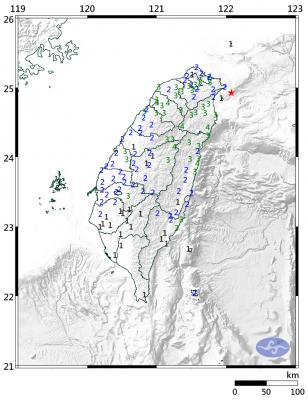
A magnitude 6.1 earthquake struck off the coast of Yilan County at 8:39pm tonight, the Central Weather Administration (CWA) said, with no immediate reports of damage or injuries. The epicenter was 38.7km east-northeast of Yilan County Hall at a focal depth of 98.3km, the CWA’s Seismological Center said. The quake’s maximum intensity, which gauges the actual physical effect of a seismic event, was a level 4 on Taiwan’s 7-tier intensity scale, the center said. That intensity level was recorded in Yilan County’s Nanao Township (南澳), Hsinchu County’s Guansi Township (關西), Nantou County’s Hehuanshan (合歡山) and Hualien County’s Yanliao (鹽寮). An intensity of 3 was

Japanese Prime Minister Sanae Takaichi’s comment last year on Tokyo’s potential reaction to a Taiwan-China conflict has forced Beijing to rewrite its invasion plans, a retired Japanese general said. Takaichi told the Diet on Nov. 7 last year that a Chinese naval blockade or military attack on Taiwan could constitute a “survival-threatening situation” for Japan, potentially allowing Tokyo to exercise its right to collective self-defense. Former Japan Ground Self-Defense Force general Kiyofumi Ogawa said in a recent speech that the remark has been interpreted as meaning Japan could intervene in the early stages of a Taiwan Strait conflict, undermining China’s previous assumptions
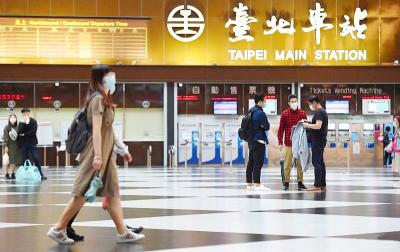
Taiwan Railways Corp (TRC) today announced that Shin Kong Mitsukoshi has been selected as the preferred bidder to operate the Taipei Railway Station shopping mall, replacing the current operator, Breeze Development Co Ltd. Among eight qualified firms that delivered presentations and were evaluated by a review committee, Shin Kong Mitsukoshi was ranked first, while Breeze was named the runner-up, the rail company said in a statement. Contract negotiations are to proceed in accordance with regulations, it said, adding that if negotiations with the top bidder fail, it could invite the second-ranked applicant to enter talks. Breeze in a statement today expressed doubts over


 RSS
RSS