


Mainland Affairs Council (MAC) Minister Andrew Hsia (夏立言) yesterday dismissed speculation that Chinese Nationalist Party (KMT) presidential candidate Eric Chu’s (朱立倫) campaign slogan of “One Taiwan” is a reference to the state of cross-strait relations.
Hsia was responding to Democratic Progressive Party (DPP) Legislator Chuang Ruei-hsiung (莊瑞雄) at a question-and-answer session at the legislature in Taipei on whether China would regard Chu as “morally bankrupt” after the unveiling of his “One Taiwan” slogan on Sunday.
“Chu described cross-strait relations as ‘both sides belonging to one China’ at his meeting with Chinese President Xi Jinping (習近平) in May, but now he is chanting ‘One Taiwan’ during the election season. China must think he lacks integrity,” Chuang said.
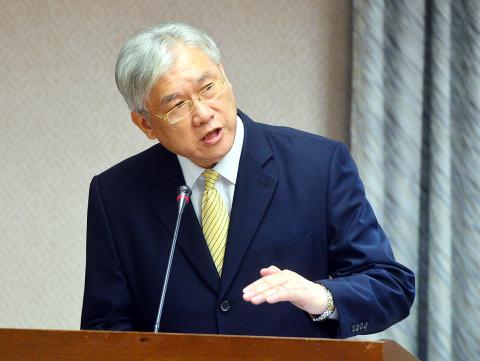
Photo: Wang Yi-sung, Taipei Times
Hsia said that he believes Chu’s campaign slogan has a distinct meaning, such as solidarity among Taiwanese.
“I do not think it refers to cross-strait ties,” Hsia said.
Straits Exchange Foundation Chairman Lin Join-sane (林中森) said that despite the ideological divide between the two nations, the government’s strategy is to shelve disputes and create a win-win situation.
“Both sides should reinforce exchanges on issues they can cooperate over, while putting aside disputes where they disagree,” Lin said.
“This is why we need the initiative of ‘one China, with different interpretations,’” he said.
Lin’s remarks were dismissed by Chuang as off-topic and wishful thinking.
Chu’s “One Taiwan” slogan has been interpreted by some netizens as supporting the cross-strait status of “one Taiwan, one China,” while others regard it as a KMT attempt to capitalize on the name of Taiwan to solicit votes.
Chu has said the slogan refers to a united Taiwanese society that brings all people together regardless of their wealth, social status or birthplace.
Turning to the APEC leaders’ summit, which is to be held in the Philippines on Nov. 18 and Nov. 19, Hsia said the council is pushing for a meeting between President Ma Ying-jeou’s (馬英九) representative, former vice president Vincent Siew (蕭萬長), and Xi on one of the two days.
If such a meeting occurs, the council suggests that the pair discuss issues such as the promotion of the proposed cross-strait agreement on trade in goods, Hsia said.
Schedules for the next round of negotiations on the agreement have not yet been set, Hsia said, adding that while both sides are inclined to ink the treaty by the end of this year, it would not be signed prior to the APEC summit.

LOUD AND PROUD Taiwan might have taken a drubbing against Australia and Japan, but you might not know it from the enthusiasm and numbers of the fans Taiwan might not be expected to win the World Baseball Classic (WBC) but their fans are making their presence felt in Tokyo, with tens of thousands decked out in the team’s blue, blowing horns and singing songs. Taiwanese fans have packed out the Tokyo Dome for all three of their games so far and even threatened to drown out home team supporters when their team played Japan on Friday. They blew trumpets, chanted for their favorite players and had their own cheerleading squad who dance on a stage during the game. The team struggled to match that exuberance on the field, with
Taiwanese paleontologists have discovered fossil evidence that pythons up to 4m long inhabited Taiwan during the Pleistocene epoch, reporting their findings in the international scientific journal Historical Biology. National Taiwan University (NTU) Institute of Ecology and Evolutionary Biology associate professor Tsai Cheng-hsiu (蔡政修) led the team that discovered the largest snake fossil ever found in Taiwan. The single trunk vertebra was discovered in Tainan at the Chiting Formation, dated to between 400,000 and 800,000 years ago in the Middle Pleistocene, the paper said. The area also produced Taiwan’s first avian fossil, as well as crocodile, mammoth, saber-toothed cat and rhinoceros fossils, it said. Discoveries

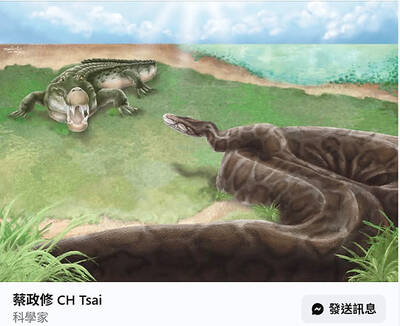
Taiwanese paleontologists have discovered fossil evidence that pythons up to 4m long inhabited Taiwan during the Pleistocene epoch, reporting their findings in the international scientific journal Historical Biology. National Taiwan University (NTU) Institute of Ecology and Evolutionary Biology associate professor Tsai Cheng-hsiu (蔡政修) led the team that discovered the largest snake fossil ever found in Taiwan. A single trunk vertebra was discovered in Tainan at the Chiting Formation, dated to between 800,000 to 400,000 years ago in the Middle Pleistocene, the paper said. The area also produced Taiwan’s first avian fossil, as well as crocodile, mammoth, sabre-toothed cat and rhinoceros fossils, it said. Discoveries

Whether Japan would help defend Taiwan in case of a cross-strait conflict would depend on the US and the extent to which Japan would be allowed to act under the US-Japan Security Treaty, former Japanese minister of defense Satoshi Morimoto said. As China has not given up on the idea of invading Taiwan by force, to what extent Japan could support US military action would hinge on Washington’s intention and its negotiation with Tokyo, Morimoto said in an interview with the Liberty Times (sister paper of the Taipei Times) yesterday. There has to be sufficient mutual recognition of how Japan could provide


 RSS
RSS