


President Ma Ying-jeou (馬英九) yesterday said that commemorating the 1945 recovery of Taiwan by the Republic of China (ROC) is an unshirkable responsibility of each and every ROC president.
Ma made the remarks at a celebration marking the 70th anniversary of “Retrocession Day” at the Zhongshan Hall in Taipei, where the then-ROC government accepted the surrender of Japan.
Retrocession Day, on Oct. 25 is the day the KMT say Chiang Kai-shek (蔣介石) and his Nationalist forces liberated Taiwan in 1945 after 50 years of Japanese occupation and Taiwan’s supposed return to Chinese rule.
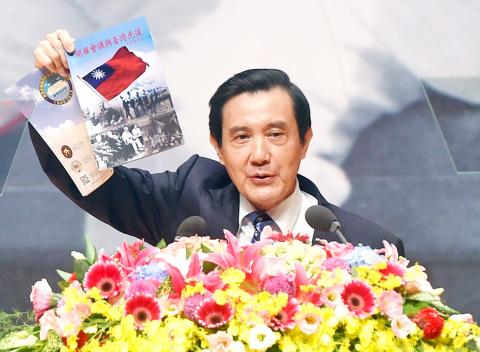
Photo: Chien Jung-fong, Taipei Times
“On the 70th anniversary of Taiwan’s retrocession, we chose to expand the scale of the annual celebration, because today is also the day we celebrate the closely intertwined relationship between the ROC and Taiwan, which are as close as lips and teeth,” Ma said.
In light of Japan’s aggression against the ROC to annex territory in northeast China in the 1930s, Ma said that Chiang, then the Chinese Nationalist Party (KMT) army generalissimo started advocating for the recovery of Taiwan, before abrogating the 1895 Treaty of Shimonoseki — by which the Qing Dynasty ceded Taiwan to Japan — and declaring war against Japan in 1941.
In addition, the Cairo Declaration — signed by Chiang, then-US president Franklin Roosevelt and then-British prime minister Winston Churchill on Dec. 1, 1943, following a conference in Egypt’s capital — also set forth a consensus that Japan would have to restore Taiwan, the Pescadores Islands (Penghu) and Manchuria to the ROC, Ma said.
“Eventually, Taiwan returned to the embrace of the ROC following its 1945 victory in the eight-year anti-Japanese war,” Ma said.
The ROC is only able to enjoy freedom, democracy and prosperity because of its safeguard and efforts to build up Taiwan, Ma said.
“That is why it is the inescapable duty of each and every ROC president to commemorate this part of history,” he added.
Ma’s statement appeared to be directed at Democratic Progressive Party (DPP) presidential candidate Tsai Ing-wen (蔡英文) who did not attend Retrocession Day celebrations.
Ma said the Cairo Declaration played a key role in the ROC’s recovery of Taiwan.
“On July 26, 1945, the ROC, the US and the UK jointly issued the Potsdam Declaration, which called for the surrender of all Japanese armed forces and stipulated that the terms of the Cairo Declaration be carried out,” Ma said.
On Aug. 15 of the same year, Japan accepted the Potsdam terms and agreed to unconditional surrender, Ma said, adding that two paragraphs in the official Instrument of Surrender, signed by Japanese representatives about a month later, also reiterated its pledge to abide by the Potsdam Declaration.
Moreover, Ma said the Peace Treaty signed between Japan and the KMT regime in Taipei on April 28, 1952, also included Japan’s renouncement of sovereignty over Taiwan and the Pescadores Islands, the nullification contents of the Treaty of Shimonoseki, and acknowledgment that the inhabitants of Taiwan at the time had ROC nationality.
“These documents served as confirmation that the ROC had recovered Taiwan,” Ma added.
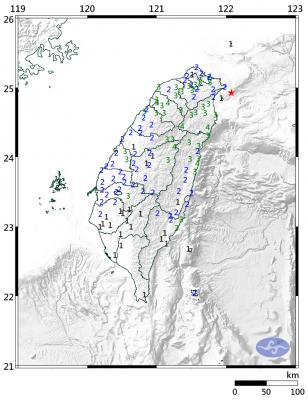
A magnitude 6.1 earthquake struck off the coast of Yilan County at 8:39pm tonight, the Central Weather Administration (CWA) said, with no immediate reports of damage or injuries. The epicenter was 38.7km east-northeast of Yilan County Hall at a focal depth of 98.3km, the CWA’s Seismological Center said. The quake’s maximum intensity, which gauges the actual physical effect of a seismic event, was a level 4 on Taiwan’s 7-tier intensity scale, the center said. That intensity level was recorded in Yilan County’s Nanao Township (南澳), Hsinchu County’s Guansi Township (關西), Nantou County’s Hehuanshan (合歡山) and Hualien County’s Yanliao (鹽寮). An intensity of 3 was
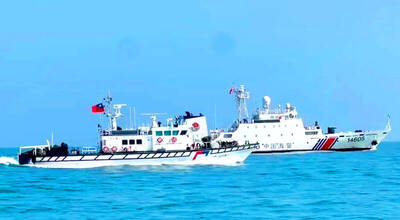
Instead of focusing solely on the threat of a full-scale military invasion, the US and its allies must prepare for a potential Chinese “quarantine” of Taiwan enforced through customs inspections, Stanford University Hoover fellow Eyck Freymann said in a Foreign Affairs article published on Wednesday. China could use various “gray zone” tactics in “reconfiguring the regional and ultimately the global economic order without a war,” said Freymann, who is also a nonresident research fellow at the US Naval War College. China might seize control of Taiwan’s links to the outside world by requiring all flights and ships entering or leaving Taiwan
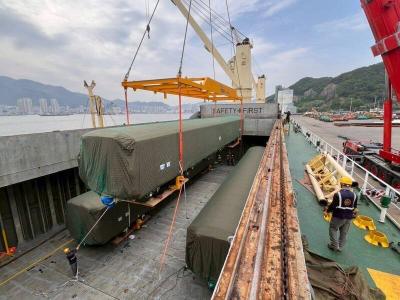
The first of 10 new high-capacity trains purchased from South Korea’s Hyundai Rotem arrived at the Port of Taipei yesterday to meet the demands of an expanding metro network, Taipei Rapid Transit Corp (TRTC) said yesterday. The train completed a three-day, 1,200km voyage from the Port of Masan in South Korea, the company said. Costing NT$590 million (US$18.79 million) each, the new six-carriage trains feature a redesigned interior based on "human-centric" transportation concepts, TRTC said. The design utilizes continuous longitudinal seating to widen the aisles and optimize passenger flow, while also upgrading passenger information displays and driving control systems for a more comfortable
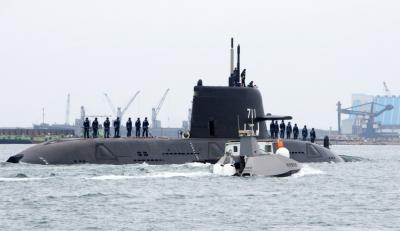
Taiwan's first indigenous defense submarine, the SS-711 Hai Kun (海鯤, or Narwhal), departed for its 13th sea trial at 7am today, marking its seventh submerged test, with delivery to the navy scheduled for July. The outing also marked its first sea deployment since President William Lai (賴清德) boarded the submarine for an inspection on March 19, drawing a crowd of military enthusiasts who gathered to show support. The submarine this morning departed port accompanied by CSBC Corp’s Endeavor Manta (奮進魔鬼魚號) uncrewed surface vessel and a navy M109 assault boat. Amid public interest in key milestones such as torpedo-launching operations and overnight submerged trials,


 RSS
RSS