


The Chinese Nationalist Party’s (KMT) extempore party congress that took place on Saturday last week might have served its purpose — removing Deputy Legislative Speaker Hung Hsiu-chu (洪秀柱) and nominating KMT Chairman Eric Chu (朱立倫) to be the party’s presidential candidate — but it also served as an example of what to expect from the party: Nothing has changed in a party with a long tradition of implicit anti-democratic rules and institutions left behind after its decades-long authoritarian party-state rule.
The congress was aired live on TV. The public witnessed Hung’s candidacy rescinded by a show of hands and Chu nominated by party representatives clapping their hands.
In a speech addressing the congress before the proceedings, Hung expressed concern about “procedural justice.”
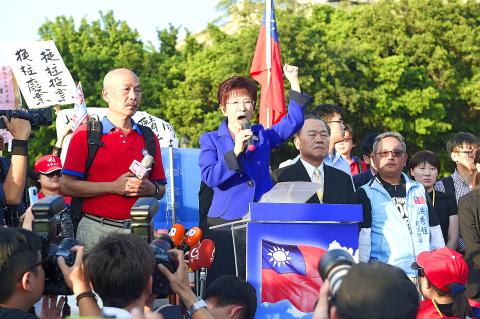
Photo: Chen Chih-chu, Taipei Times
“A state cannot have no honesty; can a party have no honesty?” she asked.
Hung questioned the legality of her nomination being annulled, and tacitly criticized party leadership for the undemocratic move of even calling an extempore congress by stressing that she was the first KMT presidential candidate nominated through the party’s democratic primary mechanism after having fulfilled the signature and poll threshold requirements.
The congress gave her what the party believed was a concession: a supposedly democratic vote by a show of hands — as opposed to KMT congresses’ traditional voting through applause — to get rid of her.
One representative protested the voting method, claiming to have in his hand a petition signed by more than 100 representatives requesting that the vote be conducted by secret ballot.
That was met by the meeting’s president, former KMT vice chairman Lin Feng-cheng (林豐正), who said: “The 100 representatives need to be present. Where are they? Let us check.”
Before he could finish the head count another representative intervened and proposed that the party’s procedures for voting during a congress be followed, meaning a show of hands to decide the matter. His proposal was met with applause.
KMT congress procedures stipulate that voting can be performed either by a show of hands or a secret ballot, depending on the president of the meeting, and that any dissenting proposal requires the support of 100 attendees to be considered.
However, the congress following due process for the first motion — dismissing Hung as presidential candidate — ironically reflects the absurdity of the congress’ second motion, which approved Chu as its candidate, for which the congress reverted to approval by applause.
The party’s primary system was a farce. The KMT might defend its actions by saying that calling the extempore congress was a rule-respecting move, but the deception was laid completely bare by the constant apologizing to Hung for her “sacrifice.”
Before the congress, Chu had emphasized “establishing and respecting the party’s democratic system” to dismiss questions by the media about the possibility of him replacing Hung as the party’s presidential candidate.
That promise — along with the vision for a new KMT that Chu had vowed after the party’s electoral drubbing in the nine-in-one local elections in November last year — crumbled as Saturday’s farce was played out.
However, Hung’s belief in procedural justice and honesty is apparently not as firm as she claims it is, either.
“The party can abandon me, but I will not give up on the party,” she said.
She proudly took the moral high ground and denounced the KMT for abandoning its “values” for the sake of electoral victories, but likewise she too laid waste to her “principles” because of “love for the party.”
The moral of the story: When the party speaks, you listen.
Hung pleaded with her supporters — who outside the congress shouted their disapproval of the party and vowed to “punish” the KMT with their votes and urged fellow Hung supporters to “shut down the 100-year-old party and start from scratch” — to remain in and continue to support the party.
Hung’s call for solidarity before the protesters — who had vehemently vented their anger at the KMT’s “top thieves” during their speeches — was like cold water extinguishing a flame. Not only had the party betrayed them, but Hung, after caving in to the KMT leadership’s strong-arming, could no longer cling to the righteous values she had used to appeal to so many with.
In the end, there is no difference between the KMT and Hung’s objectives: the survival of the party. It is, after all, the principle most devoutly followed by the KMT.

The manufacture of the remaining 28 M1A2T Abrams tanks Taiwan purchased from the US has recently been completed, and they are expected to be delivered within the next one to two months, a source said yesterday. The Ministry of National Defense is arranging cargo ships to transport the tanks to Taiwan as soon as possible, said the source, who is familiar with the matter. The estimated arrival time ranges from late this month to early next month, the source said. The 28 Abrams tanks make up the third and final batch of a total of 108 tanks, valued at about NT$40.5 billion

Two Taiwanese prosecutors were questioned by Chinese security personnel at their hotel during a trip to China’s Henan Province this month, the Mainland Affairs Council (MAC) said yesterday. The officers had personal information on the prosecutors, including “when they were assigned to their posts, their work locations and job titles,” MAC Deputy Minister and spokesman Liang Wen-chieh (梁文傑) said. On top of asking about their agencies and positions, the officers also questioned the prosecutors about the Cross-Strait Joint Crime-Fighting and Judicial Mutual Assistance Agreement, a pact that serves as the framework for Taiwan-China cooperation on combating crime and providing judicial assistance, Liang
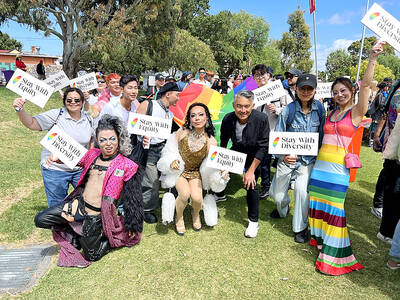
A group from the Taiwanese Designers in Australia association yesterday represented Taiwan at the Midsumma Pride March in Melbourne. The march, held in the St. Kilda suburb, is the city’s largest LGBTQIA+ parade and the flagship event of the annual Midsumma Festival. It attracted more than 45,000 spectators who supported the 400 groups and 10,000 marchers that participated this year, the association said. Taiwanese Designers said they organized a team to march for Taiwan this year, joining politicians, government agencies, professionals and community organizations in showing support for LGBTQIA+ people and diverse communities. As the first country in Asia to legalize same-sex
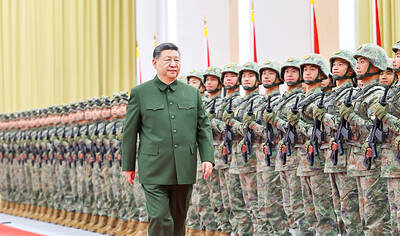
MOTIVES QUESTIONED The PLA considers Xi’s policies toward Taiwan to be driven by personal considerations rather than military assessment, the Epoch Times reports Chinese President Xi Jinping’s (習近平) latest purge of the Chinese People’s Liberation Army (PLA) leadership might have been prompted by the military’s opposition to plans of invading Taiwan, the Epoch Times said. The Chinese military opposes waging war against Taiwan by a large consensus, putting it at odds with Xi’s vision, the Falun Gong-affiliated daily said in a report on Thursday, citing anonymous sources with insight into the PLA’s inner workings. The opposition is not the opinion of a few generals, but a widely shared view among the PLA cadre, the Epoch Times cited them as saying. “Chinese forces know full well that


 RSS
RSS