


The goal of the Chinese Nationalist Party’s (KMT) planned extraordinary party congress later this month is to galvanize a consensus within the party to help it win January’s presidential election, KMT Chairman Eric Chu (朱立倫) said yesterday.
After attending a Double Ten National Day ceremony earlier in the day, Chu, who doubles as New Taipei City mayor, said at the Taipei City Hall that the agenda, the date and the location for the extraordinary party congress has not been finalized.
However, what is certain is the purpose of the meeting: To galvanize a consensus to help the party win the election, Chu said.
Chu’s remarks came after the KMT Central Standing Committee on Wednesday passed a resolution unanimously to convene an extraordinary party congress later this month to consider a proposal to replace KMT presidential candidate Hung Hsiu-chu (洪秀柱).
Hung, who was nominated by the party on July 19, has consistently lagged at least 20 points behind Democratic Progressive Party presidential candidate Tsai Ing-wen (蔡英文) in most polls, and the gap has shown no signs of narrowing.
Many KMT candidates for the legislative elections, which are scheduled to be held on the same day as the presidential election, Jan. 16, fear that the weakness of Hung’s candidacy would hurt their chances, calling for another face at the top of the ticket.
Chu is expected to be drafted to replace Hung at the party congress, but when asked about the possibility of Hung as his running mate, he said it was a hypothetical question that had not been discussed within the party.
Chu said he would continue communicating with Hung, who has resisted efforts to remove her as the party’s standard-bearer, and felt confident that the issue would be satisfactorily addressed.
In response to questions on whether the KMT would cooperate with People First Party presidential candidate James Soong (宋楚瑜), Chu said he has always respected Soong, a former KMT political heavyweight.
Chu said he would discuss possible cooperation between the two parties with Soong, adding that he believes that there are many ways to do so.

LOUD AND PROUD Taiwan might have taken a drubbing against Australia and Japan, but you might not know it from the enthusiasm and numbers of the fans Taiwan might not be expected to win the World Baseball Classic (WBC) but their fans are making their presence felt in Tokyo, with tens of thousands decked out in the team’s blue, blowing horns and singing songs. Taiwanese fans have packed out the Tokyo Dome for all three of their games so far and even threatened to drown out home team supporters when their team played Japan on Friday. They blew trumpets, chanted for their favorite players and had their own cheerleading squad who dance on a stage during the game. The team struggled to match that exuberance on the field, with
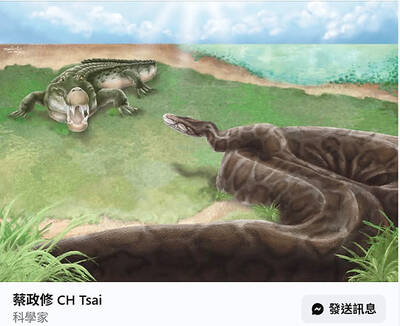
Taiwanese paleontologists have discovered fossil evidence that pythons up to 4m long inhabited Taiwan during the Pleistocene epoch, reporting their findings in the international scientific journal Historical Biology. National Taiwan University (NTU) Institute of Ecology and Evolutionary Biology associate professor Tsai Cheng-hsiu (蔡政修) led the team that discovered the largest snake fossil ever found in Taiwan. The single trunk vertebra was discovered in Tainan at the Chiting Formation, dated to between 400,000 and 800,000 years ago in the Middle Pleistocene, the paper said. The area also produced Taiwan’s first avian fossil, as well as crocodile, mammoth, saber-toothed cat and rhinoceros fossils, it said. Discoveries

Taiwanese paleontologists have discovered fossil evidence that pythons up to 4m long inhabited Taiwan during the Pleistocene epoch, reporting their findings in the international scientific journal Historical Biology. National Taiwan University (NTU) Institute of Ecology and Evolutionary Biology associate professor Tsai Cheng-hsiu (蔡政修) led the team that discovered the largest snake fossil ever found in Taiwan. A single trunk vertebra was discovered in Tainan at the Chiting Formation, dated to between 800,000 to 400,000 years ago in the Middle Pleistocene, the paper said. The area also produced Taiwan’s first avian fossil, as well as crocodile, mammoth, sabre-toothed cat and rhinoceros fossils, it said. Discoveries
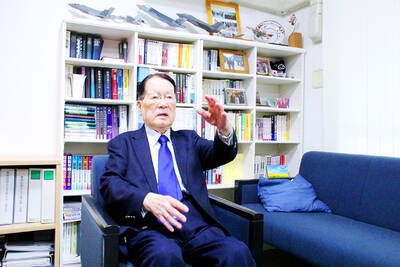
Whether Japan would help defend Taiwan in case of a cross-strait conflict would depend on the US and the extent to which Japan would be allowed to act under the US-Japan Security Treaty, former Japanese minister of defense Satoshi Morimoto said. As China has not given up on the idea of invading Taiwan by force, to what extent Japan could support US military action would hinge on Washington’s intention and its negotiation with Tokyo, Morimoto said in an interview with the Liberty Times (sister paper of the Taipei Times) yesterday. There has to be sufficient mutual recognition of how Japan could provide


 RSS
RSS