


A new smartphone app aimed at checking the validity of Alien Resident Cards (ARC) encourages discrimination, Taiwan International Workers Association (TIWA) activists said yesterday during a protest outside the National Immigration Agency (NIA) in Taipei.
Protesters shouted slogans calling for the app to be withdrawn and performed a skit in which a foreign worker was repeatedly “shot” with a cellphone mounted on a scan gun prop.
“This kind of an app treats all foreigners — especially blue-collar foreign employees — as suspects to be monitored,” TIWA member Betty Chen (陳容柔) said.
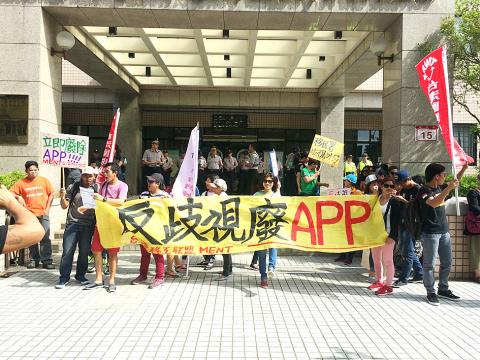
Photo: Liu Ching-hou, Taipei Times
Chen said that the NIA had taken its executive authority “to the limit” by using a “loophole” in the Personal Information Protection Act (個人資料保護法) that allows anyone with a cellphone to become a “big brother.”
“Anyone with a cellphone can download the app and require a blue-collar worker to present his ARC for verification,” she said.
The app allows users to scan the barcodes of all ARCs issued after 2012 and verify that they match the cards’ serial number and period of validity in NIA databases.
Taiwan International Workers’ Association researcher Wu Jing-ru (吳靜如) said that employers are already required to send copies of foreign workers ARCs to the immigration agency as part of the hiring process, panning NIA claims that the app is a necessary convenience for employers and helps them avoid getting fined for hiring illegal workers.
“Those who hire illegal workers do so because they are illegal — whether it is because illegal workers are cheap labor, or because they are easier to control, or for any other reason, employers deliberately choose to employ illegal workers, so there is no way this app will achieve the National Immigration Agency’s policy objective,” she said, adding that most blue-collar workers would not “dare to say no” when asked to present their ARC cards because of the pressure put on them by Taiwanese society.
Academica Sinica Institute of Ethnology senior researcher Tere Silvio said the app was “completely redundant” because the legality of workers was already verified as part of the normal hiring process.
“It is encouraging people to create a really horrible social atmosphere in which people feel like they are being asked or it is their responsibility to make sure that their neighbors are all genuine [and] have the right to be here,” she said.
NIA Information Management Section Director Lin Yi-chu (林逸麈) said the app was not intended to be discriminatory, adding that employers had to apply to verify ARC data via the NIA’s Web site before the app was developed.
Anyone can also conduct verification of a National Identification Card data through the Web site of the Ministry of the Interior’s Department of Household Registration, he said.
Foreigners can reject non-official requests to present their ARC for verification, he said.

LOUD AND PROUD Taiwan might have taken a drubbing against Australia and Japan, but you might not know it from the enthusiasm and numbers of the fans Taiwan might not be expected to win the World Baseball Classic (WBC) but their fans are making their presence felt in Tokyo, with tens of thousands decked out in the team’s blue, blowing horns and singing songs. Taiwanese fans have packed out the Tokyo Dome for all three of their games so far and even threatened to drown out home team supporters when their team played Japan on Friday. They blew trumpets, chanted for their favorite players and had their own cheerleading squad who dance on a stage during the game. The team struggled to match that exuberance on the field, with
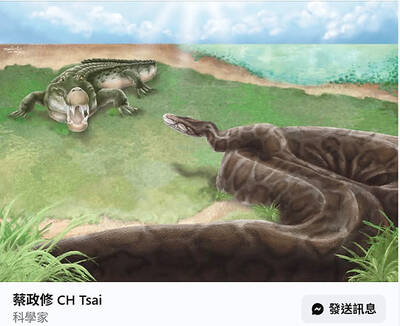
Taiwanese paleontologists have discovered fossil evidence that pythons up to 4m long inhabited Taiwan during the Pleistocene epoch, reporting their findings in the international scientific journal Historical Biology. National Taiwan University (NTU) Institute of Ecology and Evolutionary Biology associate professor Tsai Cheng-hsiu (蔡政修) led the team that discovered the largest snake fossil ever found in Taiwan. The single trunk vertebra was discovered in Tainan at the Chiting Formation, dated to between 400,000 and 800,000 years ago in the Middle Pleistocene, the paper said. The area also produced Taiwan’s first avian fossil, as well as crocodile, mammoth, saber-toothed cat and rhinoceros fossils, it said. Discoveries

Taiwanese paleontologists have discovered fossil evidence that pythons up to 4m long inhabited Taiwan during the Pleistocene epoch, reporting their findings in the international scientific journal Historical Biology. National Taiwan University (NTU) Institute of Ecology and Evolutionary Biology associate professor Tsai Cheng-hsiu (蔡政修) led the team that discovered the largest snake fossil ever found in Taiwan. A single trunk vertebra was discovered in Tainan at the Chiting Formation, dated to between 800,000 to 400,000 years ago in the Middle Pleistocene, the paper said. The area also produced Taiwan’s first avian fossil, as well as crocodile, mammoth, sabre-toothed cat and rhinoceros fossils, it said. Discoveries

Whether Japan would help defend Taiwan in case of a cross-strait conflict would depend on the US and the extent to which Japan would be allowed to act under the US-Japan Security Treaty, former Japanese minister of defense Satoshi Morimoto said. As China has not given up on the idea of invading Taiwan by force, to what extent Japan could support US military action would hinge on Washington’s intention and its negotiation with Tokyo, Morimoto said in an interview with the Liberty Times (sister paper of the Taipei Times) yesterday. There has to be sufficient mutual recognition of how Japan could provide


 RSS
RSS