


On World Animal Day yesterday, Democratic Progressive Party (DPP) presidential candidate Tsai Ing-wen (蔡英文) said that if the DPP returns to power, it would allocate more resources for the protection of animals.
The DPP government would provide personnel and operational funds for the most urgent tasks to local governments that come up with comprehensive plans, Tsai said on Facebook.
Tsai, who owns two cats, said these tasks include: increasing animal protection personnel; forming a monitoring group; enforcing pet registration policies; educating pet owners to be responsible; and funding TNVR — trap/neuter/vaccinate/return — adoption programs.
Other urgent tasks include promoting life education, improving conditions at animal shelters, bolstering the supervision of breeding facilities and cracking down on illegal breeding, Tsai said.
Many pets live in harsh environments and face unclear futures, Tsai said.
Compared with some developed countries, Taiwan has yet to perform a number of animal protection tasks governed by the law, nor has it worked to improve animal welfare or establish animal rights, Tsai said.
An amendment to the Animal Protection Act (動物保護法) earlier this year that ended the practice of “12-night euthanasia” — where animals in shelters were put down after 12 days — came about a year too late, Tsai said, adding that a number of complementary measures to correct the source of the problem have not been implemented, allowing the problem of stray animals to continue unabated.
“The government must be determined to provide abundant resources to local governments, which are at the front line for implementation, but often suffer from an inadequate budget and a shortage of manpower,” Tsai said.
Tsai said that a nation’s animal protection policy is not only about solving the problem of stray animals, adding that the government should formulate “guidelines for the protection of animals.”
These guidelines should encourage the government to work with professionals to develop short, intermediate and long-term goals for animal conservation, to census endangered species and to improve the welfare of animals used for commercial, experimental and performance purposes, she added.
Only in a world where all living beings can peacefully coexist can a friendlier and more balanced living environment be created, Tsai said.

The military has spotted two Chinese warships operating in waters near Penghu County in the Taiwan Strait and sent its own naval and air forces to monitor the vessels, the Ministry of National Defense (MND) said. Beijing sends warships and warplanes into the waters and skies around Taiwan on an almost daily basis, drawing condemnation from Taipei. While the ministry offers daily updates on the locations of Chinese military aircraft, it only rarely gives details of where Chinese warships are operating, generally only when it detects aircraft carriers, as happened last week. A Chinese destroyer and a frigate entered waters to the southwest
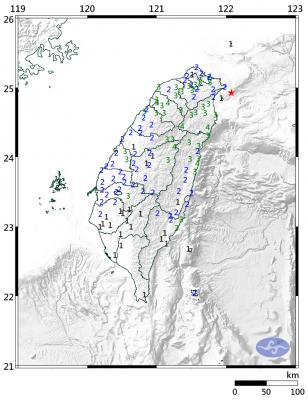
A magnitude 6.1 earthquake struck off the coast of Yilan County at 8:39pm tonight, the Central Weather Administration (CWA) said, with no immediate reports of damage or injuries. The epicenter was 38.7km east-northeast of Yilan County Hall at a focal depth of 98.3km, the CWA’s Seismological Center said. The quake’s maximum intensity, which gauges the actual physical effect of a seismic event, was a level 4 on Taiwan’s 7-tier intensity scale, the center said. That intensity level was recorded in Yilan County’s Nanao Township (南澳), Hsinchu County’s Guansi Township (關西), Nantou County’s Hehuanshan (合歡山) and Hualien County’s Yanliao (鹽寮). An intensity of 3 was

Japanese Prime Minister Sanae Takaichi’s comment last year on Tokyo’s potential reaction to a Taiwan-China conflict has forced Beijing to rewrite its invasion plans, a retired Japanese general said. Takaichi told the Diet on Nov. 7 last year that a Chinese naval blockade or military attack on Taiwan could constitute a “survival-threatening situation” for Japan, potentially allowing Tokyo to exercise its right to collective self-defense. Former Japan Ground Self-Defense Force general Kiyofumi Ogawa said in a recent speech that the remark has been interpreted as meaning Japan could intervene in the early stages of a Taiwan Strait conflict, undermining China’s previous assumptions

Taiwan Railways Corp (TRC) today announced that Shin Kong Mitsukoshi has been selected as the preferred bidder to operate the Taipei Railway Station shopping mall, replacing the current operator, Breeze Development Co Ltd. Among eight qualified firms that delivered presentations and were evaluated by a review committee, Shin Kong Mitsukoshi was ranked first, while Breeze was named the runner-up, the rail company said in a statement. Contract negotiations are to proceed in accordance with regulations, it said, adding that if negotiations with the top bidder fail, it could invite the second-ranked applicant to enter talks. Breeze in a statement today expressed doubts over


 RSS
RSS