


Two top national security officials — Military Police commander Lieutenant General Wu Ying-ping (吳應平) and the National Security Bureau’s Special Service Center deputy commander, Lieutenant General Hsu Chang (許昌) — will be leaving their posts less than four months before the presidential and legislative elections, a government source said.
Wu is to reach the legal age of retirement by the end of the year, and since it would coincide with the peak time for security assignments related to the Jan. 16 elections, the government has arranged for his early retirement at the end of the month to minimize its impact on national security, the source said.
The source added that given Wu’s excellent contribution as Military Police commander over the past three-and-a-half years, he is to be assigned to another post after retirement.
The source did not specify what the new appointment would be.
The source added that to find somebody who can fill the vacancy and “get on the job as soon as possible,” Hsu is considered to be the best candidate.
The Special Service Center is headed by the National Security Bureau director-general, who is assisted by two deputy commanders. One of the deputy commanders is the Presidential Office security chief and the other a specially appointed person. Given the two other officers’ concomitant positions, the specially appointed deputy commander — in this case, Hsu — is the de facto head of the Special Service Center.
After Hsu is appointed to take over the post of Military Police commander, National Security Bureau Director-General Yang Kuo-chiang (楊國強) will have to recommend another candidate to fill the position he is leaving.
The center has set up four teams and a training program for security missions for the presidential election.
The official presidential candidate registration is to take place from Nov. 23 to Nov. 27, and the bureau will take over the security maintenance for the candidates immediately following the registration until a day after the elections.

LOUD AND PROUD Taiwan might have taken a drubbing against Australia and Japan, but you might not know it from the enthusiasm and numbers of the fans Taiwan might not be expected to win the World Baseball Classic (WBC) but their fans are making their presence felt in Tokyo, with tens of thousands decked out in the team’s blue, blowing horns and singing songs. Taiwanese fans have packed out the Tokyo Dome for all three of their games so far and even threatened to drown out home team supporters when their team played Japan on Friday. They blew trumpets, chanted for their favorite players and had their own cheerleading squad who dance on a stage during the game. The team struggled to match that exuberance on the field, with
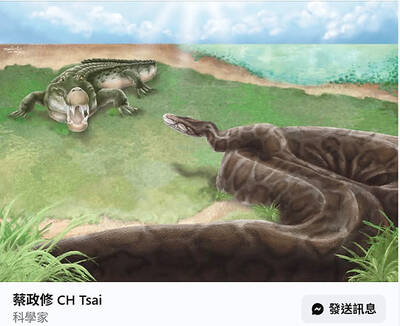
Taiwanese paleontologists have discovered fossil evidence that pythons up to 4m long inhabited Taiwan during the Pleistocene epoch, reporting their findings in the international scientific journal Historical Biology. National Taiwan University (NTU) Institute of Ecology and Evolutionary Biology associate professor Tsai Cheng-hsiu (蔡政修) led the team that discovered the largest snake fossil ever found in Taiwan. The single trunk vertebra was discovered in Tainan at the Chiting Formation, dated to between 400,000 and 800,000 years ago in the Middle Pleistocene, the paper said. The area also produced Taiwan’s first avian fossil, as well as crocodile, mammoth, saber-toothed cat and rhinoceros fossils, it said. Discoveries

Taiwanese paleontologists have discovered fossil evidence that pythons up to 4m long inhabited Taiwan during the Pleistocene epoch, reporting their findings in the international scientific journal Historical Biology. National Taiwan University (NTU) Institute of Ecology and Evolutionary Biology associate professor Tsai Cheng-hsiu (蔡政修) led the team that discovered the largest snake fossil ever found in Taiwan. A single trunk vertebra was discovered in Tainan at the Chiting Formation, dated to between 800,000 to 400,000 years ago in the Middle Pleistocene, the paper said. The area also produced Taiwan’s first avian fossil, as well as crocodile, mammoth, sabre-toothed cat and rhinoceros fossils, it said. Discoveries
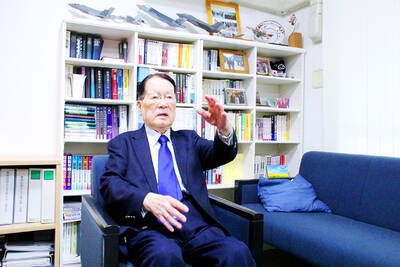
Whether Japan would help defend Taiwan in case of a cross-strait conflict would depend on the US and the extent to which Japan would be allowed to act under the US-Japan Security Treaty, former Japanese minister of defense Satoshi Morimoto said. As China has not given up on the idea of invading Taiwan by force, to what extent Japan could support US military action would hinge on Washington’s intention and its negotiation with Tokyo, Morimoto said in an interview with the Liberty Times (sister paper of the Taipei Times) yesterday. There has to be sufficient mutual recognition of how Japan could provide


 RSS
RSS