


The Chinese Nationalist Party (KMT) could face yet another crisis other than its dismal presidential campaign, as a group of pro-localization members are allegedly planning to form a splinter group to force KMT headquarters to respond directly to their calls for a change of candidate.
According to people familiar with the matter, the plan to establish a new party — which would be called the “Taiwan Nationalist Party Alliance” (台灣國民黨聯盟) — is spearheaded by several influential local members, including senior presidential adviser Liao Liou-yi (廖了以) and former Yunlin County commissioner Chang Jung-wei (張榮味).
Their primary goal is to compel the party’s leaders to take more proactive measures to address the KMT’s predicament in the Jan. 16 presidential and legislative elections, the sources said, hinting at the removal of Deputy Legislative Speaker Hung Hsiu-chu (洪秀柱) as the KMT’s presidential candidate.
If KMT headquarters fail to take action, they might inspire a bigger wave of defections than the one seen in previous months, they said.
The allegations come as Hung continues to be dogged by rumors that party leadership is planning to replace her as she trails in opinion polls.
KMT Chairman Eric Chu (朱立倫), Legislative Speaker Wang Jin-pyng (王金平) and Vice President Wu Den-yih (吳敦義) are rumored to be Hung’s likely replacements.
The Ministry of the Interior confirmed that it had received an application for the founding of a group known as the Taiwan Nationalist Party Alliance, but temporarily rejected it, pending clarification from the applicants on whether the alliance should be categorized as a “political group” or a “political party.”
However, when asked to comment on the matter, most KMT lawmakers either claimed they had no knowledge of the plan, or refused to comment on the issue.
KMT Legislator Chen Ken-te (陳根德) said he was unaware of the plan and refused to comment on a hypothetical question.
KMT Legislator Wu Yu-sheng (吳育昇), upon hearing the words “Taiwan Nationalist Party Alliance,” said that he “cannot comment.”
KMT Legislator Lu Chia-chen (盧嘉辰) said he had little information about the plan, but urged party headquarters to face up to voices of discontent if they did exist.
“The KMT must defuse this crisis at once, rather than treating it lightly or turning a blind eye to the problem. We must not let the party collapse,” Lu said.
Hung dismissed the persistent rumors, saying on Sunday that she did not care since “everything is possible in an election season.”
“All that matters is that I make my values and principles known to the public, so that they can make the right choice,” the presidential candidate said.
She added that she was not worried about the KMT turning the rumors into reality.


UPGRADE: The Kang Ding-class frigate is replacing its Chaparall missiles with Tien Chien II and Hua Yang VLS, which would provide it with long-range, 360° air defense Taiwan plans to produce 1,200 to 1,376 Hai Chien II missiles (海劍二, Sea Sword II) — also known as TC-2N — to serve as the standard air defense system of the navy’s surface combatant fleet, a source said yesterday. Last week, the Hai Chien II, the naval version of the Tien Kung II missile (天劍二, Sky Sword II), completed a live-fire test in waters off the National Chungshan Institute of Science and Technology’s Jiupeng facility (九鵬) in Pingtung County’s Manjhou Township (滿州). The MIM72 Chaparral and other dated air defense missiles that currently arm Taiwanese ships have inadequate range to combat Chinese

REASONS FOR TRAVEL: An assistant professor said that proposed amendments to penalize drivers if they used drugs overseas would not deter people from traveling People who operate a motor vehicle under the influence of marijuana would have their driver’s license revoked, even if they used the substance while overseas, the Ministry of Transportation and Communications said yesterday, citing proposed amendments to the Road Traffic Management and Penalty Act (道路交通管理處罰條例). The amendments would also authorize the government to revoke the licenses of people determined to have used Category 1 or Category 2 narcotics, even if they were not operating a vehicle while under the influence of drugs, as well as ban them from taking the license test for three years, the ministry said. People aged 18 or
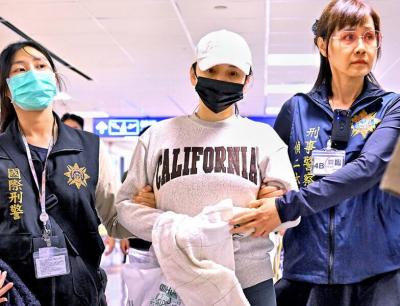
Johanne Liou (劉喬安), a Taiwanese woman who shot to unwanted fame during the Sunflower movement protests in 2014, returned to Taiwan last night after being deported from the US. She is to stand trial in Taiwan for charges involving embezzlement, fraud and drug crimes. The Criminal Investigation Bureau (CIB) said it took her into custody at Taiwan Taoyuan International Airport and would first question her before transferring her to the New Taipei District Prosecutors’ Office. She was arrested upon disembarking a flight from San Francisco that landed shortly before 7pm. Liou absconded to the US in 2019 after jumping bail
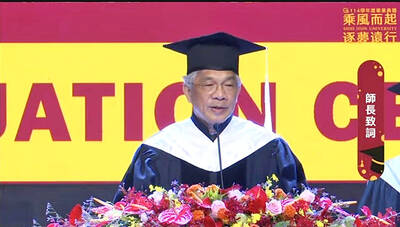
Shih Hsin University President Chen Ching-he (陳清河) yesterday issued a public apology for comments made in his commencement speech last week, stating that he has asked the school to suspend his duties and halt his wages for two months as a show of contrition. At the commencement ceremony on May 30, Chen said, “If you don’t manage your time well, or your own emotions, or your health, then I am telling every one of you — put a quick end to ‘you,’ because the world has no need for ‘you.’” The comments have sparked significant controversy online, and Chen through an open


 RSS
RSS