


The Council of Agriculture has developed a tea traceability system using cloud computing to allow consumers to trace the source and production of tea, while using Facebook to provide instant advice on pest prevention and control to farmers.
To boost the quality and traceability of tea amid recent pesticide scares involving tea drinks, the council’s Tea Research and Extension Station on Tuesday said that it launched an online platform for tea farmers and enterprises to list the information of each product batch, which consumers can access via a QR code attached to the product or access on a Web site to search for approved suppliers.
Information listed on the Web site includes the product’s place of origin, manufacturer, pesticide test results, certificates and the flow and volume of each harvest, the council said.
Four major tea companies have been included in the system, the Tait Marketing and Distribution Co, the producer of Kaisi oolong tea, and Good Young Co, which supplies the nation’s Starbucks franchises, the council said.
The system also includes 200 small-scale tea farms, with 60 tonnes of tea leaves shipped this year registered in the system, the council said, adding that it aims to include 1,000 tea farmers by the end of this year, and half of the nation’s 12,000 farmers by 2017.
The system could be used to market “quality” and organic tea products, as a tea competition in July saw all the competing, pesticide-free products labeled with the traceability code, the council said.
Separately, the council’s Kaohsiung District Agricultural Research and Extension Station launched a question-and-answer platform on Facebook to provide prompt assistance to farmers in diagnosing suspected plant diseases.
Farmers can upload photographs of affected plants to the council’s Facebook page to seek advice and station staff are to give a diagnosis and suggest pest control measures.
The page has attracted more than 5,000 users, the Kaohsiung station said.
In cases where a suspected plant disease cannot be determined by sight, the council would contact the farmer and request a sample of the diseased plants, the Kaohsiung station said.
Academics have been invited to participate in the platform, the Kaohsiung station said, adding that a suspected case of foliar blight of roselle sparked discussions online.
The tea-tracing Web site can be accessed at www.safetea.com.tw.

Yangmingshan National Park authorities yesterday urged visitors to respect public spaces and obey the law after a couple was caught on a camera livestream having sex at the park’s Qingtiangang (擎天崗) earlier in the day. The Shilin Police Precinct in Taipei said it has identified a suspect and his vehicle registration number, and would summon him for questioning. The case would be handled in accordance with public indecency charges, it added. The couple entered the park at about 11pm on Thursday and began fooling around by 1am yesterday, the police said, adding that the two were unaware of the park’s all-day live

A former soldier and an active-duty army officer were yesterday indicted for allegedly selling classified military training materials to a Chinese intelligence operative for a total of NT$79,440. The Taipei District Prosecutors’ Office indicted Chen Tai-yin (陳泰尹) and Lee Chun-ta (李俊達) for contravening the National Security Act (國家安全法) and the Anti-Corruption Act (貪污治罪條例). Chen left the military in September 2013 after serving alongside then-staff sergeant Lee, now an army lieutenant, at the 21st Artillery Command of the army’s Sixth Corps from 2011 to 2013, according to the indictment. Chen met a Chinese intelligence operative identified as “Wang” (王) through a friend in November
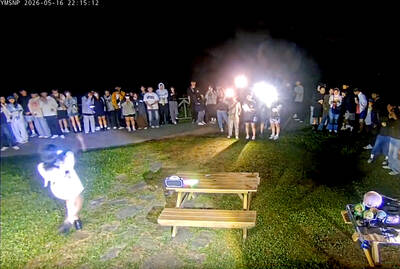
Yangmingshan National Park’s Qingtiangang (擎天崗) nature area has gone viral after a park livestream camera observed a couple in the throes of intimate congress, which was broadcast live on YouTube, drawing large late-night crowds and sparking a backlash over noise, bright lights and disruption to wildlife habitat. The area’s livestream footage appeared to show a couple engaging in sexual activity on a picnic table in the park on Friday last week, with the uncensored footage streamed publicly online. The footage quickly spread across social media, prompting a tide of visitors to travel to the site to “check in” and recreate the

Minister of Digital Affairs Lin Yi-ching (林宜敬) yesterday cited regulatory issues and national security concerns as an expert said that Taiwan is among the few Asian regions without Starlink. Lin made the remarks on Facebook after funP Innovation Group chief executive officer Nathan Chiu (邱繼弘) on Friday said Taiwan and four other countries in Asia — China, North Korea, Afghanistan and Syria — have no access to Starlink. Starlink has become available in 166 countries worldwide, including Ukraine, Malaysia, the Philippines and Vietnam, in the six years since it became commercial, he said. While China and North Korea block Starlink, Syria is not


 RSS
RSS