


The Legislative Yuan yesterday afternoon issued a statement protesting China’s introduction of a new travel pass for Taiwanese, following a delay to Premier Mao Chi-kuo’s (毛治國) policy address due to Taiwan Solidarity Union (TSU) lawmakers occupying the legislative speaker’s podium in the morning.
The three TSU lawmakers occupied the podium and held up signs accusing China’s unilateral launch of the new smartcard-like “Taiwan compatriot travel document” (台胞證) as a unilateral change to the “status quo,” saying that cross-strait exchanges should be halted.
A cross-party negotiation was held, presided over by Legislative Speaker Wang Jin-pyng (王金平), resulting in a joint statement requiring Mao to present a special report on the issue, alongside his policy report.
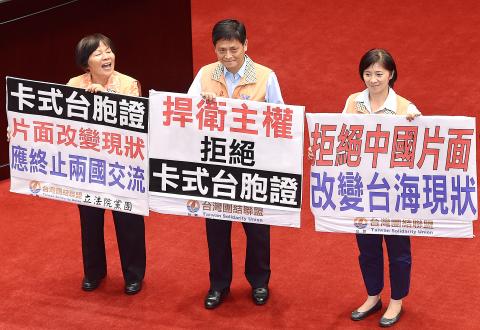
Photo: Liao Chen-huei, Taipei Times
“Also, based on the principle of reciprocal respect and equal footing, [we] demand that [Beijing] conduct sufficient communication and negotiation with [Taiwan] on issues concerning the rights of people on both sides of the Taiwan Strait in cross-strait exchanges. The executive branch should make sure that it [adheres to this directive] and protests to [China] in order to sternly express our stance and maintain the dignity of the nation’s sovereignty,” the statement said.
In Mao’s report on the new travel pass, the premier addressed China’s governance, saying that due to the special relationship between the two sides — in which “the two sides do not recognize each other’s sovereignty, but do not deny respective jurisdictions” — people traveling between China and Taiwan have been using special passes, rather than passports, for entry, “but the pass issued by our government has ‘Republic of China’ [ROC] with the national flag on it, and we also have strict measures overseeing the entry of Chinese.”
“The unilateral move by China will not change the current relationship between the two sides of the Taiwan Strait,” Mao said.
“The cross-strait relationship based on the ROC Constitution and the ‘status quo’ upheld by our policy and the popular support will definitely not be altered by any unilateral Chinese move,” he said.
Mao also reiterated that according to an analysis, the capacity of the microchip embedded in the card is small, with less than 0.1 megabytes of storage.
“And [the Chinese] have informed us that the card contains one-time programming, meaning that it cannot be rewritten,” Mao said.
“They also clarified on Monday, the day of the implementation, in response to our Mainland Affairs Council’s press release, that the card is no different than the paper pass in terms of function,” Mao added.
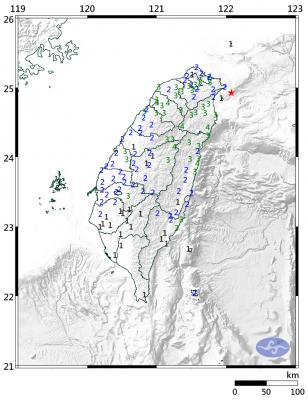
A magnitude 6.1 earthquake struck off the coast of Yilan County at 8:39pm tonight, the Central Weather Administration (CWA) said, with no immediate reports of damage or injuries. The epicenter was 38.7km east-northeast of Yilan County Hall at a focal depth of 98.3km, the CWA’s Seismological Center said. The quake’s maximum intensity, which gauges the actual physical effect of a seismic event, was a level 4 on Taiwan’s 7-tier intensity scale, the center said. That intensity level was recorded in Yilan County’s Nanao Township (南澳), Hsinchu County’s Guansi Township (關西), Nantou County’s Hehuanshan (合歡山) and Hualien County’s Yanliao (鹽寮). An intensity of 3 was
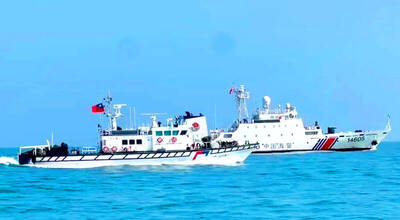
Instead of focusing solely on the threat of a full-scale military invasion, the US and its allies must prepare for a potential Chinese “quarantine” of Taiwan enforced through customs inspections, Stanford University Hoover fellow Eyck Freymann said in a Foreign Affairs article published on Wednesday. China could use various “gray zone” tactics in “reconfiguring the regional and ultimately the global economic order without a war,” said Freymann, who is also a nonresident research fellow at the US Naval War College. China might seize control of Taiwan’s links to the outside world by requiring all flights and ships entering or leaving Taiwan
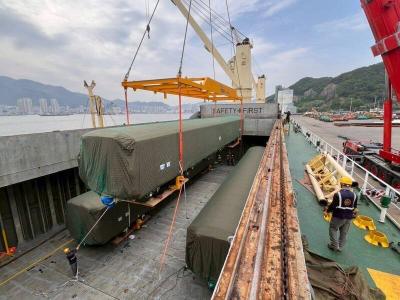
The first of 10 new high-capacity trains purchased from South Korea’s Hyundai Rotem arrived at the Port of Taipei yesterday to meet the demands of an expanding metro network, Taipei Rapid Transit Corp (TRTC) said yesterday. The train completed a three-day, 1,200km voyage from the Port of Masan in South Korea, the company said. Costing NT$590 million (US$18.79 million) each, the new six-carriage trains feature a redesigned interior based on "human-centric" transportation concepts, TRTC said. The design utilizes continuous longitudinal seating to widen the aisles and optimize passenger flow, while also upgrading passenger information displays and driving control systems for a more comfortable
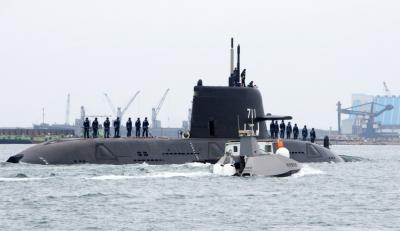
Taiwan's first indigenous defense submarine, the SS-711 Hai Kun (海鯤, or Narwhal), departed for its 13th sea trial at 7am today, marking its seventh submerged test, with delivery to the navy scheduled for July. The outing also marked its first sea deployment since President William Lai (賴清德) boarded the submarine for an inspection on March 19, drawing a crowd of military enthusiasts who gathered to show support. The submarine this morning departed port accompanied by CSBC Corp’s Endeavor Manta (奮進魔鬼魚號) uncrewed surface vessel and a navy M109 assault boat. Amid public interest in key milestones such as torpedo-launching operations and overnight submerged trials,


 RSS
RSS