


Chinese Nationalist Party (KMT) Legislator Chang Chia-chun (張嘉郡), who last month announced that she would not seek re-election, yesterday said that the party needed to work out a solution if it wanted her to rejoin the legislative elections next year.
KMT Chairman Eric Chu (朱立倫) on Wednesday said that the party would continue its efforts to recruit Chang for the Jan. 16 elections by helping her “solve her family problem” — in an apparent reference to opposition by her father, former Yunlin County commissioner Chang Jung-wei (張榮味).
Chang Jung-wei last month announced that his daughter was withdrawing from the legislative polls, which Chang Chia-chun later confirmed.
The legislator said that insofar as the party understood the situation that she was in, she hoped that “Chu or [Legislative Speaker] Wang [Jin-pyng (王金平)] could work out a solution.”
Asked about Wang’s comment that her younger brother could run if she decided not to, Chang Chia-chun said her brother is well-qualified, but “we are facing the same predicament.”
“My father is a person who keeps his promises, so once he said the word withdraw [from the legislative elections], there is probably no turning back,” Chang Chia-chun told reporters in Taipei.
She nevertheless said that she is “more than willing” to continue serving her constituency in Yunlin.
When asked to clarify what predicament she was referring to, Chang Chia-chun did not respond directly, but said: “My father has so far not publicly stated which presidential candidate he wishes to support. He has his own views on politics, so I cannot answer in his stead.”
Asked whether she would run for re-election if the party changes its presidential candidate, the KMT lawmaker said it was a hypothetical question, but added that she has also heard about the possibility of changing the party’s presidential candidate.
“I am in fact really willing [to run for re-election]. If the party’s top echelons indeed care about [my return to the campaign], they should start to solve this problem,” Chang Chia-chun said.
Wang, who is on good terms with Chang Jung-wei, said that Chang Chia-chun had already announced her withdrawal, and “there has to be an ‘inflection point’ to justify her return to the race,” declining to elaborate on what that “inflection point” is.
When asked whether it was related to the KMT’s presidential candidacy, Wang said: “I do not know; you have to ask her.”
Meanwhile, in Changhua, KMT presidential candidate Hung Hsiu-chu (洪秀柱) dismissed rumors that she might be replaced as the party’s candidate and said she was “thankful to [senior presidential adviser] King Pu-tsung (金溥聰) for his advice.”
King said in a radio interview on Wednesday that the pan-blue camp needs a “new variable” for the pan-blues to turn the tables and win.
“King is an expert on campaigning, and he probably said that because he saw that our poll numbers are not at their best,” Hung said.
She added that she had felt she was welcomed by residents in central and southern Taiwan.
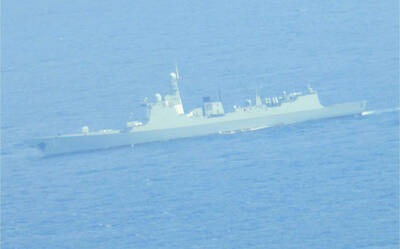
The military has spotted two Chinese warships operating in waters near Penghu County in the Taiwan Strait and sent its own naval and air forces to monitor the vessels, the Ministry of National Defense (MND) said. Beijing sends warships and warplanes into the waters and skies around Taiwan on an almost daily basis, drawing condemnation from Taipei. While the ministry offers daily updates on the locations of Chinese military aircraft, it only rarely gives details of where Chinese warships are operating, generally only when it detects aircraft carriers, as happened last week. A Chinese destroyer and a frigate entered waters to the southwest
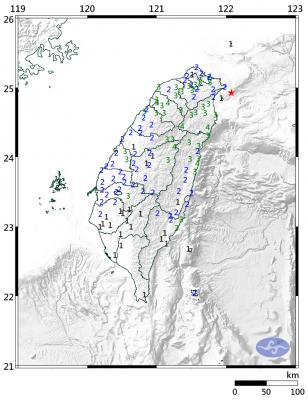
A magnitude 6.1 earthquake struck off the coast of Yilan County at 8:39pm tonight, the Central Weather Administration (CWA) said, with no immediate reports of damage or injuries. The epicenter was 38.7km east-northeast of Yilan County Hall at a focal depth of 98.3km, the CWA’s Seismological Center said. The quake’s maximum intensity, which gauges the actual physical effect of a seismic event, was a level 4 on Taiwan’s 7-tier intensity scale, the center said. That intensity level was recorded in Yilan County’s Nanao Township (南澳), Hsinchu County’s Guansi Township (關西), Nantou County’s Hehuanshan (合歡山) and Hualien County’s Yanliao (鹽寮). An intensity of 3 was

Japanese Prime Minister Sanae Takaichi’s comment last year on Tokyo’s potential reaction to a Taiwan-China conflict has forced Beijing to rewrite its invasion plans, a retired Japanese general said. Takaichi told the Diet on Nov. 7 last year that a Chinese naval blockade or military attack on Taiwan could constitute a “survival-threatening situation” for Japan, potentially allowing Tokyo to exercise its right to collective self-defense. Former Japan Ground Self-Defense Force general Kiyofumi Ogawa said in a recent speech that the remark has been interpreted as meaning Japan could intervene in the early stages of a Taiwan Strait conflict, undermining China’s previous assumptions
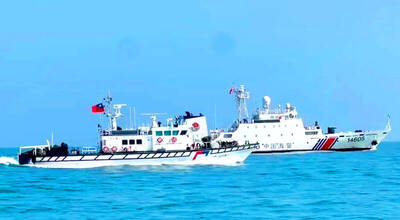
Instead of focusing solely on the threat of a full-scale military invasion, the US and its allies must prepare for a potential Chinese “quarantine” of Taiwan enforced through customs inspections, Stanford University Hoover fellow Eyck Freymann said in a Foreign Affairs article published on Wednesday. China could use various “gray zone” tactics in “reconfiguring the regional and ultimately the global economic order without a war,” said Freymann, who is also a nonresident research fellow at the US Naval War College. China might seize control of Taiwan’s links to the outside world by requiring all flights and ships entering or leaving Taiwan


 RSS
RSS