


Democratic Progressive Party (DPP) presidential candidate Tsai Ing-wen (蔡英文) yesterday visited several Hakka communities along Provincial Highway No. 3 in Taoyuan and Hsinchu County, following a news conference to give details of her “Romantic Highway No. 3” policy.
Speaking to local political leaders, supporters and Taiwanese literary writer Chung Chao-cheng (鍾肇政) in front of the Shengjiting (聖蹟亭) — the Pavilion of Sacred Relics — in Taoyuan’s Longtan District (龍潭), Tsai promised to turn the section of the highway that runs through Hakka communities in Taoyuan, Hsinchu County, Miaoli County and Taichung into an important route of development in tourism and agriculture that would lead to local prosperity.
“This is a highway of history, as, along the road, we can see the relics of [Han] settlements in history, integration between the Hans and Aborigines, and the combined prosperity of ethnic groups,” Tsai said. “It is also a highway of culture, as Chung, who left a classic page in Taiwanese literature, artist Hsiao Ju-sung (蕭如松), who left so many great works, and a well-known musician in Taiwanese musical history Teng Yu-hsien (鄧雨賢) all lived along the road.”
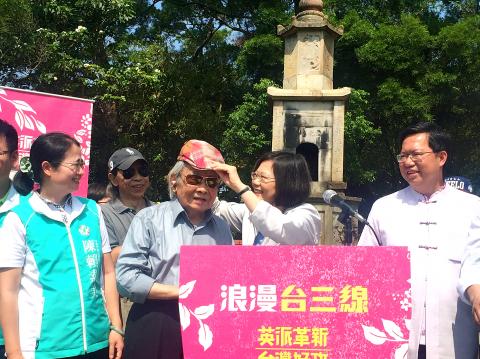
Photo: Chen Hui-ping, Taipei Times
Besides artistic personalities, Tsai said there are important tea and fruit production regions, as well as research institutes for the national defense industry along the road.
“Since it runs through many Hakka communities, we could call it the ‘Hakka Romantic Road,’ but we will make it a project for all Taiwanese,” Tsai said.
Tsai said she deliberately chose to hold the press conference in front of Shengjiting, because it is a place where people burn pieces of paper with words written on them out of respect for literature.
“Each word that I speak and each that I write are out of sincerity; they cannot be lies,” Tsai said.
Tsai said that if she is elected president, she would set up a special task force for the project to take charge of integrating government and non-governmental resources while facilitating communications among government agencies.
Following the press conference, Tsai visited a bookstore coffee shop in nearby Pingjhen District (平鎮), where she spoke with community reform advocates to learn about their ideas and challenges.
Tsai also spoke with Chung in the Japanese-era house that he lived in and where he completed many of his literary works while teaching at Longtan Elementary School.
Chung shared some of the stories behind his works.
“This is why I want to preserve culture and memories through the Romantic Highway No. 3 project,” Tsai said. “We are fortunate enough to sit here and listen to a master writer telling his stories and we want generations to come to be able to learn the stories behind masterpieces in Taiwanese literature as well.”

FUKUOKA SITUATION: Japanese media reported that the pathogen is expected to be identified by the summer, while the CDC downplayed the idea that it was hMPV A “mysterious cold-like illness” reported in Japan’s Fukuoka Prefecture does not seem to be a new disease, but Japanese authorities have been asked about the situation, the Centers for Disease Control (CDC) said yesterday. The Fukuoka Prefectural Medical Association on Wednesday told a news conference that a “mystery cold” that has become a hot topic on social media is “highly likely to be caused by some kind of viral infection,” Japan’s KBC News reported. “Many people are experiencing symptoms starting with a sore throat, followed by a runny nose, phlegm and a severe cough,” KBC News reported, citing association officials. Health authorities are

Nvidia Corp CEO Jensen Huang (黃仁勳) arrived in Taiwan yesterday ahead of upcoming AI and technology events, saying he plans to meet with clients and Taiwan Semiconductor Manufacturing Co Chairman C.C. Wei (魏哲家) during his visit. After landing at Taipei Songshan Airport, Huang posed for photos with fans and handed out Yakult drinks to reporters and supporters waiting at the scene, saying he has “a lot to do” during the trip. Asked about reports that Nvidia’s planned headquarters site in Taipei’s Beitou Shilin Technology Park could break ground on May 27, Huang said that if the company holds an event, he would

The Ministry of Finance this afternoon announced the winning numbers for the March-April uniform invoice lottery. The winning number for the NT$10 million (US$318,060) special prize is 19531471, and the winning number for the NT$2 million grand prize is 85941329. Three numbers were drawn for the NT$200,000 first prize: 07225810, 20231230 and 83518781. Those with receipts matching the last seven digits of any of the first-prize numbers will win the NT$40,000 second prize, while those matching the last six digits will win the NT$10,000 third prize. Those whose receipts match the last five digits of the first-prize numbers can claim the NT$4,000 fourth prize,

SIX SUBSIDIES: The monthly allowance for older farmers is to increase to NT$10,000, and NT$5,000 is to be given to homemakers under the national pension system, Lai said The government is to implement major welfare policies for disadvantaged groups, including raising the monthly allowance for older farmers to NT$10,000 and providing homemakers with NT$5,000 per month, President William Lai (賴清德) said yesterday. Lai made the remarks during a visit to Wangling Temple in Chiayi County, saying that the planned increases were being introduced amid economic growth and an increase in tax revenue. Touting a policy, in which the government plans to provide a monthly allowance of NT$5,000 for every child under the age of 18 in a bid to address Taiwan’s low birthrate, Lai said that if received for the


 RSS
RSS