


Policymakers might have to face the possibility of a “disruption of stability” in the Taiwan Strait, a US academic told a conference in Washington on Monday.
Shelley Rigger, a professor of East Asian politics at Davidson College in North Carolina, said there were at least two developments that could change the equilibrium and “well-established pattern” that support peace.
One is that the People’s Republic of China (PRC) might come to believe that time is no longer on its side in its drive for unification. The other is that the PRC could encounter problems so severe that the leadership sees a need for a diversion to distract the public and refocus their attention on the Chinese Communist Party (CCP) as the defender of Chinese nationalism.
Rigger made her points as the keynote speaker at a conference on “Taiwan’s 2016 Elections and the United States” organized by the Center for Strategic and International Studies and the Brookings Center for East Asia Policy Studies.
“Do we see those circumstances begin to come together now?” she asked the crowded conference.
Rigger said Beijing believes that time is on its side because its economic power is growing, as is Taiwan’s economic dependence on China, but Beijing’s view could change as it might think time is no longer on its side and waiting would put it in a weaker position.
Rigger said that Beijing is becoming increasingly powerful economically, politically and militarily relative to Taiwan.
It is becoming increasingly difficult to imagine how Taiwan could resist in the long term China’s determination to achieve unification, she said.
“In order to achieve peaceful unification, you have to be able to make the case for it and sell it in Taiwan, and that is getting harder and harder and harder, and not easier,” she said. “Unification has no support at all in Taiwan right now, but support for independence is also low. The bad news is that if you dig a little deeper, support for independence starts to look less weak and support for unification looks even weaker than the surface level trends would suggest.”
Rigger said this is not a good trend for the PRC.
She added that Beijing’s strategy of waiting for economic integration to win support for political integration is also losing momentum.
At the same time, she said, Beijing is facing economic and political headwinds that could “sharpen a perception” that Chinese President Xi Jinping (習近平) needs to do something to consolidate his support and to show that even if he cannot control everything, he can control something and that something might be Taiwan.
“And that’s not good,” she said.
In a cautious address during which she said that she did not necessarily agree with the arguments she was presenting, Rigger said the risks involved in Chinese military action against Taiwan are still very high.
She said that strong action or risk-taking could activate or intensify rather than alleviate splits in the PRC leadership and that “knowledge of that possibility may be a deterrent to taking stronger action on the Taiwan issue.”
She quoted two arguments from other panelists at the conference.
One panelist said that a Taiwan-related crisis would reflect poorly on Xi and therefore is unlikely.
However, the other panelist suggested that Xi would actually do more damage to himself if he were seen to be “looking the other way and tolerating Taiwan going in a bad direction.”
Rigger concluded that both arguments made sense.

NATIONAL SECURITY: Authorities are working to confirm the identities of the military personnel involved and investigating possible illegal conduct and regulatory violations Authorities are probing possible national security implications after Kinmen police and immigration officers on Sunday found a Chinese woman allegedly posing as a tourist while engaging in prostitution involving more than 10 military personnel. The woman, surnamed Chen (陳), has since been deported, authorities said, adding that investigators are still working to confirm the identities of those implicated, as the records only listed code names and aliases. The case stemmed from a report received by the Kinmen District Prosecutors’ Office on Friday last week from the Jinhu Precinct of the Kinmen County Police Bureau. On Sunday, police, along with the National Immigration

GLOBALGIVING: ‘ Caving to external pressure is not acceptable for an organization that has cultivated justice reform and human rights for 30 years,’ one NGO said A slew of non-government organizations (NGOs) have withdrawn from the GlobalGiving fundraising platform after it announced it would use “Chinese Taipei” instead of “Taiwan” from next month. The Taiwan Good Rice Association wrote on Facebook on Friday that it was informed on April 28 via a teleconference call of the change, which was made because the platform wanted to operate in China. Taiwan Good Rice is to terminate all cooperative relationships with GlobalGiving in response to the platform’s “unilateral and non-negotiable” decision to remove references to Taiwan, the NGO said. “Taiwan is in the official name of Taiwan Good Rice Association and the

HEAVY WEATHER: Typhoon Jangmi is due to crash straight into the Ryukyus as airlines look to shift flights to larger aircraft or cancel flights to Okinawa entirely Taiwan’s international air carriers announced flight adjustments over the weekend as Typhoon Jangmi is forecast to hit the Ryukyu Islands today and tomorrow. The Central Weather Administration (CWA) upgraded Jangmi from a tropical storm to a typhoon at 8am yesterday, with the eye located 580km south of Naha city. It was moving north at 19kph. Today, China Airlines’ CI-120, CI-121, CI-122 and CI-123 flights between Taoyuan and Naha, Okinawa, have been canceled as well as CI-132 and CI-133 between Kaohsiung and Naha. EVA Air’s BR-112, BR-113, BR-186 and BR-185 flights between Taoyuan and Naha are also canceled. Low-cost carrier Tigerair Taiwan canceled IT-230,
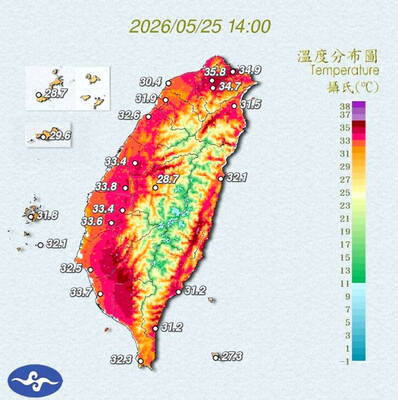
STAY COOL: The HPA recommended that people stay hydrated, use air-conditioning or fans while indoors, wear loose-fitting clothes and walk in the shade while outdoors Employers must implement measures such as installing cooling equipment, and providing drinking water and rest breaks for outdoor workers starting from Monday next week, the Taipei Department of Labor said on Sunday. Employers who fail to comply could face fines of NT$30,000 to NT$300,000 under the Occupational Safety and Health Act (職業安全衛生法), the department said. Businesses in Taipei employing fewer than 100 workers, as well as registered self-employed workers with labor insurance coverage, could receive on-site assessments and guidance from occupational safety consultants to help them apply for central government subsidies to implement or improve heat-protection measures, it said. Under the Ministry of


 RSS
RSS