


Democratic Progressive Party (DPP) Legislator Chen Chi-mai (陳其邁) yesterday accused former vice president Lien Chan (連戰) of abusing the state’s security resources by asking for a nine-strong security detail from the National Police Administration (NPA) after his four-year period of retirement benefits expired.
Under the 2007 amendments to the Act of Courtesy for Former Presidents and Vice Presidents (卸任總統副總統禮遇條例), Lien is entitled to four to eight guards for four years, but he continued to request a security detail after his benefits period ended in 2010, Chen said.
Lien requested — based on the “Regulations for Dispatching Security Guards for Central Government Chiefs and Special Individuals” (中央政府機關首長及特定人士安全警衛派檢作業規定) — a total of nine security guards, one more than allowed for retired vice presidents, on the grounds that his family has constantly received “blackmail letters and telephone calls” and because the 2010 “case where [his son] Sean Lien (連勝文) was shot has not been solved,” the lawmaker said.
However, Chen said that of the six cases the Liens reported to the police since 2011 basically involved tirades and blackmail letters, none of which were found to be substantial threats, which the regulations specify that they would have to be to justify extending protection, while the Sean Lien shooting case was closed in 2013.
The Lien family should not be using public resources as personal bodyguards, Chen said.
“With Lien Chan’s wealth, which has been estimated at about NT$30.5 billion [US$928.3 million] and a monthly pension of NT$375,000, it would not be a problem for him to hire his own bodyguards,” Chen said, adding that a nine-member security detail costs the government about NT$7.83 million a year.
Chen said the NPA should review its measures on security for retired presidents and vice presidents, saying some have been given more courtesy than they are due.
Her criticism came a few days after the Taiwan Solidarity Union caucus’ revealed that Lien Chan had asked his security detail to accompany him on his trip to Beijing last week.
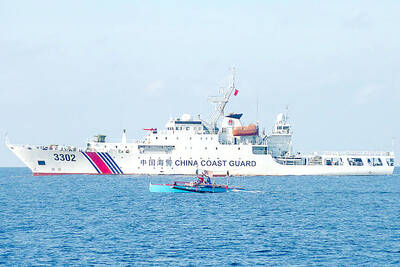
EXPANSIONIST: China deploys an average of 40 to 50 warships and coast guard vessels daily in the South China Sea, despite pledges not to militarize the region, an official said China is attempting to expand its influence across the First Island Chain and increase pressure on Japan by sending coast guard vessels into waters off of Taiwan under the pretext of maritime negotiations with Japan and the Philippines, a national security official said yesterday. China’s recent actions in the waters east of Taiwan and Japan and the Philippines’ exclusive economic zones (EEZ) are attempts to establish dominance in First Island Chain waters, said the official who declined to be named, adding that this is “expansion disguised as law enforcement.” Framing China’s actions solely as a cross-strait issue is a serious misjudgment that
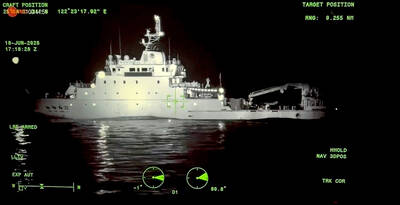
EXCUSES: Beijing is using government and research vessels as a pretext to harass the nation and enter its EEZ, and engage in ‘hegemonic expansion,’ the coast guard said The Coast Guard Administration yesterday said it drove away Chinese oceanographic research vessel Xiang Yang Hong 22 (向陽紅33) from restricted waters after warning it that it was in Taiwan’s exclusive economic zone (EEZ). The Chinese vessel entered restricted waters off the coast of Yilan County’s Suao (蘇澳) at 11:35pm on Thursday, the coast guard said, adding that it dispatched the Lanyu patrol vessel and the boat PP-10077 to shadow the Chinese ship and issue radio warnings ordering it to leave. China has no sovereignty over waters off Taiwan’s east coast, Lanyu’s crew told Xiang Yang Hong 22 over the radio, and demanded
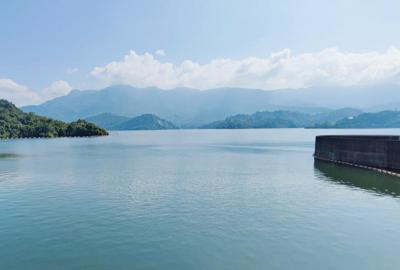
Several major reservoirs are estimated to have received 590 million tonnes of water inflow from June 4 to this morning, with storage levels at Wushantou Reservoir exceeding 50 percent and Zengwen Reservoir approaching 30 percent as of 9am today, data from the Water Resources Agency showed. Of the estimated 590 million tonnes, 450 million have already been stored in reservoirs, the data showed. As of 9am today, Baoshan Reservoir storage levels reached 100 percent, while Baoshan Second Reservoir, Yongheshan Reservoir and Techi Reservoir all exceeded 90 percent, data on the Water Resources Agency’s Web site showed. In addition, the Shimen Reservoir is at

BAIT AND SWITCH: Allowing KMT-run counties to sell to China while the threat of abrupt cancelations hangs overhead is another form of coercion, officials said Beijing is using agricultural purchase offers announced during the Straits Forum to deepen Taiwan’s dependence on the Chinese market, a Taiwanese official said yesterday as they criticized the Taitung County commissioner’s participation in the initiative. During the Straits Forum held in Xiamen on Saturday, Chinese officials announced a sales and purchase agreement for agricultural products from some counties led by the Chinese Nationalist Party (KMT). Taitung County Commissioner Yao Ching-ling (饒慶鈴), who was barred from attending the event in person by the Mainland Affairs Council, participated via video. Under the agreement, China would purchase atemoyas, pomeloes, tea and grouper harvested in Taitung,


 RSS
RSS