

Activists from a range of labor and welfare groups yesterday announced the establishment of an “Annuity Pension Reform Alliance,” demanding that presidential candidates commit to reforming national annuity pension systems.
The groups’ demands included that the candidates refrain from making empty promises to increase benefits and establish a “consultation platform” that would allow open and transparent discussion with civic groups.
“If there are no changes, we will probably go from having annuity pensions to not having them, because the nation probably would not be able to stand the pressure,” Taiwan Labor Front secretary-general Son Yu-liam (孫友聯) said, calling on candidates to make a credible commitment to reform, instead of just “buying votes” with promises to increase benefits.
National retirement benefits are currently provided by five separate pension funds. While benefits to the general population are provided through the National Pension and Labor Pension funds, retired military personnel, civil servants and public-school teachers each have their own separate funds. In addition, retired farmers also receive monthly allowances from the national budget.
“Political and economic conditions, population trends, national finances and the outlook for economic growth all indicate that the a nation can no longer support the pension annuity system in its present form,” National Taiwan University sociology professor Fu Tsung-hsi (傅從喜) said.
The Alliance for Fair Tax Reform convener Wang Jung-chang (王榮璋) said that the pension fund for military personnel looks set to go bankrupt in 2019, with the labor and public-school teacher pension funds going bankrupt in 2027, and the civil servant fund in 2031.
He called for the review and reform of the different pension funds to be linked, with the goal of more closely integrating the funds to accommodate the inevitable cuts.
The different pension funds provide greatly disparate “guarantees” of financial security to retirees, he said. While the pensions for military personnel, civil servants and public-school teachers are equal to between 80 percent to 90 percent of their salaries, benefits offered by the Labor Pension are equal to only 60 percent of workers’ salaries, he said.

NATURE TAKES ITS COURSE: The agency’s head said he felt a sense of loss watching red-banded snakes eat the babies, as they had decided on non-intervention The Forestry and Nature Conservation Agency yesterday released a documentary on a hundred-pace viper that had incubated 16 eggs, all of which hatched, but only a baby viper escaped after they were attacked by red-banded snakes. The agency’s Taichung branch last year launched the viper reproduction monitoring project soon after forest rangers Lin Chun-yu (林俊佑) and Chou Chia-cheng (周家成) spotted a pregnant hundred-pace viper in a grass-covered burrow near a parking lot in Tbulan Village (松鶴部落). The Atayal village, in Taichung’s Heping District (和平), is headed by Ecyang Yapu, who was positive about the project and assisted in access control and power

The Coast Guard Administration (CGA) yesterday said that it had deployed vessels to “monitor” Chinese ships operating in waters off the east coast. The CGA said it dispatched vessels in response to a China Coast Guard announcement that it had carried out another “routine law-enforcement patrol” in waters off the east coast. “The CGA firmly rejects China’s cognitive warfare campaign of ‘law enforcement in name, jurisdictional expansion in practice,’” it said on X. As of 11am yesterday, two China Coast Guard ships were “loitering and drifting” about 105 nautical miles (195km) and 74 nautical miles east of Green Island (綠島) respectively, it said. It

A sharp rise in compensation to be paid by air force officers who leave before completing their required service could indicate an increase in pilots leaving the military early, an analyst said on Friday, warning that the trend could worsen a shortage of experienced personnel. Chieh Chung (揭仲), a researcher at the Association for Strategic Foresight, issued the warning even though the number of volunteer military personnel is expected to increase next year. The planned headcount for volunteer military personnel, covering officers, noncommissioned officers (NCO) and enlisted soldiers, is 158,223 for next year, up 4,258 from 153,965 this year, Chieh said. The increase
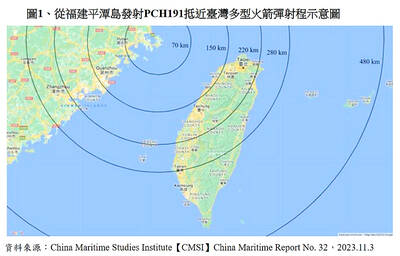
Potential improvements to munitions used by China’s long-range rocket-artillery units could extend their range to cover the entire Miyako Strait, which might give the Chinese People’s Liberation Army (PLA) the ability to secure the strategic waterway, the Mainland Affairs Council (MAC) said in a report. The PLA’s long-range rocket-artillery units deployed along the Taiwan Strait are concentrated along the coast of Fujian Province, including Changle, Pingtan and Shishi, the quarterly report on China said. The artillery brigades of the PLA’s 71st, 72nd and 73rd group armies have been deployed, with preparations for potential battlefield operations under way since August 2022, the report


 RSS
RSS