


People First Party (PFP) Secretary-General Chin Chin-sheng (秦金生) yesterday said he was not present at a military parade commemorating the 70th anniversary of the end of the Second Sino-Japanese War — an apparent attempt to distance himself from a controversial China trip.
A public furor has followed the trip by Taiwanese political figures, particularly former vice president Lien Chan (連戰) of the Chinese Nationalist Party (KMT), to Beijing to attend the military parade, with many saying the visit, without any public statements to correct the Chinese on “historical truths,” was the equivalent of capitulating to China.
The PFP has tried to maintain an open channel of communication with China since its members first visited the country in 2005, Chin said, adding that such channels were for the benefit of Taiwan, cross-strait relations and the future of Taiwan’s young people.
Chin said that he was the only representative of the party to visit China, as PFP Chairman James Soong (宋楚瑜) felt the event was controversial.
The PFP is respectful of the views of Taiwanese, Chin said, adding that it was for this reason that he excused himself from the parade review on Tiananmen Gate.
“I was not at my seat [on Tiananmen Gate], I was not on the stand; I was absent and my seat remained empty throughout [the parade],” Chin told the media after arriving at Taiwan Taoyuan International Airport. “I was resting in the back.”
He added that, to avoid causing embarrassment to organizers, he left the stand on his own.
A lack of sleep on Tuesday due to the noise caused by passing vehicles in preparation for the parade and the heavy heat on Wednesday caused everyone physical discomfort, Chin said, adding that Ruentex Corp chairman Samuel Yin (尹衍樑) also complained of discomfort on Wednesday.
Chin said that former Non-Partisan Solidarity Union legislator Lin Pin-kuan (林炳坤), who was also in the delegation, could attest that Chin was not on the platform to watch the parade.
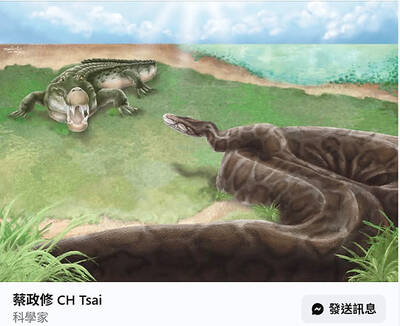
Taiwanese paleontologists have discovered fossil evidence that pythons up to 4m long inhabited Taiwan during the Pleistocene epoch, reporting their findings in the international scientific journal Historical Biology. National Taiwan University (NTU) Institute of Ecology and Evolutionary Biology associate professor Tsai Cheng-hsiu (蔡政修) led the team that discovered the largest snake fossil ever found in Taiwan. The single trunk vertebra was discovered in Tainan at the Chiting Formation, dated to between 400,000 and 800,000 years ago in the Middle Pleistocene, the paper said. The area also produced Taiwan’s first avian fossil, as well as crocodile, mammoth, saber-toothed cat and rhinoceros fossils, it said. Discoveries

Taiwanese paleontologists have discovered fossil evidence that pythons up to 4m long inhabited Taiwan during the Pleistocene epoch, reporting their findings in the international scientific journal Historical Biology. National Taiwan University (NTU) Institute of Ecology and Evolutionary Biology associate professor Tsai Cheng-hsiu (蔡政修) led the team that discovered the largest snake fossil ever found in Taiwan. A single trunk vertebra was discovered in Tainan at the Chiting Formation, dated to between 800,000 to 400,000 years ago in the Middle Pleistocene, the paper said. The area also produced Taiwan’s first avian fossil, as well as crocodile, mammoth, sabre-toothed cat and rhinoceros fossils, it said. Discoveries
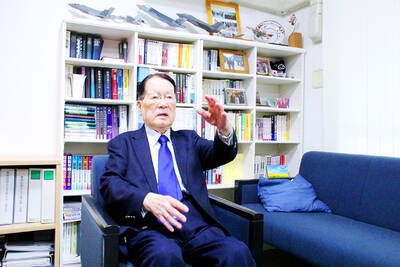
Whether Japan would help defend Taiwan in case of a cross-strait conflict would depend on the US and the extent to which Japan would be allowed to act under the US-Japan Security Treaty, former Japanese minister of defense Satoshi Morimoto said. As China has not given up on the idea of invading Taiwan by force, to what extent Japan could support US military action would hinge on Washington’s intention and its negotiation with Tokyo, Morimoto said in an interview with the Liberty Times (sister paper of the Taipei Times) yesterday. There has to be sufficient mutual recognition of how Japan could provide
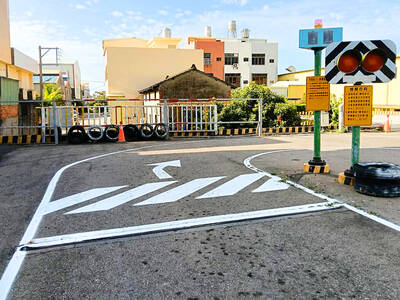
UPDATED TEST: The new rules aim to assess drivers’ awareness of risky behaviors and how they respond under certain circumstances, the Highway Bureau said Driver’s license applicants who fail to yield to pedestrians at intersections or to check blind spots, or omit pointing-and-calling procedures would fail the driving test, the Highway Bureau said yesterday. The change is set to be implemented at the end of the month, and is part of the bureau’s reform of the driving portion of the test, which has been criticized for failing to assess whether drivers can operate vehicles safely. Sedan drivers would be tested regarding yielding to pedestrians and turning their heads to check blind spots, while drivers of large vehicles would be tested on their familiarity with pointing-and-calling


 RSS
RSS