


Taipei Mayor Ko Wen-je (柯文哲) yesterday came under fire from pro-independence groups for a remark he made in Shanghai earlier this week that Taiwan and China belonged to “one family.”
Members of the 908 Taiwan Republic Campaign yesterday protested in front of the Taipei City Government building, demanding an apology from Ko for what they called his “inappropriate” remark.
Group founder Peter Wang (王獻極) said that Taiwan and China are two nations and enemies with each other.
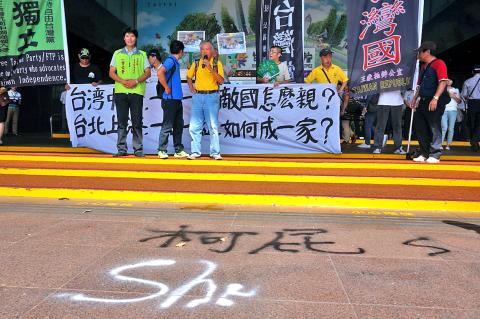
Photo: Tu Chu-min, Taipei Times
“Under this circumstance, how can we be in ‘one family’?” he asked.
He said Ko had “kissed up” to Beijing and that he had won last year’s mayoral election by “swindling” Taipei voters, citing a pre-election press conference held by a group at which Ko tore up his Republic of China (ROC) identification card and received a symbolic “Taiwan Republic” identification card.
He said that Ko’s stance on cross-strait issues is even worse than the “one China, different interpretations” stance adopted by President Ma Ying-jeou (馬英九).
Group director Chilly Chen (陳峻涵) said that if Taiwan and China were to be one family, China should first withdraw all of its missiles targeting Taiwan and acknowledge Taiwan as a nation.
Ko rejected the allegations that he had swindled his way to his post as Taipei mayor and changed his position on Taiwan’s identity.
Asked to comment on the criticism during a meeting to discuss city policies, Ko said: “I did not swindle votes. If that [ripping his ROC identity card] was swindling, people’s votes, I was doing it from day one. There was no sudden change in direction,” he said.
With reference to his trip to Shanghai earlier this week, he said: “I told officials at the [People’s Republic of China’s] Taiwan Affairs Office that it was China that decided to abandon us [Taiwan] in 1895, and now it expects us to go back. I told them: ‘You need to think about how others feel sometimes,’” he said.
On why he had not informed reporters that he had been scheduled to meet with Taiwan Affairs Office Liaison Bureau Director Liu Junchuan (劉軍川) on Tuesday, he said that Chinese officials arranged the meeting only after assessing his behavior during the first day of his visit.
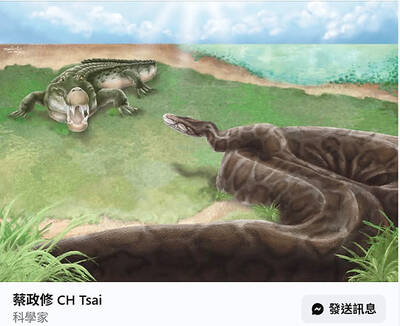
Taiwanese paleontologists have discovered fossil evidence that pythons up to 4m long inhabited Taiwan during the Pleistocene epoch, reporting their findings in the international scientific journal Historical Biology. National Taiwan University (NTU) Institute of Ecology and Evolutionary Biology associate professor Tsai Cheng-hsiu (蔡政修) led the team that discovered the largest snake fossil ever found in Taiwan. The single trunk vertebra was discovered in Tainan at the Chiting Formation, dated to between 400,000 and 800,000 years ago in the Middle Pleistocene, the paper said. The area also produced Taiwan’s first avian fossil, as well as crocodile, mammoth, saber-toothed cat and rhinoceros fossils, it said. Discoveries

Taiwanese paleontologists have discovered fossil evidence that pythons up to 4m long inhabited Taiwan during the Pleistocene epoch, reporting their findings in the international scientific journal Historical Biology. National Taiwan University (NTU) Institute of Ecology and Evolutionary Biology associate professor Tsai Cheng-hsiu (蔡政修) led the team that discovered the largest snake fossil ever found in Taiwan. A single trunk vertebra was discovered in Tainan at the Chiting Formation, dated to between 800,000 to 400,000 years ago in the Middle Pleistocene, the paper said. The area also produced Taiwan’s first avian fossil, as well as crocodile, mammoth, sabre-toothed cat and rhinoceros fossils, it said. Discoveries
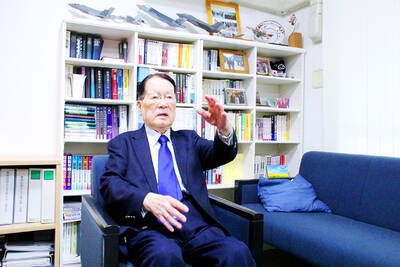
Whether Japan would help defend Taiwan in case of a cross-strait conflict would depend on the US and the extent to which Japan would be allowed to act under the US-Japan Security Treaty, former Japanese minister of defense Satoshi Morimoto said. As China has not given up on the idea of invading Taiwan by force, to what extent Japan could support US military action would hinge on Washington’s intention and its negotiation with Tokyo, Morimoto said in an interview with the Liberty Times (sister paper of the Taipei Times) yesterday. There has to be sufficient mutual recognition of how Japan could provide
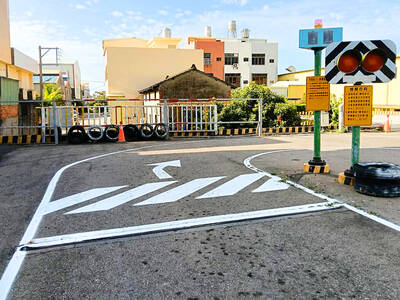
UPDATED TEST: The new rules aim to assess drivers’ awareness of risky behaviors and how they respond under certain circumstances, the Highway Bureau said Driver’s license applicants who fail to yield to pedestrians at intersections or to check blind spots, or omit pointing-and-calling procedures would fail the driving test, the Highway Bureau said yesterday. The change is set to be implemented at the end of the month, and is part of the bureau’s reform of the driving portion of the test, which has been criticized for failing to assess whether drivers can operate vehicles safely. Sedan drivers would be tested regarding yielding to pedestrians and turning their heads to check blind spots, while drivers of large vehicles would be tested on their familiarity with pointing-and-calling


 RSS
RSS