


Citing insufficient evidence, the Taipei District Prosecutors’ Office yesterday said it has dropped charges of theft, damaging and insulting the national flag against four individuals who were accused of having destroyed 74 national flags along Aiguo W Road in Taipei on Double Ten National Day last year.
According to a prosecutors’ investigation, Chou Shih-lun (周世倫), known for directing a documentary on the Sunflower movement, Hsiao Chang-chan (蕭長展), a member of The Village Armed Youths band, and two other individuals — surnamed Hu (胡) and Lu (呂) — allegedly launched an “art event” on Oct. 9 last year to raise public awareness on the restrictions the national flag faced at international events.
Police were later informed that 74 flags along Aigwo W Road between Boai Road and Zhonghua Road Sec 1 had been slashed or damaged about 2am on Oct 9.
Police listed Chou and the other three individuals as the prime suspects after identifying Chou and others from the license plates of their scooters and a photograph of a national flag with black spray-painted words on it posted on Chou’s Facebook page.
Surveillance footage revealed a group of people had gathered on Gueilin Road in Wanhua District (萬華) before walking to Aiguo W Road, prosecutors said, adding that footage did not show any of the four slashing or stealing flags along the road.
The four denied the charges and said their plan was to highlighting how the national flag faced censure at international events, adding they were simply performing action art.
Prosecutors said there was no direct evidence that the four had damaged any flags, adding that even if they had, there were not witnesses and thus it would not be act of defamation.
The four had also settled out of court with the Taipei City Public Works Department’s Parks and Street Lights Office in relation to damaged property, the prosecutors said.
Article 106 of the Criminal Code states that public defamation of the Republic of China emblem and national flag, with intent of insulting the nation, is punishable by up to one year in prison, detainment or a fine of up to NT$300.
Additional reporting by Chen En-hui

LOUD AND PROUD Taiwan might have taken a drubbing against Australia and Japan, but you might not know it from the enthusiasm and numbers of the fans Taiwan might not be expected to win the World Baseball Classic (WBC) but their fans are making their presence felt in Tokyo, with tens of thousands decked out in the team’s blue, blowing horns and singing songs. Taiwanese fans have packed out the Tokyo Dome for all three of their games so far and even threatened to drown out home team supporters when their team played Japan on Friday. They blew trumpets, chanted for their favorite players and had their own cheerleading squad who dance on a stage during the game. The team struggled to match that exuberance on the field, with
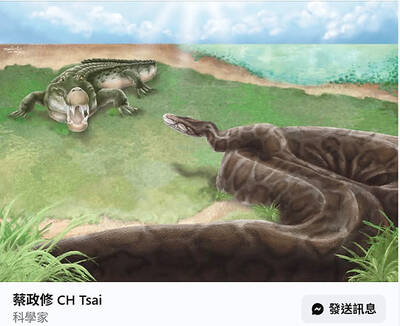
Taiwanese paleontologists have discovered fossil evidence that pythons up to 4m long inhabited Taiwan during the Pleistocene epoch, reporting their findings in the international scientific journal Historical Biology. National Taiwan University (NTU) Institute of Ecology and Evolutionary Biology associate professor Tsai Cheng-hsiu (蔡政修) led the team that discovered the largest snake fossil ever found in Taiwan. The single trunk vertebra was discovered in Tainan at the Chiting Formation, dated to between 400,000 and 800,000 years ago in the Middle Pleistocene, the paper said. The area also produced Taiwan’s first avian fossil, as well as crocodile, mammoth, saber-toothed cat and rhinoceros fossils, it said. Discoveries

Taiwanese paleontologists have discovered fossil evidence that pythons up to 4m long inhabited Taiwan during the Pleistocene epoch, reporting their findings in the international scientific journal Historical Biology. National Taiwan University (NTU) Institute of Ecology and Evolutionary Biology associate professor Tsai Cheng-hsiu (蔡政修) led the team that discovered the largest snake fossil ever found in Taiwan. A single trunk vertebra was discovered in Tainan at the Chiting Formation, dated to between 800,000 to 400,000 years ago in the Middle Pleistocene, the paper said. The area also produced Taiwan’s first avian fossil, as well as crocodile, mammoth, sabre-toothed cat and rhinoceros fossils, it said. Discoveries

Whether Japan would help defend Taiwan in case of a cross-strait conflict would depend on the US and the extent to which Japan would be allowed to act under the US-Japan Security Treaty, former Japanese minister of defense Satoshi Morimoto said. As China has not given up on the idea of invading Taiwan by force, to what extent Japan could support US military action would hinge on Washington’s intention and its negotiation with Tokyo, Morimoto said in an interview with the Liberty Times (sister paper of the Taipei Times) yesterday. There has to be sufficient mutual recognition of how Japan could provide


 RSS
RSS