


The police chief who arrested three journalists on Thursday night will not be punished, Taipei Mayor Ko Wen-je (柯文哲) said yesterday.
The journalists were arrested along with student activists and charged with trespassing on the Ministry of Education’s grounds, with police officers temporarily confiscating their mobile phones and cameras.
“I view this as an unexpected situation and am prepared to shoulder the responsibility myself because there were no clear rules to follow,” said Ko, adding that it would be unfair to for Zhongzheng First Precinct Police Chief Chang Chi-wen (張奇文) to take the blame for the journalists’ arrest.
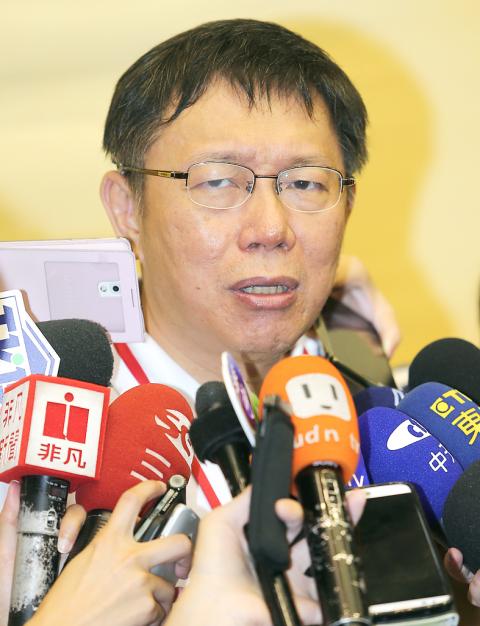
Photo: CNA
Late on Friday, Ko apologized in a media release for what he said was the police department’s “infringement on press freedom.”
During the incident, the police department was not able to follow his administration’s standard operating procedure for dealing with journalists during protests, which call for an on-site police officer to be appointed as a point man for press relations, he said.
Ko said the reporters should not have been arrested, while avoiding questions on whether they had a right to be in the building. Reporters and police officers have different responsibilities which need to be harmonized, he said.
He said the police department would review procedures for dealing with similar incidents in the future, adding that he would also work with the National Police Agency to clarify the chain of command during future protests.
The Taipei mayor shares command of the city’s police department with the agency.
“While I did not issue the order [to arrest the reporters], I do not know who was behind it and I do not dare to guess,” Ko said.
At one point, Ko called Minister of Education Wu Se-hwa (吳思華) a “hired thug,” who was obligated to press charges but later added that he had misspoken.
He said that he “did not really approve” of the students breaking in to the ministry building, but added that “when the nation is abnormal, it is difficult for every person to act normally.”
In Friday’s media release, he had said the students’ “bravery” was “praiseworthy.”

SECURITY: Starlink owner Elon Musk has taken pro-Beijing positions, and allowing pro-China companies to control Taiwan’s critical infrastructure is risky, a legislator said Starlink was reluctant to offer services in Taiwan because of the nation’s extremely high penetration rates in 4G and 5G services, the Ministry of Digital Affairs said yesterday. The ministry made the comments at a meeting of the legislature’s Transportation Committee, which reviewed amendments to Article 36 of the Telecommunications Management Act (電信管理法). Article 36 bans foreigners from holding more than 49 percent of shares in public telecommunications networks, while shares foreigners directly and indirectly hold are also capped at 60 percent of the total, unless specified otherwise by law. The amendments, sponsored by Chinese Nationalist Party (KMT) Legislator Ko

The military has spotted two Chinese warships operating in waters near Penghu County in the Taiwan Strait and sent its own naval and air forces to monitor the vessels, the Ministry of National Defense (MND) said. Beijing sends warships and warplanes into the waters and skies around Taiwan on an almost daily basis, drawing condemnation from Taipei. While the ministry offers daily updates on the locations of Chinese military aircraft, it only rarely gives details of where Chinese warships are operating, generally only when it detects aircraft carriers, as happened last week. A Chinese destroyer and a frigate entered waters to the southwest

The eastern extension of the Taipei MRT Red Line could begin operations as early as late June, the Taipei Department of Rapid Transit Systems said yesterday. Taipei Rapid Transit Corp said it is considering offering one month of free rides on the new section to mark its opening. Construction progress on the 1.4km extension, which is to run from the current terminal Xiangshan Station to a new eastern terminal, Guangci/Fengtian Temple Station, was 90.6 percent complete by the end of last month, the department said in a report to the Taipei City Council's Transportation Committee. While construction began in October 2016 with an

NON-RED SUPPLY: Boosting the nation’s drone industry is becoming increasingly urgent as China’s UAV dominance could become an issue in a crisis, an analyst said Taiwan’s drone exports to Europe grew 41.7-fold from 2024 to last year, with demand from Ukraine’s fight against Russian aggression the most likely driver of growth, a study showed. The Institute for Democracy, Society and Emerging Technology (DSET) in a statement on Wednesday said it found that many of Taiwan’s uncrewed aerial vehicle (UAV) sales were from Poland and the Czech Republic. These countries likely transferred the drones to Ukraine to aid it in its fight against the Russian invasion that started in 2022, it said. Despite the gains, Taiwan is not the dominant drone exporter to these markets, ranking second and fourth


 RSS
RSS