


Democratic Progressive Party (DPP) spokesperson Huang Di-ying (黃帝穎) yesterday criticized the government and police, saying there was serious encroachment of personal freedom and freedom of the press as police led “violent arrests of students and reporters” after protesters stormed the Ministry of Education building in Taipei late on Thursday.
DPP Legislator Cheng Li-chun (鄭麗君) demanded Minister of Education Wu Se-hwa’s (吳思華) resignation, saying the ministry had overseen “unprecedented violations of freedom of the press.”
Police arrested 33 people after a group stormed the building in protest over adjustments to high-school curriculum guidelines — which critics say were decided on in a “black box” procedure — and ministry officials who continue to ignore requests for dialogue.
Three reporters were among those arrested, including Liberty Times (the Taipei Times’ sister newspaper) photojournalist Liao Chen-huei (廖振輝), who was among the first to arrive after the protesters stormed the building.
While he was taking photographs, he was told by officers that he was to be arrested.
Another reporter, who works for Coolloud Collective (苦勞網) — an online platform dedicated to social activism — was also detained.
Huang said police intervention over the actions of the reporters had no legal basis.
“The Constitution protects the freedom of the press from government intervention to guarantee the autonomy and independence of the media’s role in supervising the government. Restricting reporters’ personal freedom is an attempt to cover up the truth and has seriously violated freedom of the press and obstructed the development of a democratic society,” Huang said.
Press freedom has deteriorated during the administration of President Ma Ying-jeou (馬英九) according to a Freedom House ranking, Huang said, adding that police had deployed disproportionate force to “evict the media” on March 23 last year during the Sunflower movement, drawing criticism from the International Federation of Journalists.
“The arrests of journalists on Thursday on the pretext of a lack of invitation from the ministry was a flagrant abuse of freedom of the press,” he said.
“The violent treatment by police, the handcuffing of unarmed students and the confiscation of cellphones, and the arrests of the journalists while prohibiting them from using recording equipment was unconstitutional,” Huang added.
“Where should reporters go if not where the news is happening?” Cheng asked.
Police told Cheng that the reporters were under investigation because the ministry has taken legal action against them.
One reporter said he was knocked on the back of the head by police, despite identifying himself as a member of the press.
The Liberty Times Union yesterday also lashed out at the ministry, denouncing its “taking reporters as criminal suspects.”
“The Zhongzeng First Precinct confiscated the reporters’ communication devices, detained them in the building and transported them to a mobile police department for prosecutors to investigate further, a process that assumed the reporters were suspects,” the union said.
“The union severely condemns the action, which is a suspected breach of constitutional rights and an offense against personal freedom. The action has seriously trampled upon freedom of the press,” it said in a statement, calling on the central government and local administrations to revisit standard operating procedures for dealing with social activism.
The Association of Taiwan Journalists said prohibiting reporters from using mobile phones and filing news stories was a serious breach of press freedom and human rights.
“We do not accept the actions of the Taipei Police Department, who passed the buck to the ministry and prosecutors after making the arrests of journalists, even after the reporters had clearly identified themselves,” the association said, adding that it would offer assistance to any of the affected journalists who want to take legal action.
DPP Chairperson Tsai Ing-wen (蔡英文) and 13 local governments across the nation affiliated with the party issued a joint statement urging the ministry to not implement the curriculum guidelines as planned, withdraw lawsuits against student protesters and apologize to the public over the issue.

NATIONAL SECURITY: Authorities are working to confirm the identities of the military personnel involved and investigating possible illegal conduct and regulatory violations Authorities are probing possible national security implications after Kinmen police and immigration officers on Sunday found a Chinese woman allegedly posing as a tourist while engaging in prostitution involving more than 10 military personnel. The woman, surnamed Chen (陳), has since been deported, authorities said, adding that investigators are still working to confirm the identities of those implicated, as the records only listed code names and aliases. The case stemmed from a report received by the Kinmen District Prosecutors’ Office on Friday last week from the Jinhu Precinct of the Kinmen County Police Bureau. On Sunday, police, along with the National Immigration

GLOBALGIVING: ‘ Caving to external pressure is not acceptable for an organization that has cultivated justice reform and human rights for 30 years,’ one NGO said A slew of non-government organizations (NGOs) have withdrawn from the GlobalGiving fundraising platform after it announced it would use “Chinese Taipei” instead of “Taiwan” from next month. The Taiwan Good Rice Association wrote on Facebook on Friday that it was informed on April 28 via a teleconference call of the change, which was made because the platform wanted to operate in China. Taiwan Good Rice is to terminate all cooperative relationships with GlobalGiving in response to the platform’s “unilateral and non-negotiable” decision to remove references to Taiwan, the NGO said. “Taiwan is in the official name of Taiwan Good Rice Association and the

HEAVY WEATHER: Typhoon Jangmi is due to crash straight into the Ryukyus as airlines look to shift flights to larger aircraft or cancel flights to Okinawa entirely Taiwan’s international air carriers announced flight adjustments over the weekend as Typhoon Jangmi is forecast to hit the Ryukyu Islands today and tomorrow. The Central Weather Administration (CWA) upgraded Jangmi from a tropical storm to a typhoon at 8am yesterday, with the eye located 580km south of Naha city. It was moving north at 19kph. Today, China Airlines’ CI-120, CI-121, CI-122 and CI-123 flights between Taoyuan and Naha, Okinawa, have been canceled as well as CI-132 and CI-133 between Kaohsiung and Naha. EVA Air’s BR-112, BR-113, BR-186 and BR-185 flights between Taoyuan and Naha are also canceled. Low-cost carrier Tigerair Taiwan canceled IT-230,
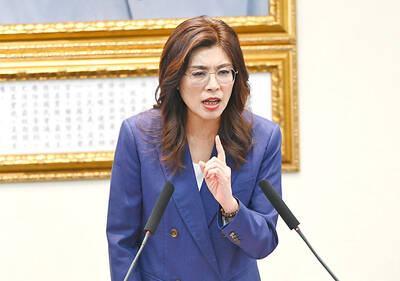
Chinese Nationalist Party (KMT) Chairwoman Cheng Li-wun (鄭麗文) yesterday briefed her party’s Central Standing Committee regarding her scheduled visit to the US between Monday next week and June 16, saying that her purpose would be to persuade the US that the Republic of China (ROC) Constitution was a “one China” constitution that would foster stable and peaceful cross-strait relations. The ROC Constitution is the most important defense for all Taiwanese citizens, as it upholds our democracy and has contributed to our robust economy, which aligns with international and US interests, she said. “We would not be troublemakers and drag the US under,”


 RSS
RSS