


The Chiayi City Government’s plan to demolish an old city hall and auction the site has drawn criticism due to the historical value of the building.
The city government said the old city hall is scheduled for demolition next month and it expects to auction the 1,360 ping (4,496m2) plot by the end of December.
The land sale is expected to add about NT$1 billion (US$31.8 million) to the government’s coffers.
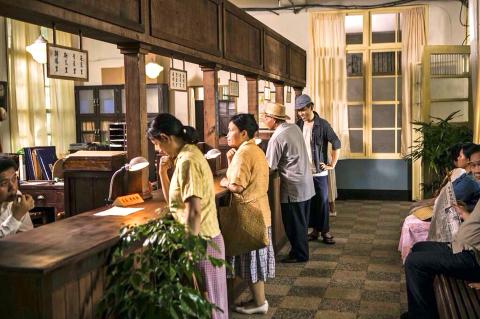
Photo: Ting Wei-chieh, Taipei Times
The city government said it held five auctions for the plot since 2003, but was unable to attract bids.
To invite qualified tenders, the government has been demolishing illegal structures and banning unlicensed stalls around the old city hall.
However, local historians said that renovating the hall for public use would be more valuable than the proposed demolition and land sale, with some artists and literati calling on the government to convert the building into a museum.
Chiayi City Councilor Tsai Yung-chuan (蔡永泉) said the old city hall used to be the seat of the city council, the city office and a household registration office, which houses a collection of artifacts.
“The government should inventory those artifacts and keep at least a 20-ping space as a symbol of history rather than tearing down the whole structure and selling the plot in its entirety, which amounts to the erasure of history,” Tsai said.
Taoshan Salon founder Lin Jui-hsia (林瑞霞) said innovative construction and interior design could embed the remains of the old city hall into the new building.
Chiayi City Councilor Chang Jung-tsang (張榮藏) said that the government put forward a revised development project of the site in April last year, which has been mothballed in the city council due to last November’s nine-in-one elections.
After a city government reshuffle following the elections, the demolition of the old city hall was contracted without a resubmission of the development project to the council, which Chang said was a scheme to force the project through before it goes through due process.
Built in 1954, the building was the city office of then-Chiayi City — a county municipality — and later became the city hall when the city was upgraded to a provincial municipality in 1982, the city government said.
It said the building is featured in the film Where the Wind Settles (風中家族), which recreates the aura of a former age with the building’s vintage interior typical of government offices of the time.
The building has remained empty since the city government moved its headquarter to a now-demolished city hall in the city’s East District (東區) in 1998 and part of the old city hall site has been converted into a parking lot, the city government said.
It said that the proposed auction aims to boost land utilization and local business, adding that all artifacts with historical value would be preserved.
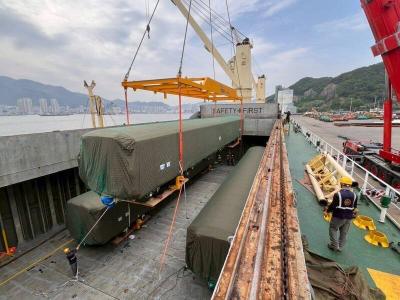
The first of 10 new high-capacity trains purchased from South Korea’s Hyundai Rotem arrived at the Port of Taipei yesterday to meet the demands of an expanding metro network, Taipei Rapid Transit Corp (TRTC) said yesterday. The train completed a three-day, 1,200km voyage from the Port of Masan in South Korea, the company said. Costing NT$590 million (US$18.79 million) each, the new six-carriage trains feature a redesigned interior based on "human-centric" transportation concepts, TRTC said. The design utilizes continuous longitudinal seating to widen the aisles and optimize passenger flow, while also upgrading passenger information displays and driving control systems for a more comfortable
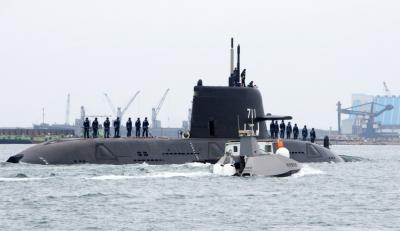
Taiwan's first indigenous defense submarine, the SS-711 Hai Kun (海鯤, or Narwhal), departed for its 13th sea trial at 7am today, marking its seventh submerged test, with delivery to the navy scheduled for July. The outing also marked its first sea deployment since President William Lai (賴清德) boarded the submarine for an inspection on March 19, drawing a crowd of military enthusiasts who gathered to show support. The submarine this morning departed port accompanied by CSBC Corp’s Endeavor Manta (奮進魔鬼魚號) uncrewed surface vessel and a navy M109 assault boat. Amid public interest in key milestones such as torpedo-launching operations and overnight submerged trials,
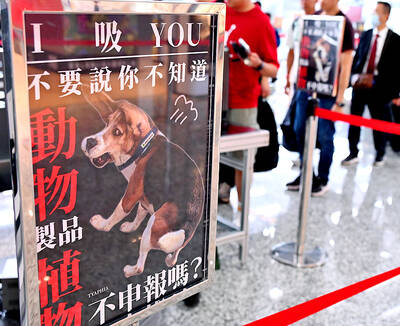
Quarantine awareness posters at Taiwan Taoyuan International Airport have gone viral for their use of wordplay. Issued by the airport branch of the Animal and Plant Health Inspection Agency, the posters feature sniffer dogs making a range of facial expressions, paired with advisory messages built around homophones. “We update the messages for holidays and campaign needs, periodically refreshing materials to attract people’s attention,” quarantine officials said. “The aim is to use the dogs’ appeal to draw focus to quarantine regulations.” A Japanese traveler visiting Taiwan has posted a photo on X of a poster showing a quarantine dog with a

SECURITY RISK: A university student sent a general alarm signal to THSRC’s control center on April 5, causing four operating trains to temporarily halt services The Ministry of Transportation and Communications yesterday pledged to submit a report on ways to harden the communication security of railway systems after a university student hacked into Taiwan High Speed Rail Corp’s (THSRC) radio communications system and disrupted operations of four high-speed rail trains last month. Investigation by the police and prosecutors found that the university student and radio enthusiast, surnamed Lin (林), first used a software-defined radio (SDR) filter to analyze THSRC signals, downloaded the data to a computer, cracked the parameters and then programmed the codes into his radio devices. Lin then sent a general alarm signal to


 RSS
RSS