


The controversial Meinung Reservoir project is “no longer an issue,” Democratic Progressive Party (DPP) Chairperson Tsai Ing-wen (蔡英文) said on Sunday, as she pledged to protect the environment in the predominantly Hakka community.
Tsai made the remarks during a visit to Kaohsiung to attend the Yellow Butterfly Festival in Meinung Township (美濃).
Now in its 20th year, the festival was originally launched amid public opposition to the reservoir project, whose proposed site allegedly lies on the Jhutoushan Fault (竹頭山斷層).
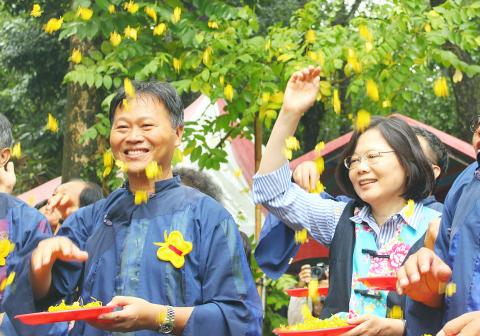
Photo: Chen You-cheng, Taipei Times
The project’s detractors say the proposed reservoir would flood the habitat of the lemon emigrant butterfly (Catopsilia pomona) and a range of animal species native to Meinung.
In a speech, Tsai spoke out against the contentious project.
“After 20 years, I believe that the Meinung Reservoir is no longer an issue,” she said.
She said that without a catchment basin, she would endeavor to overcome the “daunting task” of ensuring a safe water supply in a sustainable manner if she becomes president.
She also praised local environmentalists’ conservation efforts, which she said have resulted in a steady increase in the number of lemon emigrant butterflies in the region.
“It is our shared hope to conserve this area to achieve biodiversity,” Tsai said.
Meinung People’s Association director Arthur Liu (劉孝伸) said the theme of this year’s event was pursuing eco-friendly and sustainable development in the spirit of the Satoyama Initiative.
This can be achieved by refraining from using pesticides and herbicides and practicing sustainable fishing methods to achieve biodiversity.
He said that over recent years, the number of lemon emigrant butterflies has risen significantly in Meinung and the nearby Liouguei District (六龜).
He said that after rain, thousands of butterflies cover the sky of the Yellow Butterfly Jade Valley in Meinung, which attracts visitors from across the nation to witness the spectacle.
The event also features a ritual to worship the Bogong (伯公), Hakka deities that watch over the mountains and wildlife, as well as the spirits of wild animals slaughtered by humans.
The ritual is held to repent for human wrongs and to pray for stability and abundance in residents’ lives, Liu said.
Performing art groups Assignment Theater and Dada Idea also graced the event with their shows, which featured plots based on historical events in Meinung, including protests against the reservoir project.
Liu said the serious air pollution in Kaohsiung related to the amount of water consumed by manufacturing plants, because if they were to consume more water than they currently use, their production capacity would also increase, resulting in even more air pollution.
In response to comments by Kaohsiung Mayor Chen Chu (陳菊), who said she would seek to “overturn” the business structure of the municipality for environmental conservation, Liu called on Chen to put forth a roadmap for the plan.

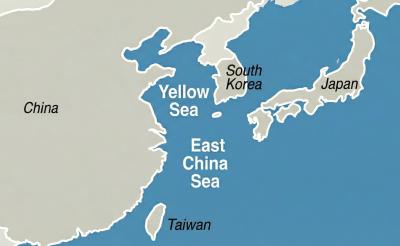
China has reserved offshore airspace in the Yellow Sea and East China Sea from March 27 to May 6, issuing alerts usually used to warn of military exercises, although no such exercises have been announced, the Wall Street Journal (WSJ) reported yesterday. Reserving such a large area for 40 days without explanation is an “unusual step,” as military exercises normally only last a few days, the paper said. These alerts, known as Notice to Air Missions (Notams), “are intended to inform pilots and aviation authorities of temporary airspace hazards or restrictions,” the article said. The airspace reserved in the alert is

NAMING SPAT: The foreign ministry called on Denmark to propose an acceptable solution to the erroneous nationality used for Taiwanese on residence permits Taiwan has revoked some privileges for Danish diplomatic staff over a Danish permit that lists “Taiwan” as “China,” Eric Huang (黃鈞耀), head of the Ministry of Foreign Affairs’ Department of European Affairs, told a news conference in Taipei yesterday. Reporters asked Huang whether the Danish government had responded to the ministry’s request that it correct the nationality on Danish residence permits of Taiwanese, which has been listed as “China” since 2024. Taiwan’s representative office in Denmark continues to communicate with the Danish government, and the ministry has revoked some privileges previously granted to Danish representatives in Taiwan and would continue to review

More than 6,000 Taiwanese students have participated in exchange programs in China over the past two years, despite the Mainland Affairs Council’s (MAC) “orange light” travel advisory, government records showed. The MAC’s publicly available registry showed that Taiwanese college and university students who went on exchange programs across the Strait numbered 3,592 and 2,966 people respectively. The National Immigration Agency data revealed that 2,296 and 2,551 Chinese students visited Taiwan for study in the same two years. A review of the Web sites of publicly-run universities and colleges showed that Taiwanese higher education institutions continued to recruit students for Chinese educational programs without
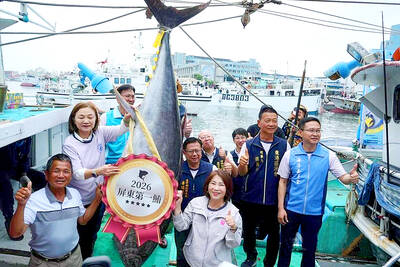
The first bluefin tuna of the season, brought to shore in Pingtung County and weighing 190kg, was yesterday auctioned for NT$10,600 (US$333.5) per kilogram, setting a record high for the local market. The auction was held at the fish market in Donggang Fishing Harbor, where the Siaoliouciou Island-registered fishing vessel Fu Yu Ching No. 2 delivered the “Pingtung First Tuna” it had caught for bidding. Bidding was intense, and the tuna was ultimately jointly purchased by a local restaurant and a local company for NT$10,600 per kilogram — NT$300 ,more than last year — for a total of NT$2.014 million. The 67-year-old skipper


 RSS
RSS