


Chinese Nationalist Party (KMT) presidential nominee Hung Hsiu-chu (洪秀柱) yesterday said former vice president Lien Chan (連戰) approves of her cross-strait policy, which calls for a peace agreement with China, adding that a new Chinese law shows the need for cross-strait talks.
In a news conference after meeting with Lien, Hung said he “greatly appreciates” her cross-strait proposal, adding that Lien mentioned his meeting with former Chinese president Hu Jintao (胡錦濤) in 2005, at which a peace agreement was discussed.
“[Lien] called on KMT members to respect the spirit the party was established under, which are to uphold party solidarity and act as one in any predicament,” Hung said.
Some KMT legislators have expressed disapproval over the party’s recent dealings, as well as Hung.
“He said it is normal to have different opinions in a democracy and advised me to table policies that will benefit both the nation and the public, and to go to the public more frequently,” Hung said.
She said that Beijing’s new national security law — which stipulates that people in Taiwan, Hong Kong and Macau have the same responsibility as all Chinese to “safeguard China’s sovereignty and territorial integrity” — shows how important it is that the political dialogue she has called for between the two sides happens.
“We hope that [Beijing] recognizes that between [the two sides] there should be equality and dignity. Without political talks and a peace agreement, [Beijing] deems the cross-strait relationship as one categorized by a superior-subordinate relationship, placing the nation alongside Hong Kong and Macau,” Hung said.
“Could we accept that?” she asked.
“The signing of a peace agreement would demand that [China] face squarely the existence of the Republic of China [ROC] and to ensure Taiwan’s future,” she said, adding: “Would you say that our [cross-strait] argument is mistaken, especially after witnessing [China’s] adoption of the security law?”
“How could we be placed alongside Hong Kong and Macau? If we want to voice our demands in a circumstance as difficult as this — and to promote peaceful cross-strait developments — political talks are absolutely needed,” Hung said.
Asked if she would protest against China’s new law, Hung said she has done so in a statement that asks Beijing “not to hurt the feelings of Taiwanese.”
The statement — which her campaign office released late on Wednesday — said that as the People’s Republic of China and ROC’s constitutions both specify “the obligation of not pursuing the separation of sovereignty and territory,” China’s promulgation of Article 11 of its national security law is “a political statement unilaterally announced.”
“According to the ROC Constitution, as the two sides of the Taiwan Strait are now separately governed, the mainland’s national security law is not legally binding for the [ROC] government and its people,” it said.
“If China’s national security law overreaches the mainland’s remit of governance, it would not only face difficulties of execution, but also incite unnecessary disputes or even endanger peaceful cross-strait development,” Hung said in the statement.
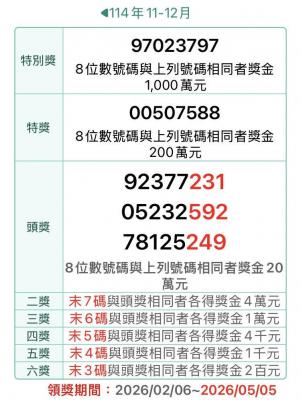
Seven of the 17 NT$10 million (US$311,604) winning receipts from the November-December uniform invoice lottery remain unclaimed as of today, the Ministry of Finance said, urging winners to redeem their prizes by May 5. The reminder comes ahead of the release of the winning numbers for the January-February lottery tomorrow. Among the unclaimed receipts was one for a NT$173 phone bill in Keelung, while others were for a NT$5,913 purchase at Costco in Taipei's Neihu District (內湖), a NT$49 purchase at a FamilyMart in New Taipei City's Tamsui District (淡水), and a NT$500 purchase at a tea shop in New Taipei City's
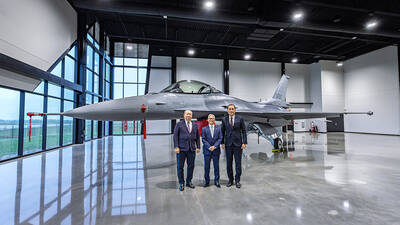
Taiwanese officials were shown the first of 66 F-16V fighter jets purchased by Taiwan from the United States, the Ministry of National Defense said yesterday, adding the aircraft has completed an initial flight test and is expected to be delivered later this year. A delegation led by Deputy Minister of National Defense Hsu Szu-chien (徐斯儉) visited Lockheed Martin’s F-16 C/D Block 70 (also known as F-16V) assembly line in South Carolina on March 16 to view the aircraft. The jet will undergo a final acceptance flight in the US before being delivered to Taiwan, the
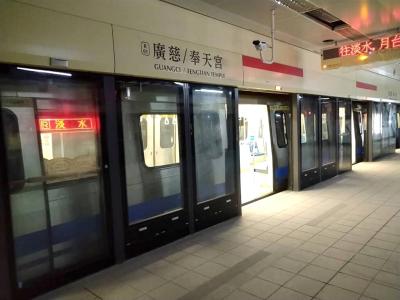
The New Taipei Metro's Sanyin Line and the eastern extension of the Taipei Metro's Tamsui-Xinyi Line (Red Line) are scheduled to begin operations in June, the National Development Council said today. The Red Line, which terminates at Xiangshan Station, would be connected by the 1.4km extension to a new eastern terminal, Guangci/Fengtian Temple Station, while the Sanyin Line would link New Taipei City's Tucheng and Yingge stations via Sanxia District (三峽). The council gave the updates at a council meeting reviewing progress on public construction projects for this year. Taiwan's annual public infrastructure budget would remain at NT$800 billion (US$25.08 billion), with NT$97.3
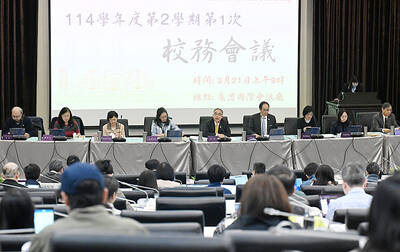
TALENT SCOUTING: The university is investing substantial funds in its future to bring in the kind of researchers that would keep the college internationally competitive National Taiwan University (NTU) plans to invest NT$2 billion (US$62.6 million) to launch two programs aimed at attracting and retaining top research talent, university president Chen Wen-chang (陳文章) said yesterday. The funding would support the “Palm Grove Scholars Project,” which targets academics aged 40 to 55. Up to 20 scholars would be selected, each receiving as much as NT$10 million annually, Chen said. The initiative is designed to attract leading researchers to Taiwan and strengthen NTU’s global competitiveness by fostering a more research-friendly environment and expanding international collaboration, he said. NTU is also introducing a “Hong Hu” chair grant, which would provide Palm


 RSS
RSS