


Sixteen students have been racing through the halls of the US Congress over the past two weeks lobbying politicians to improve Taiwan-US relations.
They were members of the “Ambassador Program” organized by the Formosa Foundation to encourage Capitol Hill to improve trade relations, arms sales, military cooperation and Taiwan’s meaningful participation in international organizations.
This was the program’s 13th annual “Congressional boot camp,” which was designed to help the students develop grassroots advocacy and campaign skills.
During the whirlwind sessions, the students met with a total of 119 members of Congress.
While almost all of the students were from Taiwan or the US, this year’s class included one student from China currently studying in the US.
“With on-the-ground activist work and training with think tanks and experts, the ambassadors garner a strong knowledge base on Taiwan-US relations and gain an insider’s perspective on how Congress works,” program director Yeh Chieh-ting (葉介庭) said.
US House Foreign Affairs Committee Asia Subcommittee chairman Representative Matt Salmon talked with the students about the US’ “one China” policy and about his current efforts to win Interpol membership for the nation.
Others who talked with the students included US-Taiwan Business Council president Rupert Hammond-Chambers, Washington-based Liberty Times correspondent Nadia Tsao (曹郁芬), American Institute in Taiwan (AIT) managing director Joseph Donovan and Project 2049 executive director Mark Stokes.
Human Rights Watch China director Sophie Richardson, the National Interest executive editor Harry Kazianis and Freedom House vice president of analysis Vanessa Tucker also addressed the ambassadors.
Others who spoke to the group included RAND Corp policy analyst Joanna Yu Taylor, University of Miami professor June Dreyer, author Gordon Chang (章家敦), Brookings Institution scholar Richard Bush, Foreign Policy Initiative executive director Christopher Griffin and Formosan Association for Public Affairs president Mark Kao (高龍榮).
Since its launch in 2003, more than 300 students have graduated the Ambassador Program, collectively holding more than 1,700 meetings with members of Congress.
The program is financed entirely from individual and private contributions.

REASONS FOR TRAVEL: An assistant professor said that proposed amendments to penalize drivers if they used drugs overseas would not deter people from traveling People who operate a motor vehicle under the influence of marijuana would have their driver’s license revoked, even if they used the substance while overseas, the Ministry of Transportation and Communications said yesterday, citing proposed amendments to the Road Traffic Management and Penalty Act (道路交通管理處罰條例). The amendments would also authorize the government to revoke the licenses of people determined to have used Category 1 or Category 2 narcotics, even if they were not operating a vehicle while under the influence of drugs, as well as ban them from taking the license test for three years, the ministry said. People aged 18 or
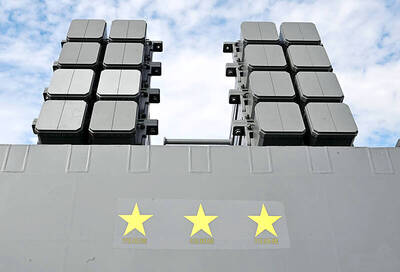
UPGRADE: The Kang Ding-class frigate is replacing its Chaparall missiles with Tien Chien II and Hua Yang VLS, which would provide it with long-range, 360° air defense Taiwan plans to produce 1,200 to 1,376 Hai Chien II missiles (海劍二, Sea Sword II) — also known as TC-2N — to serve as the standard air defense system of the navy’s surface combatant fleet, a source said yesterday. Last week, the Hai Chien II, the naval version of the Tien Kung II missile (天劍二, Sky Sword II), completed a live-fire test in waters off the National Chungshan Institute of Science and Technology’s Jiupeng facility (九鵬) in Pingtung County’s Manjhou Township (滿州). The MIM72 Chaparral and other dated air defense missiles that currently arm Taiwanese ships have inadequate range to combat Chinese

GLOBALGIVING: ‘ Caving to external pressure is not acceptable for an organization that has cultivated justice reform and human rights for 30 years,’ one NGO said A slew of non-government organizations (NGOs) have withdrawn from the GlobalGiving fundraising platform after it announced it would use “Chinese Taipei” instead of “Taiwan” from next month. The Taiwan Good Rice Association wrote on Facebook on Friday that it was informed on April 28 via a teleconference call of the change, which was made because the platform wanted to operate in China. Taiwan Good Rice is to terminate all cooperative relationships with GlobalGiving in response to the platform’s “unilateral and non-negotiable” decision to remove references to Taiwan, the NGO said. “Taiwan is in the official name of Taiwan Good Rice Association and the

HEAVY WEATHER: Typhoon Jangmi is due to crash straight into the Ryukyus as airlines look to shift flights to larger aircraft or cancel flights to Okinawa entirely Taiwan’s international air carriers announced flight adjustments over the weekend as Typhoon Jangmi is forecast to hit the Ryukyu Islands today and tomorrow. The Central Weather Administration (CWA) upgraded Jangmi from a tropical storm to a typhoon at 8am yesterday, with the eye located 580km south of Naha city. It was moving north at 19kph. Today, China Airlines’ CI-120, CI-121, CI-122 and CI-123 flights between Taoyuan and Naha, Okinawa, have been canceled as well as CI-132 and CI-133 between Kaohsiung and Naha. EVA Air’s BR-112, BR-113, BR-186 and BR-185 flights between Taoyuan and Naha are also canceled. Low-cost carrier Tigerair Taiwan canceled IT-230,


 RSS
RSS