


Local history and culture experts in New Taipei City’s Sansia District (三峽) called on the Chingshui Zushi Temple to make sure temple visitors do not damage the site’s architecture.
An expert who wishes to remain anonymous said tourists and visitors are forcing coins into the mouths of wooden lions and damaging the sculptures.
The expert said the visitors wished to pray for good luck, but that their actions were selfish.
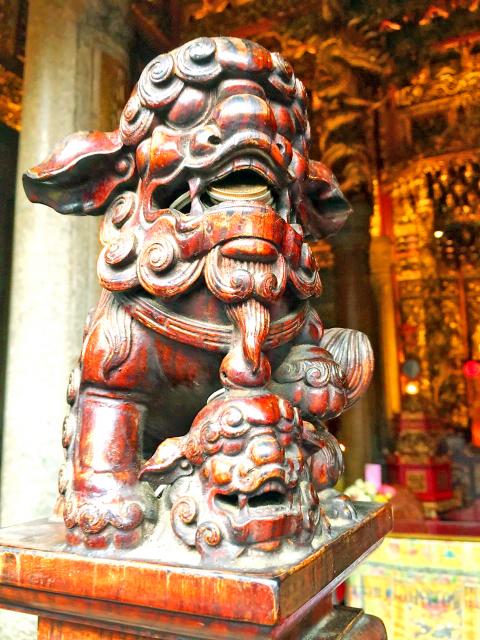
Photo: Chang an-chiao, Taipei Times
The expert said he asks visitors not to put coins in the sculptures’ mouths whenever he sees them doing so, adding that temple staff should do more to protect the sculptures.
Forcing coins into the artworks not only scratches the wood, but could also eventually break the sculpture, the expert said.
Former temple director-general Cheng You-tsai (鄭有才) said the 14 wooden lions at the site were the work of Chen Cheng-hsiung (陳正熊), adding that the sculptures are part of the temple’s columns.
Cheng said that Chen had used Makassar ebony imported from Indonesia that had been soaked in water for a year before completing the sculptures.
It was not a two-part casting process, like most modern sculptures are, Cheng added.
Such work is priceless and rare, and more than just part of the temple, Cheng said.
One of the temple’s faithful, surnamed Chang (張), said that most people who leave coins in the lions’ mouths are not aware of the value of the sculptures and believe the practice is a tradition of the temple, as other visitors leave coins as well.
The temple is filled with cultural treasures and works of art, Chang said, adding that visitors of all religious and non-religious backgrounds should be respectful when they enter.
Temple general affairs division head Liu Chin-ta (劉金達) said that the temple did not house any deities related to wealth, but many visitors leave coins in the lions’ mouths in hopes that the monk god Chingshui Zushi will answer their prayers.
Liu said that the lions were not the only items to suffer damage and that coins have also been found on some of the sculpted decorations on the railings, adding that children have been responsible for other damage.
Temple staff said that although they try to prevent such incidents, too many regulations could anger believers.

The Centers for Disease Control (CDC) yesterday reported the first case of a new COVID-19 subvariant — BA.3.2 — in a 10-year-old Singaporean girl who had a fever upon arrival in Taiwan and tested positive for the disease. The girl left Taiwan on March 20 and the case did not have a direct impact on the local community, it said. The WHO added the BA.3.2 strain to its list of Variants Under Monitoring in December last year, but this was the first imported case of the COVID-19 variant in Taiwan, CDC Deputy Director-General Lin Ming-cheng (林明誠) said. The girl arrived in Taiwan on

South Korea is planning to revise its controversial electronic arrival card, a step Taiwanese officials said prompted them to hold off on planned retaliatory measures, a South Korean media report said yesterday. A Yonhap News Agency report said that the South Korean Ministry of Foreign Affairs is planning to remove the “previous departure place” and “next destination” fields from its e-arrival card system. The plan, reached after interagency consultations, is under review and aims to simplify entry procedures and align the electronic form with the paper version, a South Korean ministry official said. The fields — which appeared only on the electronic form

A bipartisan group of US senators has introduced a bill to enhance cooperation with Taiwan on drone development and to reduce reliance on supply chains linked to China. The proposed Blue Skies for Taiwan Act of 2026 was introduced by Republican US senators Ted Cruz and John Curtis, and Democratic US senators Jeff Merkley and Andy Kim. The legislation seeks to ease constraints on Taiwan-US cooperation in uncrewed aerial systems (UAS), including dependence on China-sourced components, limited access to capital and regulatory barriers under US export controls, a news release issued by Cruz on Wednesday said. The bill would establish a "Blue UAS

The Ministry of Foreign Affairs (MOFA) is suspending retaliation measures against South Korea that were set to take effect tomorrow, after Seoul said it is updating its e-arrival system, MOFA said today. The measures were to be a new round of retaliation after Taiwan on March 1 changed South Korea's designation on government-issued alien resident certificates held by South Korean nationals to "South Korea” from the "Republic of Korea," the country’s official name. The move came after months of protests to Seoul over its listing of Taiwan as "China (Taiwan)" in dropdown menus on its new online immigration entry system. MOFA last week


 RSS
RSS