


The Control Yuan yesterday released its review of the political donations received by mayoral candidates in the six special municipalities in the elections in November last year, and Taipei Mayor Ko Wen-je (柯文哲) received the most donations — NT$139.8 million (US$4.52 million), beating his Chinese Nationalist Party (KMT) rival Sean Lien (連勝文) by NT$30 million.
The Control Yuan report showed that independent Ko received more than NT$115 million from members of the public, NT$14 million from anonymous donors and NT$8.6 million from private companies.
Lien received about NT$112 million in donations, of which NT$58.8 million came from the private sector, NT$25 million from political parties and NT$27.9 million from the public, the report showed.
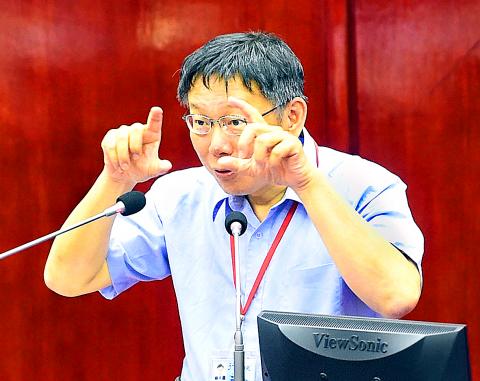
Photo: Fang Pin-chao, Taipei Times
According to accounts submitted by his campaign office, Ko spent most of his money on advertising, about NT$64.9 million, followed by NT$33.3 million in salary payments to campaign staff.
The physician-turned-politician returned NT$350,000 to donors and ran a deficit of about NT$2.5 million, the report showed.
Lien also spent most of his donations on advertising, almost NT$104 million, paid his staff about NT$17.49 million and ran a deficit of about NT$31.7 million, the report showed.
Ko and Lien declared overall campaign spending of about NT$140 million, the statistics showed.
DPP Taipei City Councilor Hsu Shu-hua (許淑華) asked Ko for his thoughts about Lien’s reported campaign figures during yesterday’s meeting of the Taipei City Council.
Ko burst into laughter and said “impossible.”
Data showing Lien spending the same amount of money he did was “against common sense,” Ko said.
Democratic Progressive Party (DPP) Taichung mayoral candidate Lin Chia-lung (林佳龍) — who won the election — and then-Taichung mayor Jason Hu (胡志強), a KMT member, both attracted more donations than Lien, NT$127 million and NT$126 million respectively, the report showed.
Figures from the Control Yuan report showed that of all the candidates for the six mayorships, only Tainan Mayor William Lai (賴清德) of the DPP recorded a surplus in his campaign finances.
Lai raised NT$20 million, but only spent NT$9.1 million.
Taoyuan Mayor Cheng Wen-tsan (鄭文燦) of the DPP ran the biggest deficit, NT$36.07 million, according to the Control Yuan report.
Cheng’s opponent, John Wu (吳志揚) of the KMT, received donations totaling NT$64.7 million and spent NT$64.9 million, the report showed.

The Centers for Disease Control (CDC) yesterday reported the first case of a new COVID-19 subvariant — BA.3.2 — in a 10-year-old Singaporean girl who had a fever upon arrival in Taiwan and tested positive for the disease. The girl left Taiwan on March 20 and the case did not have a direct impact on the local community, it said. The WHO added the BA.3.2 strain to its list of Variants Under Monitoring in December last year, but this was the first imported case of the COVID-19 variant in Taiwan, CDC Deputy Director-General Lin Ming-cheng (林明誠) said. The girl arrived in Taiwan on

South Korea is planning to revise its controversial electronic arrival card, a step Taiwanese officials said prompted them to hold off on planned retaliatory measures, a South Korean media report said yesterday. A Yonhap News Agency report said that the South Korean Ministry of Foreign Affairs is planning to remove the “previous departure place” and “next destination” fields from its e-arrival card system. The plan, reached after interagency consultations, is under review and aims to simplify entry procedures and align the electronic form with the paper version, a South Korean ministry official said. The fields — which appeared only on the electronic form

The Ministry of Foreign Affairs (MOFA) is suspending retaliation measures against South Korea that were set to take effect tomorrow, after Seoul said it is updating its e-arrival system, MOFA said today. The measures were to be a new round of retaliation after Taiwan on March 1 changed South Korea's designation on government-issued alien resident certificates held by South Korean nationals to "South Korea” from the "Republic of Korea," the country’s official name. The move came after months of protests to Seoul over its listing of Taiwan as "China (Taiwan)" in dropdown menus on its new online immigration entry system. MOFA last week
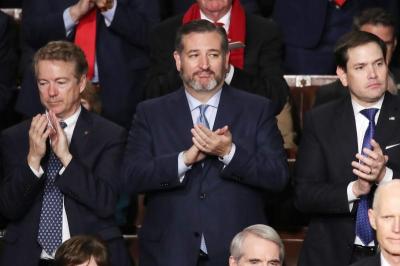
A bipartisan group of US senators has introduced a bill to enhance cooperation with Taiwan on drone development and to reduce reliance on supply chains linked to China. The proposed Blue Skies for Taiwan Act of 2026 was introduced by Republican US senators Ted Cruz and John Curtis, and Democratic US senators Jeff Merkley and Andy Kim. The legislation seeks to ease constraints on Taiwan-US cooperation in uncrewed aerial systems (UAS), including dependence on China-sourced components, limited access to capital and regulatory barriers under US export controls, a news release issued by Cruz on Wednesday said. The bill would establish a "Blue UAS


 RSS
RSS