

Veteran political activist Shih Ming-te (施明德), who announced his presidential bid last week, yesterday launched a signature-collection app developed by his campaign team. While the legality of online signature collection might be challenged, as it has not been approved by the Central Election Committee, Shih said the move is not prohibited and is legal.
Shih would need at least 300,000 signatures to qualify as an independent presidential candidate. He launched his signature campaign yesterday, saying he would sue the committee if it raises questions to impede his effort.
Emphasizing that a legal expert said the collection campaign is workable, Shih said the committee had deliberately picked on young people who sought signatures to recall legislators, but he would not let the committee off the hook if it tries to block his campaign.
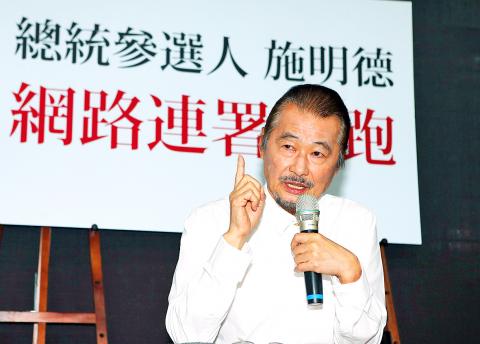
Photo: CNA
Chen Chia-chun (陳嘉君), Shih’s wife, said online collection is not prohibited by presidential election regulations and is therefore legal.
Committee Deputy Chairman Chen Wen-sheng (陳文生) said signature collection for independent presidential candidates must employ an official committee form displaying the names of the intended presidential and vice presidential candidates.
Also, signature collection must be on paper, the only medium in which signatures could be verified, Chen Wen-sheng added.
Whether online signature collection could be valid would be referred to a committee meeting for adjudication, he said.
However, a second committee official said Shih’s campaign would probably run afoul of committee regulations.
Chen Wen-sheng did not respond to Shih’s claims about potential legal action against the committee, saying that the agency would handle the issue in accordance with the law, while emphasizing that the collection form must carry the names of both the intended presidential and vice presidential candidates.
Appendectomy Project spokesperson Lin Zu-yi (林祖儀), also known as “Mr Lin from Taipei (台北林先生), said he supports online signature collection and accused the committee of deliberately burdening his advocacy group with restrictions at the height of its campaign to recall Chinese Nationalist Party (KMT) Legislator Alex Tsai (蔡正元).
Lin said the project was obligated to proceed with paper signature forms, but the method was highly inefficient as well as socially taxing.
The Appendectomy Project team would push for amendments to the Civil Servants Election And Recall Act (公職人員選舉罷免法) to “electronize” signature collection and recall procedures, he said.
In line with that stance, he would support online signature collection in the presidential election, Lin said, adding however that this does not entail his support for any particular presidential candidate.

A total of 400 foreign “high- level” professionals have been naturalized as Republic of China (Taiwan) citizens over the past decade as the government has eased nationality rules to attract talent from a wider range of fields, the Ministry of the Interior said yesterday. The 400th high-level professional, who works in the electronics industry, was approved for ROC citizenship on Aug. 26, the MOI said. The MOI quoted the newly naturalized citizen as saying that Taiwan is a leader in fields such as semiconductors, electronics manufacturing, artificial intelligence development and energy technology. He also said

OCT. 31: The antiviral drugs Tamiflu and Eraflu have been distributed to about 4,000 medical facilities nationwide for people in seven groups who develop flu-like symptoms As the domestic influenza epidemic enters its peak season and continues to escalate, the Centers for Disease Control (CDC) yesterday announced that publicly funded influenza antiviral drugs for seven eligible groups have been extended to Oct. 31, allowing those who develop flu-like symptoms to receive the medication without undergoing a rapid influenza test. The CDC has extended the expanded use of flu antiviral drugs to seven groups: healthcare and influenza-prevention personnel; residents and staff at nursing homes, long-term care facilities and similar institutions; kindergarten and daycare workers and home-based caregivers; students from kindergarten through high school, vocational high school and the
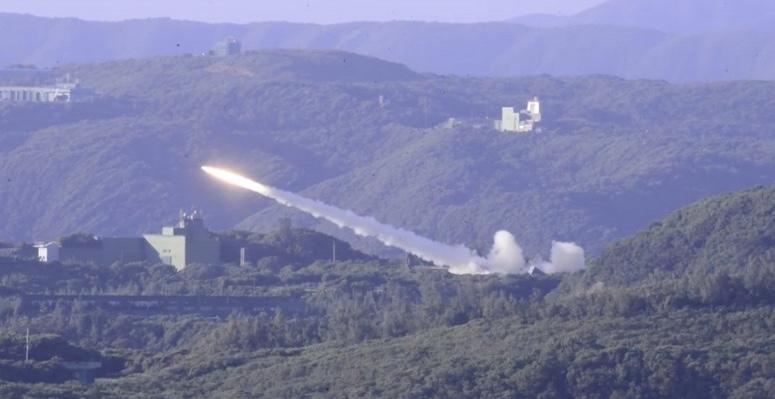
A Chinese military drone was spotted conducting reconnaissance off Taitung County as President William Lai (賴清德) visited Pingtung County this morning to inspect a drill of the armed forces’ precision-strike capabilities, prompting the military to closely monitor its actions. Today was the final day of a three-day military exercise at Jioupeng Base (九鵬基地) to test the joint combat capabilities of the armed forces and coast guard. The exercise began on Wednesday simulating air defense interception and yesterday tested long-range strike capabilities and new air defense weapons. This morning, the military conducted a final exercise involving air defense, anti-ship and drone operations. Military sources said
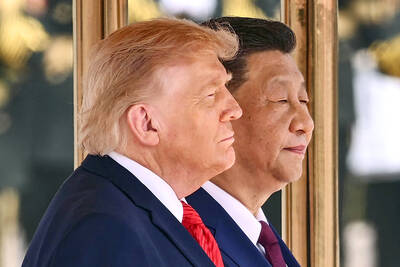
China has warned that it could cancel a planned US-China leaders’ summit if Washington approves new arms sales to Taiwan, a Japanese media outlet quoted sources as saying yesterday. US President Donald Trump, “apparently eager to showcase some diplomatic achievements ahead of November’s midterm congressional elections, places great importance on holding the summit with Chinese President Xi Jinping (習近平),” Japan’s Kyodo News reported. “While preparing for Xi’s upcoming trip, China has restated its position that the Taiwan issue is a ‘red line’ in bilateral relations,” the report said. The report said that when Xi met with Trump in Beijing in May, Xi said


 RSS
RSS