


More than 1,000 Taichung residents yesterday protested against a move by the Taichung City Government to allow Taiwan Semiconductor Manufacturing Co (TSMC) to relocate more than 150,000 trees on Dadu Mountain (大肚山) for the firm’s 18-inch wafer foundry in the Central Taiwan Science Park.
Braving the rain, the demonstrators called on the city government to block the tree relocation plan, saying that most trees relocated in the past to accommodate large construction projects have died.
They said that the move would impede carbon dioxide reduction and intensify global warming, adding that the move posed risks to the local ecology.
The Environmental Protection Administration (EPA) in March approved TSMC’s expansion plan, saying that forests on the expansion site were largely “artificial forests” and that relocating them would not threaten the ecology.
Under the EPA resolution, TSMC could relocate trees to carry out the expansion, as long as it replants them on the slope.
Taiwan Academy for Ecology secretary-general Tsai Chih-hao (蔡智豪) said the expansion would add an estimated 4.4 million tonnes of carbon dioxide emissions to Taichung’s annual emissions of 44.2 million tonnes.
The city’s emissions would then constitute about a thousandth of global emissions, Tsai said.
He said that carbon reduction is an immediate necessity, but that the city government has announced a reduction goal to limit only carbon dioxide generated by households and the tertiary sector, while ignoring carbon dioxide produced by industry.
Under the city’s reduction goal, which came into effect in 2012, Taichung residents would be able to cut carbon dioxide emissions by an estimated 3.23 million tonnes by 2020, he said.
The TSMC plan would cripple efforts to cut emissions, and result in increased emissions, he said.
Citing Taiwan Academy of Ecology research, Tsai said the estimate of 150,000 trees — a calculation by the Taiwan Tree Protection Union — understates the environmental impact the plant expansion is expected to cause.
The actual number of trees expected to be affected would be closer to 1.21 million, if tree buds and smaller trees are taken into account, he said.
He responded to the EPA’s claim that replanting large numbers of trees would not have an ecological impact, by saying that findings in decade-long research by his organization on the flora and fauna on Dadu Mountain suggest otherwise.
He urged Taichung Mayor Lin Chia-lung (林佳龍) to resist policies that promote pollution-intensive developments and to instead focus on Taichung’s cultural importance and tourism.
TSMC said that, based on the chipmaker’s calculations, there are 20,000 trees, including saplings, in the 53-hectare newly developed industrial area, rather than 150,000 as reported.
Of the 20,000 trees, TSMC plans to relocate about 5,400 and plant 3,800 new trees there. That would help boost carbon sequestration in the area by 10 percent, it said.
In addition to TSMC, the nation’s biggest bicycle maker, Giant Manufacturing Co, also plans to build a new factory there.
Additional reporting by Lisa Wang

The Ministry of Finance this afternoon announced the winning numbers for the March-April uniform invoice lottery. The winning number for the NT$10 million (US$318,060) special prize is 19531471, and the winning number for the NT$2 million grand prize is 85941329. Three numbers were drawn for the NT$200,000 first prize: 07225810, 20231230 and 83518781. Those with receipts matching the last seven digits of any of the first-prize numbers will win the NT$40,000 second prize, while those matching the last six digits will win the NT$10,000 third prize. Those whose receipts match the last five digits of the first-prize numbers can claim the NT$4,000 fourth prize,
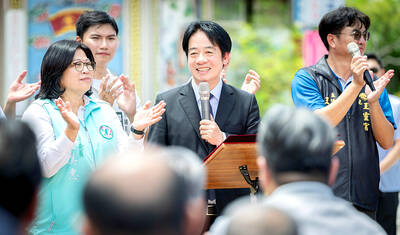
SIX SUBSIDIES: The monthly allowance for older farmers is to increase to NT$10,000, and NT$5,000 is to be given to homemakers under the national pension system, Lai said The government is to implement major welfare policies for disadvantaged groups, including raising the monthly allowance for older farmers to NT$10,000 and providing homemakers with NT$5,000 per month, President William Lai (賴清德) said yesterday. Lai made the remarks during a visit to Wangling Temple in Chiayi County, saying that the planned increases were being introduced amid economic growth and an increase in tax revenue. Touting a policy, in which the government plans to provide a monthly allowance of NT$5,000 for every child under the age of 18 in a bid to address Taiwan’s low birthrate, Lai said that if received for the
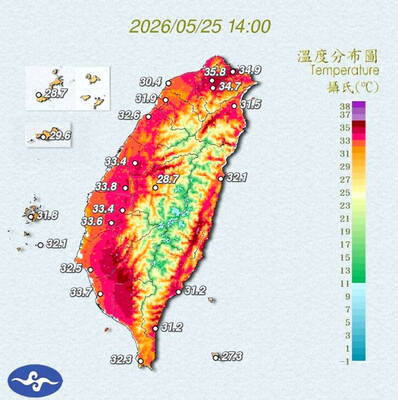
STAY COOL: The HPA recommended that people stay hydrated, use air-conditioning or fans while indoors, wear loose-fitting clothes and walk in the shade while outdoors Employers must implement measures such as installing cooling equipment, and providing drinking water and rest breaks for outdoor workers starting from Monday next week, the Taipei Department of Labor said on Sunday. Employers who fail to comply could face fines of NT$30,000 to NT$300,000 under the Occupational Safety and Health Act (職業安全衛生法), the department said. Businesses in Taipei employing fewer than 100 workers, as well as registered self-employed workers with labor insurance coverage, could receive on-site assessments and guidance from occupational safety consultants to help them apply for central government subsidies to implement or improve heat-protection measures, it said. Under the Ministry of

NATIONAL SECURITY: Authorities are working to confirm the identities of the military personnel involved and investigating possible illegal conduct and regulatory violations Authorities are probing possible national security implications after Kinmen police and immigration officers on Sunday found a Chinese woman allegedly posing as a tourist while engaging in prostitution involving more than 10 military personnel. The woman, surnamed Chen (陳), has since been deported, authorities said, adding that investigators are still working to confirm the identities of those implicated, as the records only listed code names and aliases. The case stemmed from a report received by the Kinmen District Prosecutors’ Office on Friday last week from the Jinhu Precinct of the Kinmen County Police Bureau. On Sunday, police, along with the National Immigration


 RSS
RSS