


Green Party Taiwan and the Economic Democracy Union yesterday voiced objections to Taiwan joining the Beijing-led Asian Infrastructure Investment Bank (AIIB), a topic expected to be covered at a meeting between Mainland Affairs Council Minister Andrew Hsia (夏立言) and China’s Taiwan Affairs Office Minister Zhang Zhijun (張志軍) today in Kinmen County.
Green Party Taiwan co-convener Lee Ken-cheng (李根政) told a press conference in Taipei that the party is against the nation’s bid to become a member of the AIIB if the application process is opaque or subordinates Taiwan’s sovereignty.
Lee said that the Ministry of Finance’s submission of an application in late March to become a founding member of the bank had fueled controversy in Taiwan, with critics saying the authorities had failed to follow proper procedures and had compromised the nation’s sovereignty.
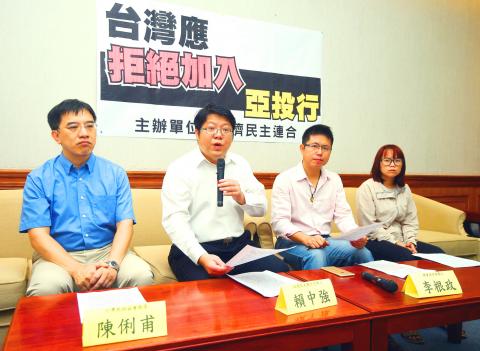
Photo: Wang Min-wei, Taipei Times
Beijing rejected Taiwan’s application, saying it would only grant Taiwan a seat on the AIIB’s board of founding members if the nation agrees to its “one China” policy.
Lee said that the AIIB is China’s strategy to boost its global influence by lending capital to developing countries for basic infrastructure and to appeal to European countries that are struggling financially.
In doing so, China would have an outlet for its surplus cash and undermine the US dollar, Lee said, adding that he doubted developing countries’ opinions would weigh much in the AIIB.
Economic Democracy Union convener Lai Chung-chiang (賴中強) said that Taiwan should not be part of an organization aimed at boosting Chinese political and economic influence.
China also has an atrocious track record of damaging the environment and ignoring human rights while building its own infrastructure, he said.
As China claims Taiwan as its territory, Taiwan should not pander to the strategic development goals of a country that harbors such aggression, Lai said.
President Ma Ying-jeou’s (馬英九) administration should not misappropriate the nation’s reserve funds or other money to invest in the AIIB, Lai said, adding that the union would lobby legislators to block proposals for the organization.
In related news, Democratic Progressive Party Legislator Tuan Yi-kang (段宜康) on Thursday posted on Facebook a screenshot of records of a conversation on the Line app, which he said shows that the government is mobilizing people to welcome Zhang’s visit to Kinmen.
“We are looking for some people to give him a warm welcome. The wage for one-and-a-half days from 1pm to 6pm on May 23 and 8am to 6pm on May 24 is NT$1,500. Everyone can get a T-shirt, a lunch box and drinks. Transportation is also available,” the message read.
The sender of the message said the job is to form a crowd around activities that Zhang would participate in when he is in Kinmen, including meetings with Hsia, Kinmen County Commissioner Chen Fu-hai (陳福海) and local business leaders, as well as visits to a reservoir and some local manufacturers.
“Some people are organizing a cheering squad to flatter Zhang,” Tuan said. “Is this sort of pomp and circumstance necessary to welcome Chinese officials?
“If they really think that they are warmly welcomed, they might misjudge the situation and have some misconceptions,” he said.
The Mainland Affairs Council did not comment on the allegations.
Additional reporting by Shih Hsiu-chuan, Tseng Wei-chen and Peng Hsien-chun

The Centers for Disease Control (CDC) yesterday reported the first case of a new COVID-19 subvariant — BA.3.2 — in a 10-year-old Singaporean girl who had a fever upon arrival in Taiwan and tested positive for the disease. The girl left Taiwan on March 20 and the case did not have a direct impact on the local community, it said. The WHO added the BA.3.2 strain to its list of Variants Under Monitoring in December last year, but this was the first imported case of the COVID-19 variant in Taiwan, CDC Deputy Director-General Lin Ming-cheng (林明誠) said. The girl arrived in Taiwan on

South Korea is planning to revise its controversial electronic arrival card, a step Taiwanese officials said prompted them to hold off on planned retaliatory measures, a South Korean media report said yesterday. A Yonhap News Agency report said that the South Korean Ministry of Foreign Affairs is planning to remove the “previous departure place” and “next destination” fields from its e-arrival card system. The plan, reached after interagency consultations, is under review and aims to simplify entry procedures and align the electronic form with the paper version, a South Korean ministry official said. The fields — which appeared only on the electronic form

The Ministry of Foreign Affairs (MOFA) is suspending retaliation measures against South Korea that were set to take effect tomorrow, after Seoul said it is updating its e-arrival system, MOFA said today. The measures were to be a new round of retaliation after Taiwan on March 1 changed South Korea's designation on government-issued alien resident certificates held by South Korean nationals to "South Korea” from the "Republic of Korea," the country’s official name. The move came after months of protests to Seoul over its listing of Taiwan as "China (Taiwan)" in dropdown menus on its new online immigration entry system. MOFA last week

A bipartisan group of US senators has introduced a bill to enhance cooperation with Taiwan on drone development and to reduce reliance on supply chains linked to China. The proposed Blue Skies for Taiwan Act of 2026 was introduced by Republican US senators Ted Cruz and John Curtis, and Democratic US senators Jeff Merkley and Andy Kim. The legislation seeks to ease constraints on Taiwan-US cooperation in uncrewed aerial systems (UAS), including dependence on China-sourced components, limited access to capital and regulatory barriers under US export controls, a news release issued by Cruz on Wednesday said. The bill would establish a "Blue UAS


 RSS
RSS