


National Security Bureau (NSB) officials yesterday said they are monitoring leads regarding a planned protest that might interfere with high-level cross-strait talks set to take place in Kinmen (金門) this weekend.
Bureau Director-General Lee Shying-jow (李翔宙) told legislators during yesterday’s meeting of the legislature’s Foreign Affairs and National Defense Committee in Taipei that his agency is responsible for the security of officials at a meeting between Mainland Affairs Council Minister Andrew Hsia (夏立言) and China’s Taiwan Affairs Office Minister Zhang Zhijun (張志軍).
Lee said the bureau gathered intelligence and met on Tuesday over reports on groups that intend to protest and disrupt the meeting.
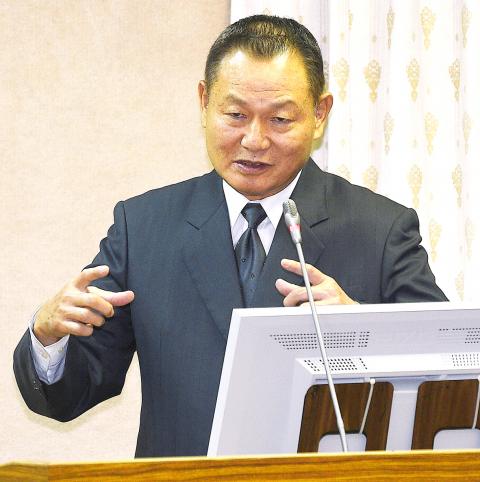
Photo: Chen Chih-chu, Taipei Times
“We are continuing to monitor the situation and following up on developments. Our work is to ensure the meeting can be completed peacefully,” Lee said.
The Hsia-Zhang meeting was postponed to this month after the original scheduled talks in February were canceled amid a dispute over China’s unilateral decision to establish the M503 flight route and three feeder routes over the Taiwan Strait.
One organization planning to protest at the Hsia-Zhang meeting is the Taiwan Solidarity Union’s (TSU) auxiliary group, TSU Youth.
“We have several protests planned, with some of our executives having already arrived in Kinmen and others to join them in coming days,” TSU Youth director Chang Chao-lin (張兆林) said. “There are other pro-Taiwanese independence groups heading to Kinmen for the protest and to disrupt the meeting.”
“We are against any secret talks to negotiate our political future by government officials who do not represent the opinions and aspirations of Taiwanese. We are fighting against the Ma administration, which is selling out Taiwan to China,” he added.

The Centers for Disease Control (CDC) yesterday reported the first case of a new COVID-19 subvariant — BA.3.2 — in a 10-year-old Singaporean girl who had a fever upon arrival in Taiwan and tested positive for the disease. The girl left Taiwan on March 20 and the case did not have a direct impact on the local community, it said. The WHO added the BA.3.2 strain to its list of Variants Under Monitoring in December last year, but this was the first imported case of the COVID-19 variant in Taiwan, CDC Deputy Director-General Lin Ming-cheng (林明誠) said. The girl arrived in Taiwan on

South Korea is planning to revise its controversial electronic arrival card, a step Taiwanese officials said prompted them to hold off on planned retaliatory measures, a South Korean media report said yesterday. A Yonhap News Agency report said that the South Korean Ministry of Foreign Affairs is planning to remove the “previous departure place” and “next destination” fields from its e-arrival card system. The plan, reached after interagency consultations, is under review and aims to simplify entry procedures and align the electronic form with the paper version, a South Korean ministry official said. The fields — which appeared only on the electronic form

The Ministry of Foreign Affairs (MOFA) is suspending retaliation measures against South Korea that were set to take effect tomorrow, after Seoul said it is updating its e-arrival system, MOFA said today. The measures were to be a new round of retaliation after Taiwan on March 1 changed South Korea's designation on government-issued alien resident certificates held by South Korean nationals to "South Korea” from the "Republic of Korea," the country’s official name. The move came after months of protests to Seoul over its listing of Taiwan as "China (Taiwan)" in dropdown menus on its new online immigration entry system. MOFA last week

A bipartisan group of US senators has introduced a bill to enhance cooperation with Taiwan on drone development and to reduce reliance on supply chains linked to China. The proposed Blue Skies for Taiwan Act of 2026 was introduced by Republican US senators Ted Cruz and John Curtis, and Democratic US senators Jeff Merkley and Andy Kim. The legislation seeks to ease constraints on Taiwan-US cooperation in uncrewed aerial systems (UAS), including dependence on China-sourced components, limited access to capital and regulatory barriers under US export controls, a news release issued by Cruz on Wednesday said. The bill would establish a "Blue UAS


 RSS
RSS