


Six “living national treasures” — people who embody important intangible cultural properties — are being honored with the Ministry of Culture’s National Cultural Heritage Conservation Award: architects Hsu Han-jen (許漢珍) and Liao Chih-te (廖枝德), who specialize in traditional Chinese architecture; master carpenter Yeh Ching-yi (葉經義); Luantan (亂彈) Opera actress Pan Yu-chiao (潘玉嬌); Beiguan musician Chiu Huo-jung (邱火榮) and late paper-cutting master Lee Huan-chang (李煥章).
While grateful for the ministry’s recognition, the laureates said at a pre-ceremony press conference earlier this week that modern technology and new legislation have presented challenges to their fields, as a younger generation of artists — which are virtually nonexistent in certain fields — can hardly make a living in the modern world.
Hsu, 86, is an internationally renowned architect of traditional Chinese wooden structures, who learned his art from his father, Hsu Tung-lu (許銅爐).
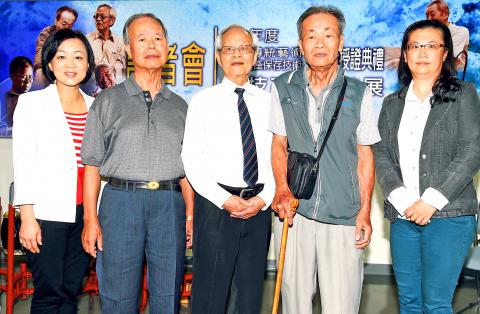
Photo: Sung Chih-hsiung, Taipei Times
“I am very happy that the government does not forsake someone as old as I am and recognizes me as a national treasure,” Hsu Han-jen said.
To comply with modern building regulations, Hsu Han-jen said he had taught himself to integrate traditional craft with the technical drawings of Western architecture and recreate wooden temples with reinforced concrete, while managing to fashion structures in traditional styles.
Liao, 85, is a master architect specializing in traditional Chinese wooden frame structures who has been using conventional techniques to build houses for more than five decades, he said.
He has constructed more than 50 traditional houses, all of which are still in good condition, he said.
Liao is in hospital with a heart condition and his daughter Liao Chuan-ching (廖娟靖) said that her father once said: “All I want to do in my life is build houses.”
“He is very happy to preserve traditional skills,” she said.
Yeh, 78, one of the most representative artisans of traditional carpentry in the nation since the end of World War II, said that it was a great honor for him to be named a living national treasure, and he thanked his wife in particular, saying: “I could not have come to where I am today without her.”
Yeh’s carpentry is known for its delicacy, precision and vividness.
Multi-instrumentalist Chiu is particularly known for playing the suona (嗩吶) drum and string instruments, and he has been promoting traditional Beiguan music for years.
Pan, 81, was one of the first child stars after World War II and she remains the best performer among the few Luantan Opera entertainers still left, and can still perform up to 160 plays in this genre.
The living national treasures are all concerned about the conservation of cultural heritage.
Hsu Han-jen said that even if a new generation of artisans could really master the knowledge and skills required for wooden-structured architecture and carpentry, “they could not bid for any construction contract without a certificate according to the existing regulations.”
Society has evolved so that traditional, experienced, yet “uncertified” architects like him, even ones recognized as living national treasures, can not participate in the government’s efforts to preserve historical sites, simply because they have no certificate.
The declining status of traditional architects, compared with the legal status and prestige enjoyed by modern architects, has deterred many talented people from entering the industry, he said.
Bureau of Cultural Heritage Deputy Director Chang Jen-chi (張仁吉) said that the preservation of cultural properties is extremely urgent and timely.
It is why the Cultural Heritage Preservation Act (文化資產保存法) needs to be amended to tackle issues involving the passing on of intangible cultural heritage, he said.
Each year since 2009, several “national treasures” from across the nation have been awarded with the National Cultural Heritage Conservation Award in recognition of their lifetime achievements and contributions to the nation’s cultural heritage.

LOUD AND PROUD Taiwan might have taken a drubbing against Australia and Japan, but you might not know it from the enthusiasm and numbers of the fans Taiwan might not be expected to win the World Baseball Classic (WBC) but their fans are making their presence felt in Tokyo, with tens of thousands decked out in the team’s blue, blowing horns and singing songs. Taiwanese fans have packed out the Tokyo Dome for all three of their games so far and even threatened to drown out home team supporters when their team played Japan on Friday. They blew trumpets, chanted for their favorite players and had their own cheerleading squad who dance on a stage during the game. The team struggled to match that exuberance on the field, with
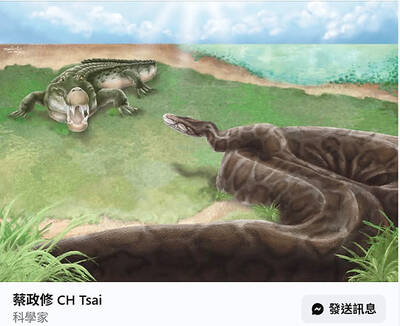
Taiwanese paleontologists have discovered fossil evidence that pythons up to 4m long inhabited Taiwan during the Pleistocene epoch, reporting their findings in the international scientific journal Historical Biology. National Taiwan University (NTU) Institute of Ecology and Evolutionary Biology associate professor Tsai Cheng-hsiu (蔡政修) led the team that discovered the largest snake fossil ever found in Taiwan. The single trunk vertebra was discovered in Tainan at the Chiting Formation, dated to between 400,000 and 800,000 years ago in the Middle Pleistocene, the paper said. The area also produced Taiwan’s first avian fossil, as well as crocodile, mammoth, saber-toothed cat and rhinoceros fossils, it said. Discoveries

Taiwanese paleontologists have discovered fossil evidence that pythons up to 4m long inhabited Taiwan during the Pleistocene epoch, reporting their findings in the international scientific journal Historical Biology. National Taiwan University (NTU) Institute of Ecology and Evolutionary Biology associate professor Tsai Cheng-hsiu (蔡政修) led the team that discovered the largest snake fossil ever found in Taiwan. A single trunk vertebra was discovered in Tainan at the Chiting Formation, dated to between 800,000 to 400,000 years ago in the Middle Pleistocene, the paper said. The area also produced Taiwan’s first avian fossil, as well as crocodile, mammoth, sabre-toothed cat and rhinoceros fossils, it said. Discoveries
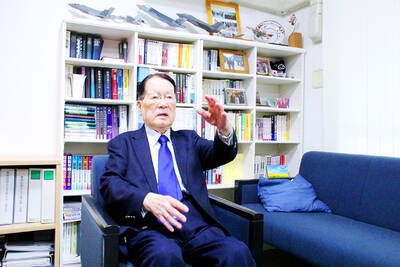
Whether Japan would help defend Taiwan in case of a cross-strait conflict would depend on the US and the extent to which Japan would be allowed to act under the US-Japan Security Treaty, former Japanese minister of defense Satoshi Morimoto said. As China has not given up on the idea of invading Taiwan by force, to what extent Japan could support US military action would hinge on Washington’s intention and its negotiation with Tokyo, Morimoto said in an interview with the Liberty Times (sister paper of the Taipei Times) yesterday. There has to be sufficient mutual recognition of how Japan could provide


 RSS
RSS