


Democratic Progressive Party (DPP) Chairperson Tsai Ing-wen’s (蔡英文) China policy was a concern among panelists discussing the continuity of cross-strait peace at a Taipei forum yesterday.
While acknowledging that pledges made by Tsai to maintain the “status quo” and preserve peace should she win next year’s presidential election were “admirable goals,” American Institute in Taiwan board member David Brown said at a roundtable discussion that: “What she has not said is how she would be able to accomplish those goals.”
Brown said he and many in the US hoped Tsai would be able to provide additional clarity on those goals during her trip to Washington later this month.

Photo: AFP
Beijing has laid down a significant challenge for the DPP in that it must find a way to accommodate what China sees as its core interests — maintaining a “one China” model.
“The preferred way of doing that is through the [so-called] ‘1992 consensus,’ but if that’s not possible, please find a formula for doing it,” Brown said, referring to a supposed understanding between the Chinese Nationalist Party (KMT) and the Chinese government that both sides acknowledge there is “one China” but differ on what “one China” means, a notion which is rejected by the DPP.
Meanwhile, Brown commended KMT Chairman Eric Chu (朱立倫) on his decision to meet with Chinese President Xi Jinping (習近平) 10 days ago in Beijing, which he said he initially thought “was unlikely to take place … because it was a very risky undertaking both in terms of cross-strait relations and [Chu’s] position in domestic politics here, but he went.”
“And going is an example of leadership, dealing with difficult issues, taking responsibility,” Brown told the forum, which was organized by the Mainland Affairs Council.
“The outcome of the meeting was modest, but it did show that it took place in a smooth fashion without difficulties,” he added.
Chu’s visit to China demonstrated that the KMT would stand for continuity in cross-strait relations, and should the party emerge victorious in the election, “that would be very reassuring to China, to the US and others,” Brown said.
Brown said he was surprised that when Chu met with Xi, the KMT leader did not come away with something deliverable he could bring back to the people of Taiwan.
“I think Beijing needs to give considerable thought to things it can do to help the KMT [in the election], if that’s its goal,” he said.
Earlier yesterday, while moderating a session on cross-strait relations and national security, Brown posed a question to You Ji (由冀), a professor of international relations at the University of Macau’s Department of Government and Public Administration, on whether military elements would be involved in Beijing’s reaction to Taiwanese choosing a president who does not support the “1992 consensus.”
You said China had termed the circumstances under which former president Chen Shui-bian (陳水扁) of the DPP planned to write a new constitution during his term as a “sub-war state.”
Yesterday’s forum began with a speech by President Ma Ying-jeou (馬英九), who again reiterated the importance of adhering to the “1992 consensus.”
Separately yesterday, Ma described the relationship between Taiwan and China as one that “after a long period of division, tends to unite; after a long period of union, to divide (分久必合,合久必分), a line drawn from the novel Romance of the Three Kingdoms (三國演義).
The Romance of the Three Kingdoms is a historical Chinese novel mixing fact with fiction dealing with the Three Kingdoms period (220-280 CE).

The military has spotted two Chinese warships operating in waters near Penghu County in the Taiwan Strait and sent its own naval and air forces to monitor the vessels, the Ministry of National Defense (MND) said. Beijing sends warships and warplanes into the waters and skies around Taiwan on an almost daily basis, drawing condemnation from Taipei. While the ministry offers daily updates on the locations of Chinese military aircraft, it only rarely gives details of where Chinese warships are operating, generally only when it detects aircraft carriers, as happened last week. A Chinese destroyer and a frigate entered waters to the southwest
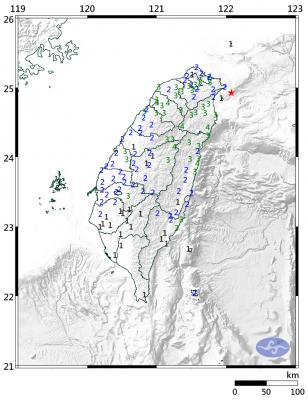
A magnitude 6.1 earthquake struck off the coast of Yilan County at 8:39pm tonight, the Central Weather Administration (CWA) said, with no immediate reports of damage or injuries. The epicenter was 38.7km east-northeast of Yilan County Hall at a focal depth of 98.3km, the CWA’s Seismological Center said. The quake’s maximum intensity, which gauges the actual physical effect of a seismic event, was a level 4 on Taiwan’s 7-tier intensity scale, the center said. That intensity level was recorded in Yilan County’s Nanao Township (南澳), Hsinchu County’s Guansi Township (關西), Nantou County’s Hehuanshan (合歡山) and Hualien County’s Yanliao (鹽寮). An intensity of 3 was
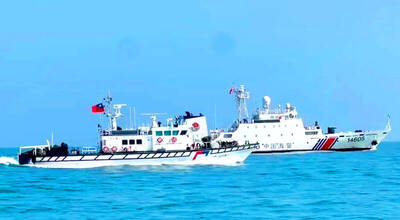
Instead of focusing solely on the threat of a full-scale military invasion, the US and its allies must prepare for a potential Chinese “quarantine” of Taiwan enforced through customs inspections, Stanford University Hoover fellow Eyck Freymann said in a Foreign Affairs article published on Wednesday. China could use various “gray zone” tactics in “reconfiguring the regional and ultimately the global economic order without a war,” said Freymann, who is also a nonresident research fellow at the US Naval War College. China might seize control of Taiwan’s links to the outside world by requiring all flights and ships entering or leaving Taiwan
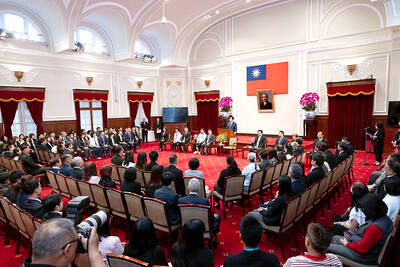
The next minimum wage hike is expected to exceed NT$30,000, President William Lai (賴清德) said yesterday during an award ceremony honoring “model workers,” including migrant workers, at the Presidential Office ahead of Workers’ Day today. Lai said he wished to thank the awardees on behalf of the nation and extend his most sincere respect for their hard work, on which Taiwan’s prosperity has been built. Lai specifically thanked 10 migrant workers selected for the award, saying that although they left their home countries to further their own goals, their efforts have benefited Taiwan as well. The nation’s industrial sector and small businesses lay


 RSS
RSS