


There has been a spike in applications to take the special police examination this year due to rumors that the Ministry of Examination is intending to increase the difficulty of the physical portion of the test next year.
After reviewing police and firefighter examinations in the US and Canada, the ministry discovered that the two nations required applicants to pass competency-based physical examinations that have equal standards for men and women.
The US and Canadian fitness tests require examinees to go cross many different kinds of barriers, as well as up and down stairs, pulling or pushing heavy objects multiple times, falling prone on the ground and getting back up multiple times, and standing up from a prone position, the ministry said.
For firefighters the bar is set even higher with eight different tests — going up stairs, dragging fire hoses, grabbing equipment, setting up ladders, demolishing obstacles, searching in buildings, rescuing people and breaching openings in ceilings, the ministry said.
“Due to the growing severity of security issues facing police officers and firefighters, we are mulling adjustments to the examination that simulate actual events that could occur in the line of duty,” said a ministry official, who declined to be named.
The proposed changes to the physical examination are to test the speed, endurance and agility of the examinees, the official said.
The special police examination and the normal police examination, with the former taken only by National Police University students, have separate standards for men and women, the official said.
Men must leap more than 1.9m from a standing position and run 1,600m within 494 seconds, while women are required to achieve a 1.3m standing jump and run 800m within 280 seconds.
Academics said that in comparison to foreign standards, the standards are more geared toward gauging the fitness of examinees in terms of health, such as cardiovascular endurance, muscle power and muscle endurance, and that such examinations do not simulate events in the field.
National Taiwan Sports University dean Kao Chun-hsiung (高俊雄) said the standards are a bit on the low side and suggested that the special police examination physical test should be amended.
Standing jumps and running are tests of instantaneous muscle power and cardiovascular performance, both important aspects of being a police officer, Kao said, adding that there should be stricter standards so that police can effectively enforce the law.
Police officers said that, while examinees are asked to run with weights while maintaining the same standards, the basic requirements are “high-school level.”
Students who have passed the normal police examination do not enter the force until they have received four more years of training, while those who have passed the special police examination are considered junior police officers, they said.
The officers said that National Police University graduates also have to pass additional physical training standards, such as men finishing a 3km run within 18 minutes and women within 20 minutes, as well as demonstrating the ability to swim 50m and gaining a black belt in judo and wrestling.
Statistics showed that since the rumor started to circulate, applications to take the special police examination have increased by 2,000 compared with last year.
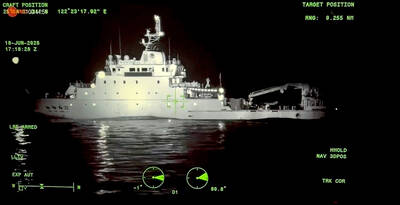
EXCUSES: Beijing is using government and research vessels as a pretext to harass the nation and enter its EEZ, and engage in ‘hegemonic expansion,’ the coast guard said The Coast Guard Administration yesterday said it drove away Chinese oceanographic research vessel Xiang Yang Hong 22 (向陽紅33) from restricted waters after warning it that it was in Taiwan’s exclusive economic zone (EEZ). The Chinese vessel entered restricted waters off the coast of Yilan County’s Suao (蘇澳) at 11:35pm on Thursday, the coast guard said, adding that it dispatched the Lanyu patrol vessel and the boat PP-10077 to shadow the Chinese ship and issue radio warnings ordering it to leave. China has no sovereignty over waters off Taiwan’s east coast, Lanyu’s crew told Xiang Yang Hong 22 over the radio, and demanded
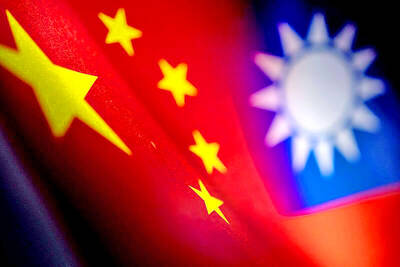
BAIT AND SWITCH: Allowing KMT-run counties to sell to China while the threat of abrupt cancelations hangs overhead is another form of coercion, officials said Beijing is using agricultural purchase offers announced during the Straits Forum to deepen Taiwan’s dependence on the Chinese market, a Taiwanese official said yesterday as they criticized the Taitung County commissioner’s participation in the initiative. During the Straits Forum held in Xiamen on Saturday, Chinese officials announced a sales and purchase agreement for agricultural products from some counties led by the Chinese Nationalist Party (KMT). Taitung County Commissioner Yao Ching-ling (饒慶鈴), who was barred from attending the event in person by the Mainland Affairs Council, participated via video. Under the agreement, China would purchase atemoyas, pomeloes, tea and grouper harvested in Taitung,

SHIFTING FIRE: While the tempo of purely military exercises around Taiwan has gone down somewhat, Beijing is working to isolate Lai diplomatically from support abroad Chinese President Xi Jinping (習近平) is shifting tactics in his campaign to pressure Taiwan, ramping up diplomatic isolation of the nation while dialing down provocative displays of military aggression. Taiwan recorded a daily average of five Chinese military aircraft crossing the Taiwan Strait’s buffer line with China through May this year — half the number logged in the same period last year. In March, Beijing did not send a single fighter jet near Taiwan for seven days, the longest absence on record outside of typhoon season. In comparison, China sent 153 planes near Taiwan during one day at its peak in
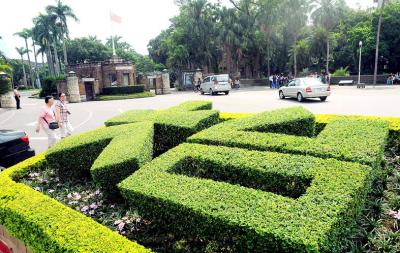
Four Taiwanese universities have been ranked among the world's top 200 institutions in the Quacquarelli Symonds (QS) World University Rankings for next year, the highest Taiwan has ever placed in the category, with National Taiwan University (NTU) achieving its best performance at 54th globally and 17th in Asia. The four Taiwanese institutions in the global top 200 are NTU (54th), National Tsing Hua University (142nd), National Yang Ming Chiao Tung University (177th) and National Cheng Kung University (191st), the rankings showed. All four universities achieved their highest-ever global rankings this year, QS data showed. National Cheng Kung University entered the top 200 for


 RSS
RSS