


Taiwan faces “imminent military threats” from China, and its current defense posture — “compounded by financial constraints” — will soon become obsolete at dealing with the threats, a paper written by former Taiwanese defense minister Andrew Yang (楊念祖) said.
“The military threat from mainland China has remained a daily reality, as Beijing still holds the option to employ the use of force to achieve political unification,” Yang said in the paper published in the Washington-based Jamestown Foundation’s China Brief journal.
Taiwan must create innovative, asymmetric capabilities that “exploit the enemy’s weaknesses” to fend off a surprise attack, Yang wrote.
The US and Taiwan have a shared concern about the strategic and security “game change” in the East China Sea, with Beijing responsible for provoking and escalating tensions, Yang wrote.
“The US and Taiwan should seek a window of opportunity to reset US-Taiwan defense communication to evaluate Taiwan’s military transformation,” the paper said.
He said that the US Congress should encourage the White House to increase Taiwan’s role in enhancing regional peace and security, and in sharing responsibility for dealing with emerging challenges and contingencies.
“The US and Taiwan should also pay attention to the need of enhancing the experience and professionalism of Taiwanese military officers and personnel,” Yang wrote.
In a second paper in the journal, former US Army attache to Beijing Dennis Blasko said most foreign analysts assume that China’s special operations forces — armed with the most modern weapons and equipment in China’s People’s Liberation Army (PLA) — would be used against Taiwan.
Blasko said that China has an estimated 20,000 to 30,000 special operations soldiers.
Blasko said that China’s special operations units have grown substantially since their beginnings 20 years ago and are likely to continue to receive priority for development.
They are now focused on battlefield tactics in support of conventional units, but they could be used for strategic missions, “provided they can be inserted and supported at longer ranges,” Blasko said.
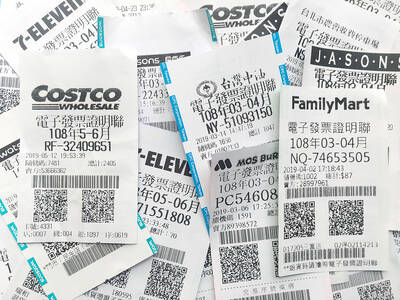
A NT$39 receipt for two bottles of tea at a FamilyMart was among the NT$10 million (US $312,969) special prize winners in the January-February uniform invoice lottery. FamilyMart said that two NT$10 million-winning receipts were issued at its stores, as well as two NT$2 million grand prizes and three NT$200,000 first prizes. The two NT$10 million receipts were issued at stores in Pingtung County and Yilan County’s Dongshan Township (冬山). One winner spent just NT$39 on two bottles of tea, while another spent NT$80 on water, tea and coffee, the company said. Meanwhile, 7-Eleven reported three NT$10 million winners — in New Taipei

Considering that most countries issue more than five denominations of banknotes, the central bank has decided to redesign all five denominations, the bank said as it prepares for the first major overhaul of the banknotes in more than 24 years. Central bank Governor Yang Chin-lung (楊金龍) is expected to report to the Legislative Yuan today on the bank’s operations and the redesign’s progress. The bank in a report sent to the legislature ahead of today’s meeting said it had commissioned a survey on the public’s preferences. Survey results showed that NT$100 and NT$1,000 banknotes are the most commonly used, while NT$200 and NT$2,000

ANNUAL EVENT: Two massive Pokemon balloons are to be set up in Daan Park, with an event zone operating from 10am to 6pm This year’s Taipei Floral Picnic is to be held at Daan Park today and tomorrow, featuring an exclusive Pokemon Go event, a themed food market, a coffee rave picnic area and stage performances, the Taipei Department of Information and Tourism said yesterday. Two massive Pokemon balloons are to be set up in the park as attractions, with an exclusive event zone operating from 10am to 6pm, it said. Participants who complete designated tasks on-site would have a chance to receive limited-edition souvenirs, it added. People could also try the newly launched game Pokemon Pokopia in the trial area, the department said. Three PokeStops are
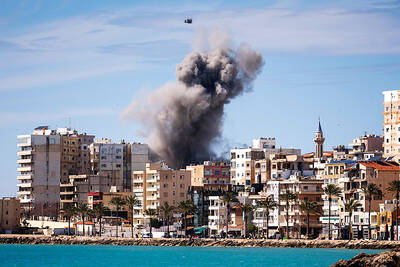
Taiwan is concerned that China could exploit the US’ war in the Middle East, with state media citing examples from the conflict to cast doubt on the efficiency of US weapons Taiwan would use to repel an invasion. Taiwanese officials said the resumption of Beijing’s large-scale air force incursions near Taiwan after an unusual decline show that China wants to take advantage of the redeployment of US forces from East Asia to the Middle East. “This is a moment for China to exercise influence,” a senior Taiwanese security official said, speaking on condition of anonymity. “What China is trying to create is a


 RSS
RSS