


Representatives from civic groups yesterday urged the government to withdraw its proposed version of an oversight mechanism to monitor future cross-strait agreements.
Although a public hearing on the act was originally scheduled for yesterday, it was later replaced by an unofficial conference after Taiwan Solidarity Union (TSU) lawmakers on Tuesday launched a prolonged campaign to prevent the bill from reaching the Internal Administration Committee.
Economic Democracy Union convener Lai Chung-chiang (賴中強) said the government’s version of the oversight bill lacked teeth, calling it nearly identical to a “four-stage communications and counseling mechanism” suggested by former premier Jiang Yi-huah (江宜樺) in March last year.
Lai said that the proposed bill required the government only to “explain” potential cross-strait treaties to the legislature, but it failed to grant the Legislative Yuan binding powers to monitor government actions.
“How can you present a public relations scheme as an oversight mechanism?” Lai asked, adding that the proposal presented no substantial changes to the government’s current “black box” methods for handling cross-strait affairs.
Lai demanded that the government withdraw its proposal, adding that all seven other proposals for the oversight mechanism were negotiable, including one version submitted by the Chinese Nationalist Party (KMT).
In response, Mainland Affairs Council Minister Andrew Hsia (夏立言) said that demands to withdraw the Executive Yuan’s version of the bill before the committee stage were “unfair” and “too arbitrary.”
Hsia added that any cross-strait oversight mechanism should be in accordance with the Constitution of the Republic of China, adding that referring to China by its official title, the People’s Republic of China, would be unacceptable for any legislation as that would run against the Constitution.
There are eight versions of the proposed oversight mechanism pending reviews, including six put forward by the Democratic Progressive Party (DPP) and one by KMT Legislator Johnny Chiang (江啟臣).
Controversies over the oversight mechanism have simmered since the Sunflower movement protests in March and April last year, which included an extended occupation of the main legislative chamber by the student-led group after KMT Legislator Chang Ching-chung (張慶忠) attempted to push through a service trade agreement with China without legislative deliberation.
While Chang was originally scheduled to preside over yesterday’s conference, fellow KMT lawmaker Chiu Wen-yen (邱文彥) chaired in his place following opposition to Chang’s role by the DPP and TSU over the past week.
“I am Chiu Wen-yen, not Chang Ching-chung,” Chiu said before yesterday’s meeting adjourned at midday.
Negotiations on the issue should continue, Chiu added.
Additional reporting by CNA

The manufacture of the remaining 28 M1A2T Abrams tanks Taiwan purchased from the US has recently been completed, and they are expected to be delivered within the next one to two months, a source said yesterday. The Ministry of National Defense is arranging cargo ships to transport the tanks to Taiwan as soon as possible, said the source, who is familiar with the matter. The estimated arrival time ranges from late this month to early next month, the source said. The 28 Abrams tanks make up the third and final batch of a total of 108 tanks, valued at about NT$40.5 billion

Two Taiwanese prosecutors were questioned by Chinese security personnel at their hotel during a trip to China’s Henan Province this month, the Mainland Affairs Council (MAC) said yesterday. The officers had personal information on the prosecutors, including “when they were assigned to their posts, their work locations and job titles,” MAC Deputy Minister and spokesman Liang Wen-chieh (梁文傑) said. On top of asking about their agencies and positions, the officers also questioned the prosecutors about the Cross-Strait Joint Crime-Fighting and Judicial Mutual Assistance Agreement, a pact that serves as the framework for Taiwan-China cooperation on combating crime and providing judicial assistance, Liang
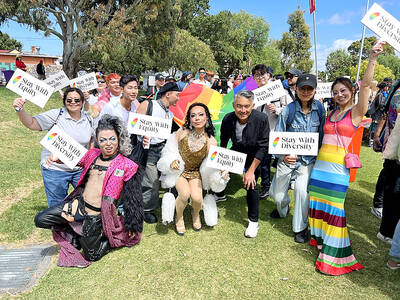
A group from the Taiwanese Designers in Australia association yesterday represented Taiwan at the Midsumma Pride March in Melbourne. The march, held in the St. Kilda suburb, is the city’s largest LGBTQIA+ parade and the flagship event of the annual Midsumma Festival. It attracted more than 45,000 spectators who supported the 400 groups and 10,000 marchers that participated this year, the association said. Taiwanese Designers said they organized a team to march for Taiwan this year, joining politicians, government agencies, professionals and community organizations in showing support for LGBTQIA+ people and diverse communities. As the first country in Asia to legalize same-sex
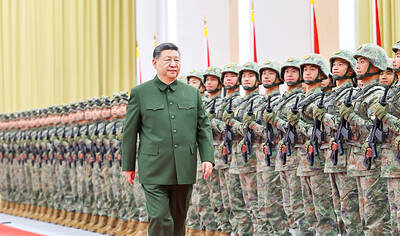
MOTIVES QUESTIONED The PLA considers Xi’s policies toward Taiwan to be driven by personal considerations rather than military assessment, the Epoch Times reports Chinese President Xi Jinping’s (習近平) latest purge of the Chinese People’s Liberation Army (PLA) leadership might have been prompted by the military’s opposition to plans of invading Taiwan, the Epoch Times said. The Chinese military opposes waging war against Taiwan by a large consensus, putting it at odds with Xi’s vision, the Falun Gong-affiliated daily said in a report on Thursday, citing anonymous sources with insight into the PLA’s inner workings. The opposition is not the opinion of a few generals, but a widely shared view among the PLA cadre, the Epoch Times cited them as saying. “Chinese forces know full well that


 RSS
RSS