


Reporters Without Borders (RSF) on Friday released Chinese internal memos and directives to protest the recent conviction of veteran Chinese journalist Gao Yu (高瑜), which revealed that President Ma Ying-jeou’s (馬英九) speech delivered on Double Ten National Day last year was banned from being reporting by media in China.
“All Web sites, including mobile news clients, must delete Ma Ying-jeou’s 10/10 speech,” the documents on instructions of censorship and propaganda showed.
The documents released on the Web site of the Paris-based organization also revealed that the Chinese Communist Party ordered all books written by Chinese-American academic Yu Ying-shih (余英時), and Taiwanese novelist and director Giddens Ko (柯景騰), known as Jiu Ba-dao (九把刀), be removed from shelves.
It was reported in October last year that publishers in China received a notice from authorities to ban the work of Yu and Ko, who both showed support for the Sunflower movement in March and April last year in Taiwan. However, then-Minister of Council for Cultural Affairs Lung Ying-tai (龍應台) refused to confirm the reports.
Along with the instructions shown in the documents were “problems” reported to the Chinese State Internet Information Office under China’s Ministry of Public Security, including one involving Sina Weibo, a Chinese microblogging service.
Sina Weibo was criticized for changing the title “Hong Kong version of Color Revolution deemed to fail” without authorization and incorporating other information in the story in a way that showed support for the Occupy Central movement.
Reporters Without Borders released the documents soon after Gao was sentenced on Friday to seven years in prison for “disclosing state secrets.”
It was a form of protest against the sentence and to demonstrate the ineffectiveness of the Chinese government’s attempts to control news and information, it said.
The documents — which include censorship directives to news media, memos circulated within Internet companies that cooperate with the censors, and summaries of meetings — testify to the scale of the party’s efforts to shape public opinion in accordance with its political vision, Reporters Without Borders said.
“We are appalled by this verdict and sentence, which ignored the proof of Gao Yu’s innocence supplied by her lawyers,” Reporters Without Borders Asia-Pacific desk head Benjamin Ismail said in the statement.
In Taipei, Democratic Progressive Party Legislator Chiu Chih-wei (邱志偉) said the widespread suppression of freedom of expression in China highlighted the importance of people-to-people exchanges across the Taiwan Strait.
Constructive people-to-people exchanges between Taiwan and China would allow Chinese to form their own opinions about Taiwan and compare them with how it has been portrayed differently in Chinese media, Chiu said.
Chinese Nationalist Party (KMT) Legislator Apollo Chen (陳學聖) said he was not surprised at the media ban imposed on Ma’s Double Ten National Day speech.
Chen called on the government to place media exchanges high on the cross-strait agenda by granting landing rights to Chinese satellite television channels on a reciprocal principle to allow Chinese audiences to be exposed to Taiwanese news events.
The impacts Chinese media would have on the Taiwanese audience would be much less of a concern, Chen said.
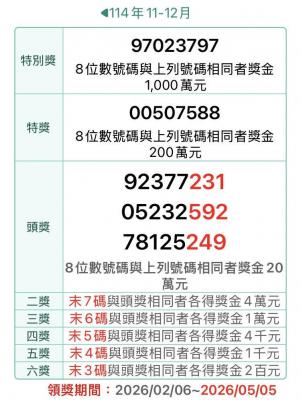
Seven of the 17 NT$10 million (US$311,604) winning receipts from the November-December uniform invoice lottery remain unclaimed as of today, the Ministry of Finance said, urging winners to redeem their prizes by May 5. The reminder comes ahead of the release of the winning numbers for the January-February lottery tomorrow. Among the unclaimed receipts was one for a NT$173 phone bill in Keelung, while others were for a NT$5,913 purchase at Costco in Taipei's Neihu District (內湖), a NT$49 purchase at a FamilyMart in New Taipei City's Tamsui District (淡水), and a NT$500 purchase at a tea shop in New Taipei City's

Taiwanese officials were shown the first of 66 F-16V fighter jets purchased by Taiwan from the United States, the Ministry of National Defense said yesterday, adding the aircraft has completed an initial flight test and is expected to be delivered later this year. A delegation led by Deputy Minister of National Defense Hsu Szu-chien (徐斯儉) visited Lockheed Martin’s F-16 C/D Block 70 (also known as F-16V) assembly line in South Carolina on March 16 to view the aircraft. The jet will undergo a final acceptance flight in the US before being delivered to Taiwan, the
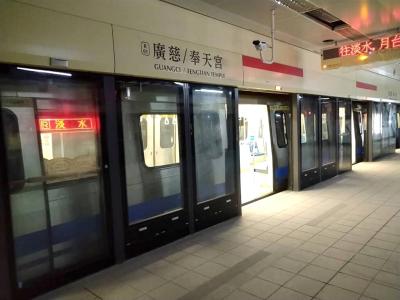
The New Taipei Metro's Sanyin Line and the eastern extension of the Taipei Metro's Tamsui-Xinyi Line (Red Line) are scheduled to begin operations in June, the National Development Council said today. The Red Line, which terminates at Xiangshan Station, would be connected by the 1.4km extension to a new eastern terminal, Guangci/Fengtian Temple Station, while the Sanyin Line would link New Taipei City's Tucheng and Yingge stations via Sanxia District (三峽). The council gave the updates at a council meeting reviewing progress on public construction projects for this year. Taiwan's annual public infrastructure budget would remain at NT$800 billion (US$25.08 billion), with NT$97.3
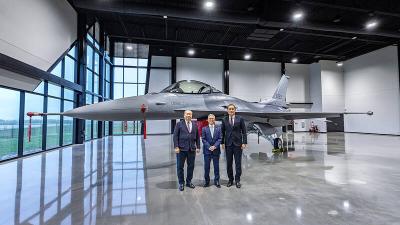
Deliveries of delayed F-16V jets are expected to begin in September, Minister of National Defense Wellington Koo (顧立雄) said today, after senior defense officials visited the US last week. The US in 2019 approved a US$8 billion sale of Lockheed Martin F-16 jets to Taiwan, a deal that would take the nation’s F-16 fleet to more than 200 jets, but the project has been hit by issues including software problems. Koo appeared today before a meeting of the legislature’s Foreign Affairs and National Defense Committee, which is discussing different versions of the special defense budget this week. The committee is questioning officials today,


 RSS
RSS