


Seventy percent of the fire suits worn by Taipei firefighters are “expired” and potentially worn out, putting their lives at risk, city councilors said yesterday.
Taipei City councilors Wang Wei-chung (王威中) and Kao Chia-yu (高嘉瑜) of the Democratic Progressive Party (DPP) said that an inventory list provided by the Taipei Fire Department showed only 349 suits for the department’s 1,243 firefighters. While the department claimed that any additional suits had been “scrapped,” interviews with firefighters revealed that close to 1,000 expired suits with more than three years of usage continued to be worn by city firefighters, the councilors said.
National Association for Firefighters’ Rights secretary-general Cheng Ya-ling (鄭雅菱) said the continued use of older suits was worrisome because there was no system in place for testing suit safety, with firefighters instead required to report any problems themselves.
She said that important problems — such as the suits’ fabric becoming brittle — could not be reliably tested by firefighters themselves without specialized instruments.
In addition, firefighters often feel embarrassed to ask for a replacement suit if damage is not obvious, although even a small puncture greatly reduces suit safety, she said.
“Most firefighters’ suits and hats have never been inspected,” she said “They have no way of being certain that this equipment can protect them, with ‘testing’ only occurring during real emergencies.”
However, even if firefighters discover a problem, the department’s lack of backup suits and equipment means that they must wait up to eight months before receiving a new suit, she said.
The Taipei Fire Department’s disaster rescue division director Wang Cheng-hsiung (王證雄) said that the department had provided an “erroneous” inventory list due to a “misunderstanding.”
While the Executive Yuan has set a three-year standard for the replacement of fire suits, because the suits are permanently flameproof, the department has chosen to use many suits for more than three years due to budget constraints, he said, adding that new suits cost NT$23,000 each.
He said that half of the department’s suits received a manual safety check every year during their biannual washing, adding that the check only encompassed deformities visible to the naked eye, with no way of determining whether the suits’ material had become brittle.
He added the department had already decided to begin replacing the suits every three years to improve safety and to provide all firefighters with their own backup suit, beginning with a budget request for 400 new suits this year.

The military has spotted two Chinese warships operating in waters near Penghu County in the Taiwan Strait and sent its own naval and air forces to monitor the vessels, the Ministry of National Defense (MND) said. Beijing sends warships and warplanes into the waters and skies around Taiwan on an almost daily basis, drawing condemnation from Taipei. While the ministry offers daily updates on the locations of Chinese military aircraft, it only rarely gives details of where Chinese warships are operating, generally only when it detects aircraft carriers, as happened last week. A Chinese destroyer and a frigate entered waters to the southwest

A magnitude 6.1 earthquake struck off the coast of Yilan County at 8:39pm tonight, the Central Weather Administration (CWA) said, with no immediate reports of damage or injuries. The epicenter was 38.7km east-northeast of Yilan County Hall at a focal depth of 98.3km, the CWA’s Seismological Center said. The quake’s maximum intensity, which gauges the actual physical effect of a seismic event, was a level 4 on Taiwan’s 7-tier intensity scale, the center said. That intensity level was recorded in Yilan County’s Nanao Township (南澳), Hsinchu County’s Guansi Township (關西), Nantou County’s Hehuanshan (合歡山) and Hualien County’s Yanliao (鹽寮). An intensity of 3 was

Japanese Prime Minister Sanae Takaichi’s comment last year on Tokyo’s potential reaction to a Taiwan-China conflict has forced Beijing to rewrite its invasion plans, a retired Japanese general said. Takaichi told the Diet on Nov. 7 last year that a Chinese naval blockade or military attack on Taiwan could constitute a “survival-threatening situation” for Japan, potentially allowing Tokyo to exercise its right to collective self-defense. Former Japan Ground Self-Defense Force general Kiyofumi Ogawa said in a recent speech that the remark has been interpreted as meaning Japan could intervene in the early stages of a Taiwan Strait conflict, undermining China’s previous assumptions
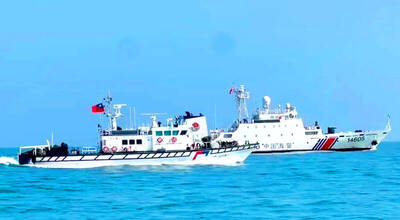
Instead of focusing solely on the threat of a full-scale military invasion, the US and its allies must prepare for a potential Chinese “quarantine” of Taiwan enforced through customs inspections, Stanford University Hoover fellow Eyck Freymann said in a Foreign Affairs article published on Wednesday. China could use various “gray zone” tactics in “reconfiguring the regional and ultimately the global economic order without a war,” said Freymann, who is also a nonresident research fellow at the US Naval War College. China might seize control of Taiwan’s links to the outside world by requiring all flights and ships entering or leaving Taiwan


 RSS
RSS