


The Ministry of National Defense (MND) on Friday convened a meeting with senior military officials and academics to work toward the adoption of International Humanitarian Law (IHL), which regulates the conduct of armed conflict, for the protection of people and properties during wartime.
The meeting was chaired by the ministry’s Armaments Bureau General deputy director Liu Chen-wu (劉震武), a former chief commander of the air force.
Liu said the meeting’s aim was to initiate a task force to push for the adoption of the IHL conventions, by finalizing the draft bill in 18 months, and completing its passage into law in the legislature in two years’ time.
Throughout the process, the ministry would promote the IHL in education training at military academies and instill the concepts in soldiers and officers, so they would possess common ground on which to operate, as the armed forces became increasingly modernized through conduct that conforms to international standards, Liu said.
The ministry’s task force said the draft bill would include the four well-known Geneva conventions, which were developed and adopted by international communities between 1864 and 1949.
They consist of the Geneva Convention for the Amelioration of the Condition of the Wounded and Sick in Armed Forces in the Field; for the Amelioration of the Condition of Wounded, Sick and Shipwrecked Members of Armed Forces at Sea; the Convention relative to the Treatment of Prisoners of War; and the Convention relative to the Protection of Civilan Persons in Time of War.
The draft is also to cover two later amendment protocols to the Geneva conventions in 1977: Protocol I and II, relating to the the protection of victims of both international and non-international armed conflicts.
“International Humanitarian Law is an important aspect of building up the nation’s military defense and combat preparation. Our ministry will undertake efforts for the law drafting, and push for its deliberation and approval in the legislature. This can show the world our nation’s determination to comply with international conventions for the protection of human rights,” a statement issued by the ministry said.

The military has spotted two Chinese warships operating in waters near Penghu County in the Taiwan Strait and sent its own naval and air forces to monitor the vessels, the Ministry of National Defense (MND) said. Beijing sends warships and warplanes into the waters and skies around Taiwan on an almost daily basis, drawing condemnation from Taipei. While the ministry offers daily updates on the locations of Chinese military aircraft, it only rarely gives details of where Chinese warships are operating, generally only when it detects aircraft carriers, as happened last week. A Chinese destroyer and a frigate entered waters to the southwest
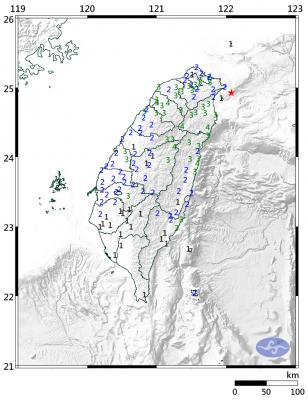
A magnitude 6.1 earthquake struck off the coast of Yilan County at 8:39pm tonight, the Central Weather Administration (CWA) said, with no immediate reports of damage or injuries. The epicenter was 38.7km east-northeast of Yilan County Hall at a focal depth of 98.3km, the CWA’s Seismological Center said. The quake’s maximum intensity, which gauges the actual physical effect of a seismic event, was a level 4 on Taiwan’s 7-tier intensity scale, the center said. That intensity level was recorded in Yilan County’s Nanao Township (南澳), Hsinchu County’s Guansi Township (關西), Nantou County’s Hehuanshan (合歡山) and Hualien County’s Yanliao (鹽寮). An intensity of 3 was
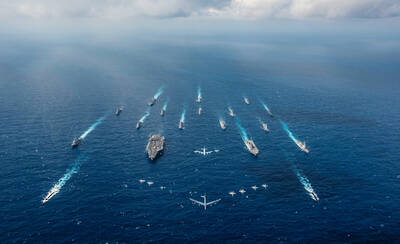
Japanese Prime Minister Sanae Takaichi’s comment last year on Tokyo’s potential reaction to a Taiwan-China conflict has forced Beijing to rewrite its invasion plans, a retired Japanese general said. Takaichi told the Diet on Nov. 7 last year that a Chinese naval blockade or military attack on Taiwan could constitute a “survival-threatening situation” for Japan, potentially allowing Tokyo to exercise its right to collective self-defense. Former Japan Ground Self-Defense Force general Kiyofumi Ogawa said in a recent speech that the remark has been interpreted as meaning Japan could intervene in the early stages of a Taiwan Strait conflict, undermining China’s previous assumptions
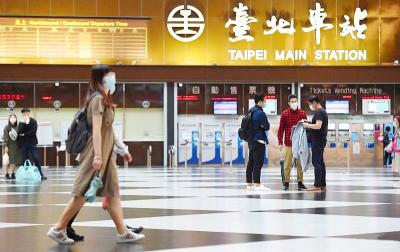
Taiwan Railways Corp (TRC) today announced that Shin Kong Mitsukoshi has been selected as the preferred bidder to operate the Taipei Railway Station shopping mall, replacing the current operator, Breeze Development Co Ltd. Among eight qualified firms that delivered presentations and were evaluated by a review committee, Shin Kong Mitsukoshi was ranked first, while Breeze was named the runner-up, the rail company said in a statement. Contract negotiations are to proceed in accordance with regulations, it said, adding that if negotiations with the top bidder fail, it could invite the second-ranked applicant to enter talks. Breeze in a statement today expressed doubts over


 RSS
RSS