


A group of South Korean workers yesterday protested inside a branch of Bank SinoPac in Taipei to highlight the decision by E Ink Holdings Inc — a subsidiary of the Yuen Foong Yu Group that owns the bank — to close a Hydis plant in South Korea on Tuesday.
E Ink purchased Hydis — a plasma display manufacturer originally owned by South Korea’s Hyundai Group — in 2008 and laid off 400 employees in 2013 before deciding to close the plant this year.
E Ink said that despite the plant’s closure, it would ensure that Hydis remains in business.
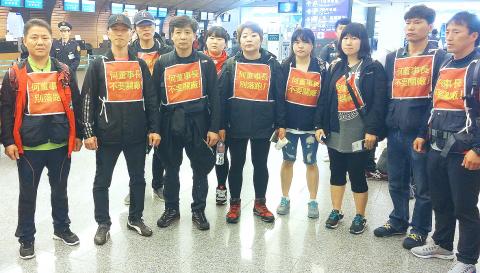
Photo: Yao Chieh-hsiu, Taipei Times
The protesting workers held a press conference outside the bank, telling reporters that Yuen Foong Yu Group’s decision to close the plant when the company remained profitable was illogical.
Without giving advance notice, the protesters then entered the bank holding signs reading: “Chairman Ho, don’t run away,” and “Chairman Ho, don’t close the plant” — referring to Yuen Foong Yu chairman Ho Shou-chuan (何壽川) — and held a peaceful protest that included chanting slogans and dancing.
“We cannot accept that the Yuen Foong Yu Group arbitrarily decided to shut the company down when it is doing well financially while refusing to provide us with information from the board meetings,” the protesters said. “Our efforts here are simply to fight for our rights as workers.”
Bank staff continued to conduct business during the protest, the Chinese-language online media outlet Storm Media reported.
Police officers, speaking in Mandarin, ordered the workers to stop, before realizing that the protesters might not understand them, at which point they resorted to saying “stop” in English.
Before the protesters left the bank, the police issued two warnings to them, saying that they might have violated the Assembly and Parade Act (集會遊行法) and the Social Order Maintenance Act (社會秩序維護法).
“Our intent is not to interrupt the daily lives of Taiwanese, but to defend our own rights and to protect Hydis’ patents on fringe field switching technology,” the workers said.
Before ending the protest, the workers sang the Workers’ Fight Song (勞動者戰歌) in Mandarin, and performed a traditional Korean ritual of respect by kneeling down and placing their foreheads on the ground to thank Taiwanese activists who had come to support them.
E Ink Holdings said it was sorry to hear of the “inappropriate behavior of certain people,” adding that it has acted according to South Korean laws and urged the workers to return to South Korea to negotiate with the management.
The demonstration at the bank is not the first time that South Korean workers have protested in Taipei over the Hydis closure.
About 30 South Korean protested in front of the Ministry of Labor on Tuesday, calling on the government to facilitate talks with Yuen Foong Yu.
Six representatives from the Hydis employees’ union led a protest march to the Yeun Foong Yu offices in Taipei on Feb. 12.
The South Korean workers left for home yesterday evening.
Additional reporting by staff reporter and CNA

FUKUOKA SITUATION: Japanese media reported that the pathogen is expected to be identified by the summer, while the CDC downplayed the idea that it was hMPV A “mysterious cold-like illness” reported in Japan’s Fukuoka Prefecture does not seem to be a new disease, but Japanese authorities have been asked about the situation, the Centers for Disease Control (CDC) said yesterday. The Fukuoka Prefectural Medical Association on Wednesday told a news conference that a “mystery cold” that has become a hot topic on social media is “highly likely to be caused by some kind of viral infection,” Japan’s KBC News reported. “Many people are experiencing symptoms starting with a sore throat, followed by a runny nose, phlegm and a severe cough,” KBC News reported, citing association officials. Health authorities are

Nvidia Corp CEO Jensen Huang (黃仁勳) arrived in Taiwan yesterday ahead of upcoming AI and technology events, saying he plans to meet with clients and Taiwan Semiconductor Manufacturing Co Chairman C.C. Wei (魏哲家) during his visit. After landing at Taipei Songshan Airport, Huang posed for photos with fans and handed out Yakult drinks to reporters and supporters waiting at the scene, saying he has “a lot to do” during the trip. Asked about reports that Nvidia’s planned headquarters site in Taipei’s Beitou Shilin Technology Park could break ground on May 27, Huang said that if the company holds an event, he would

Carrefour Taiwan is to begin using a new name from the start of July, but it cannot divulge the name until then, the chairman of the supermarket chain's parent company said today. President Chain Store Co chairman Lo Chih-hsien (羅智先) was asked by reporters after a shareholders' meeting to confirm whether the company has settled on a new name for the supermarket brand. In March, the government-registered name of two Carrefour Taiwan branches was quietly changed to "Le Chia Kang" (樂家康) in Chinese, raising speculation that has been selected as the name. Lo said that because of local regulations and contractual obligations, the

The Philippines would likely be involved in any conflict over Taiwan due to its proximity to the democracy claimed by China, President Ferdinand Marcos Jr said, reiterating a stance that risks angering Beijing. “In the Philippines, we do not have a choice because Taiwan is so close to the Philippines and we have almost 200,000 Filipino nationals living and working in Taiwan,” Marcos said in an interview with Japanese media in Manila on Monday. The Philippine leader’s comments come ahead of a state visit to Japan next week, where he is to meet with Japanese Prime Minister Sanae Takaichi to discuss security


 RSS
RSS