


Union representatives from South Korea’s Hydis Technologies, a subsidiary of Taiwanese e-paper manufacturer E Ink Holdings, yesterday held a rally in Taipei to protest E Ink’s decision to cease operations in Icheon, South Korea.
Now on their second trip to Taiwan, the South Korean workers have staged a series of demonstrations over the past week, expressing stiff opposition toward E Ink’s plans to dismiss more than 350 Hydis employees by the end of this month.
They said that it was against South Korean labor regulations for a profitable company to implement a mass layoff of its employees, adding that Hydis made more than NT$2.8 billion (US$89.81 million) last year from its patent royalties in fringe field switching — a key technology in the LCD electronics industry.
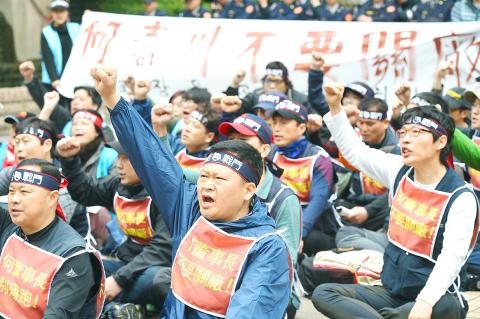
Photo: Chang Chia-ming, Taipei Times
Union representatives accused E Ink of following in the footsteps of China’s BOE Technology, which was accused of industrial espionage during its ownership of Hydis from 2003 to 2006.
Despite rainy weather, dozens of activists from Taiwanese unions joined yesterday’s demonstration to express solidarity with their South Korean counterparts.
The workers demanded a meeting with Ho Shou-chuan (何壽川), the chairman of Yeung Foong Yu Group — of which E Ink is an affiliate — after they failed to reach consensus with E Ink management during previous negotiations.
Wearing the all-white cleanroom suits that are usually worn by assembly line workers in the high-tech industry, the South Korean workers chanted slogans in Mandarin Chinese and Korean, demanding that Ho address their demands.
Halfway through the march, the workers staged a demonstration outside Ho’s house, saying that Ho and other Yuen Foong Yu Group board members repeatedly ignored their demands to engage in negotiations.
Worker Lee Mi-ok, 30, said she has worked at Hydis for more than a decade, after she was forced to terminate her college studies to provide for her family.
“After my father passed away, the burden of my family’s livelihood fell on my shoulders,” she said through an interpreter. “My mother is a strong, resilient woman. When I think about her example, I tell myself that I need to stand firm, too.”
Although E Ink said it provided favorable severance packages to the laid-off employees, the workers said that they were more interested in retaining their jobs.
“In South Korea we have a saying: ‘Dismissal is murder,’” Hydis union leader Woo Boo-ki said through an interpreter, adding that both he and his wife relied on their jobs at Hydis for their income.
In a demonstration in front of the Yuen Foong Yu Group headquarters on Tuesday, Woo and Park Ju-mun, leader of a regional union organization in South Korea’s Gyeonggi Province, had their heads shaved to protest against the shutdowns.
Chung Fu-chi (鍾馥吉), president of the employees’ union of Bank Sinopac — also a Yuen Foong Yu Group affiliate — attended the rally to express his support for the South Korean workers, saying that union organizations should stand in unity regardless of nationality.
In a statement earlier this week, E Ink said its multiyear efforts to improve the financial conditions of the company have failed and accused union representatives of “spreading rumors.”

NATIONAL SECURITY: Authorities are working to confirm the identities of the military personnel involved and investigating possible illegal conduct and regulatory violations Authorities are probing possible national security implications after Kinmen police and immigration officers on Sunday found a Chinese woman allegedly posing as a tourist while engaging in prostitution involving more than 10 military personnel. The woman, surnamed Chen (陳), has since been deported, authorities said, adding that investigators are still working to confirm the identities of those implicated, as the records only listed code names and aliases. The case stemmed from a report received by the Kinmen District Prosecutors’ Office on Friday last week from the Jinhu Precinct of the Kinmen County Police Bureau. On Sunday, police, along with the National Immigration
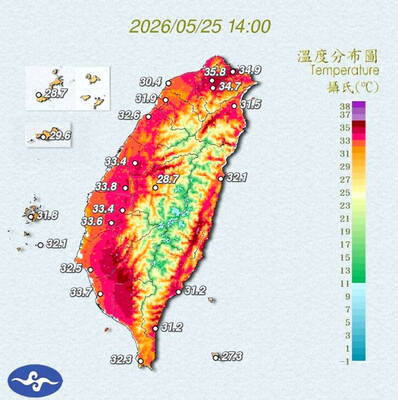
STAY COOL: The HPA recommended that people stay hydrated, use air-conditioning or fans while indoors, wear loose-fitting clothes and walk in the shade while outdoors Employers must implement measures such as installing cooling equipment, and providing drinking water and rest breaks for outdoor workers starting from Monday next week, the Taipei Department of Labor said on Sunday. Employers who fail to comply could face fines of NT$30,000 to NT$300,000 under the Occupational Safety and Health Act (職業安全衛生法), the department said. Businesses in Taipei employing fewer than 100 workers, as well as registered self-employed workers with labor insurance coverage, could receive on-site assessments and guidance from occupational safety consultants to help them apply for central government subsidies to implement or improve heat-protection measures, it said. Under the Ministry of

GLOBALGIVING: ‘ Caving to external pressure is not acceptable for an organization that has cultivated justice reform and human rights for 30 years,’ one NGO said A slew of non-government organizations (NGOs) have withdrawn from the GlobalGiving fundraising platform after it announced it would use “Chinese Taipei” instead of “Taiwan” from next month. The Taiwan Good Rice Association wrote on Facebook on Friday that it was informed on April 28 via a teleconference call of the change, which was made because the platform wanted to operate in China. Taiwan Good Rice is to terminate all cooperative relationships with GlobalGiving in response to the platform’s “unilateral and non-negotiable” decision to remove references to Taiwan, the NGO said. “Taiwan is in the official name of Taiwan Good Rice Association and the

Chinese Nationalist Party (KMT) Chairwoman Cheng Li-wun (鄭麗文) yesterday briefed her party’s Central Standing Committee regarding her scheduled visit to the US between Monday next week and June 16, saying that her purpose would be to persuade the US that the Republic of China (ROC) Constitution was a “one China” constitution that would foster stable and peaceful cross-strait relations. The ROC Constitution is the most important defense for all Taiwanese citizens, as it upholds our democracy and has contributed to our robust economy, which aligns with international and US interests, she said. “We would not be troublemakers and drag the US under,”


 RSS
RSS