

The Chinese Nationalist Party (KMT) yesterday decided to stick to its usual timeline for nominating its presidential candidate even though distraught party members have urged the party to step up the pace.
At the meeting of the party’s Central Standing Committee yesterday, 11 members, led by Lin Rong-te (林榮德), appealed to the party, which has yet to initiate its presidential nomination process, to move the process forward.
KMT spokesperson Lin Yi-hua (林奕華) told reporters after the meeting that the proposal was not adopted by the committee as KMT Chairman and New Taipei City Mayor Eric Chu (朱立倫) said that the party would continue the process at its own pace.
“Chairman Chu said that the party would not unveil its presidential candidate later than usual, which falls between April and the middle of June,” Lin Yi-hua said.
Lin Yi-hua said that Chu did sympathize with party members about their concern that the party is making a late start compared with the Democratic Progressive Party (DPP).
Although the DPP has already produced a presumptive presidential nominee, the DPP has not yet gone through its primary process either, Lin Yi-hua quoted Chu as saying.
DPP Chairperson Tsai Ing-wen (蔡英文) is running in the party’s primary uncontested. She registered as a candidate on Feb. 14 and is to be nominated on April 15.
Earlier yesterday, Legislative Deputy Speaker Hung Hsiu-chu (洪秀柱) renewed efforts to urge KMT members interested in running for the presidency to declare their candidacy as soon as possible and hinted that she might throw her hat into the ring if no one announces their intention to run.
“At a time when there is a spirit of defeatism among party members, it is more necessary than ever for someone to step forward and put on a brave face,” Hung said during a radio interview.
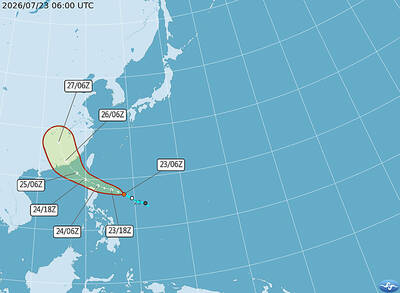
BRACE FOR WET DAYS: Heavy rain is expected in Hualien, Taitung and the Hengchun Peninsula, and northern areas would see localized showers, it said A tropical depression east of the Philippines is expected to strengthen into Typhoon Noul, and a sea warning was likely to be issued as early as 11:30pm last night, the Central Weather Administration (CWA) said yesterday. The storm would be closest to Taiwan tomorrow, and bring heavy rain to Hualien and Taitung counties, as well as the Hengchun Peninsula (恆春半島), it said. If the storm strengthens into a typhoon, it would be the 12th this year. As the storm has maintained a steady speed, it is expected to cross the Bashi Channel relatively quickly, CWA forecaster Tseng Chao-cheng (曾昭誠) said. The storm is forecast
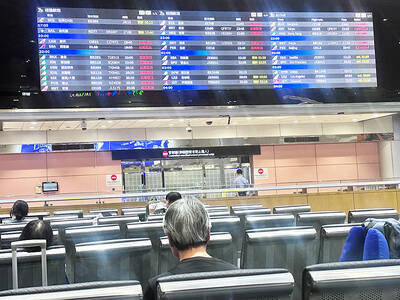
Travel agencies and hotels offering airport pickup services face fines beginning next month if they continue to hold space in arrival halls with placards, luggage or other personal items, Taoyuan International Airport Corp (TIAC) said in a letter to operators. As the number of visitors to Taiwan continues to grow, many travel agencies and hotels provide meet-and-greet services that allow arriving travelers to head directly to their hotels or begin their itineraries upon landing. However, some pickup personnel have been occupying the wall near the exit of the arrival hall with signs, luggage and personal items, obstructing passenger flow, disrupting terminal

The Chinese Nationalist Party (KMT) caucus yesterday submitted a motion to suspend the Cabinet’s NT$44.2 billion (US$1.37 billion) drone industry plan, calling the program “bloat” and questioning its legality. The comprehensive uncrewed vehicle industry development plan seeks to support the growth of a self-sufficient domestic drone industry for national defense through 2030. The KMT caucus introduced the motion to suspend the plan as part of interparty negotiations over this year’s budget, which remains stalled in the legislature. Local Chinese-language media reported that the KMT caucus wrote in the motion that the Executive Yuan’s belated approval of the plan in October
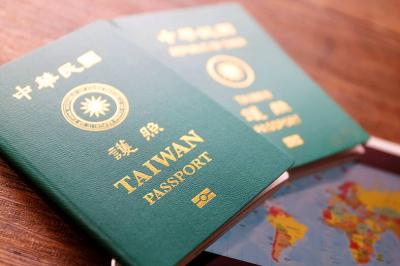
Taiwanese planning trips to Morocco should carefully assess their travel plans, the Ministry of Foreign Affairs (MOFA) said today, following reports that a travel agency had suspended its visa authorization letter application service for people visiting the country. Lion Travel yesterday said in a notice on its Web site that the Moroccan embassy in Japan had stopped accepting visa applications, prompting the company to suspend its visa authorization letter application service for people visiting Morocco. Taiwanese are required to obtain an entry visa authorization letter before traveling to Morocco, the Bureau of Consular Affairs Web site says. Applications are submitted through the Moroccan


 RSS
RSS