


Amid disputes and infighting among the Democratic Progressive Party’s (DPP) different fractions, former Kaohsiung City Marine Bureau director Lai Jui-lung (賴瑞隆) beat Kaohsiung City Councilor Chen Hsin-yu (陳信瑜) in the battle for the party’s nomination in next year’s legislative election.
Having won support from 33.7 percent of the respondents in an approval rating survey, while his opponent had only 28.7 percent, Lai was confirmed as the DPP nominee in next year’s legislative election to represent Siaogang (小港) and Cianjhen (前鎮) districts in Kaohsiung, the DPP said in a repress release.
According to the party’s regulations, when a primary is necessary to determine the party’s nominee, an support rate survey is to be conducted by three marketing firms in the constituency, and the primary candidate with the highest average support rate wins the official nomination.
Although Siaogang and Cianjhen is not the only electoral district that requires a primary, it is perhaps the bloodiest constituency in terms of infighting between Kaohsiung Mayor Chen Chu’s (陳菊) faction, represented by Lai, and former premier Frank Hsieh’s (謝長廷) faction, represented by Chen Hsin-yu.
Not only have Lai and Chen Hsin-yu verbally attacked on each other, but their associates also criticized each other’s camps.
Hsieh complained that Chen Chu’s criticism of Chen Hsin-yu was so harsh that it was like “shooting a kitten with a machine gun,” while DPP Legislator Tuan Yi-kang (段宜康), a close associate with Chen Chu, complained of “humiliation of Chen Chu.”
Due to the vitriolic verbal exchanges, Hsieh resigned on Thursday as a coordinator for nomination in Kaohsiung.
The situation is complicated.
In the beginning, former president Chen Shui-bian’s (陳水扁) son, Chen Chih-chung (陳致中), was also in the battle for nomination, but he later withdrew from the primary, and threw his support behind Lai.
Although Chen Chih-chung said at the time that he decided to withdraw for the good of the party, there was initial speculation that Hsieh had forced him to withdraw to help Chen Hsin-yu, while the Chinese-language China Times Weekly yesterday reported that Chen Chu had asked Chen Chih-chung to back out to “clear the way” for Lai, and promised to offer certain city government positions to Chen Chih-chung.
Aside from Kaohsiung, the DPP also completed nomination for the legislative seat representing New Taipei City’s Shulin (樹林) and Yingge (鶯歌) districts, as well as nine boroughs in Sinjhuang District (新莊).
Leading with 38 percent support — far outstripping the 11 percent support of DPP New Taipei City Councilor Ou Chin-shih (歐金獅) and New Taipei City Councilor Liao Pen-yen’s (廖本煙) son, Liao Yi-kun (廖宜琨) — former premier Su Tseng-chang’s (蘇貞昌) daughter, Su Chiao-hui (蘇巧慧), won the party’s nomination for the seat.

FUKUOKA SITUATION: Japanese media reported that the pathogen is expected to be identified by the summer, while the CDC downplayed the idea that it was hMPV A “mysterious cold-like illness” reported in Japan’s Fukuoka Prefecture does not seem to be a new disease, but Japanese authorities have been asked about the situation, the Centers for Disease Control (CDC) said yesterday. The Fukuoka Prefectural Medical Association on Wednesday told a news conference that a “mystery cold” that has become a hot topic on social media is “highly likely to be caused by some kind of viral infection,” Japan’s KBC News reported. “Many people are experiencing symptoms starting with a sore throat, followed by a runny nose, phlegm and a severe cough,” KBC News reported, citing association officials. Health authorities are

Nvidia Corp CEO Jensen Huang (黃仁勳) arrived in Taiwan yesterday ahead of upcoming AI and technology events, saying he plans to meet with clients and Taiwan Semiconductor Manufacturing Co Chairman C.C. Wei (魏哲家) during his visit. After landing at Taipei Songshan Airport, Huang posed for photos with fans and handed out Yakult drinks to reporters and supporters waiting at the scene, saying he has “a lot to do” during the trip. Asked about reports that Nvidia’s planned headquarters site in Taipei’s Beitou Shilin Technology Park could break ground on May 27, Huang said that if the company holds an event, he would

The Ministry of Finance this afternoon announced the winning numbers for the March-April uniform invoice lottery. The winning number for the NT$10 million (US$318,060) special prize is 19531471, and the winning number for the NT$2 million grand prize is 85941329. Three numbers were drawn for the NT$200,000 first prize: 07225810, 20231230 and 83518781. Those with receipts matching the last seven digits of any of the first-prize numbers will win the NT$40,000 second prize, while those matching the last six digits will win the NT$10,000 third prize. Those whose receipts match the last five digits of the first-prize numbers can claim the NT$4,000 fourth prize,
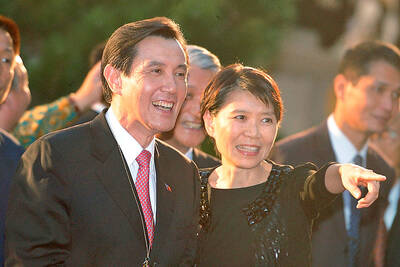
Former president Ma Ying-jeou (馬英九) yesterday expressed “shock and regret” over a statement issued by his wife without his consent, and rejected her assertion that his eldest sister, Ma Yi-nan (馬以南), would manage his medical care or act as his spokesperson amid an ongoing embezzlement probe into his foundation. Ma Ying-jeou in a statement said he was shocked by a statement by his wife, Chou Mei-ching (周美青), regarding his affairs. Ma Yi-nan “must not” be in charge of his healthcare and other personal affairs, nor can she be allowed to represent the Ma family, the former president said. He said he was also


 RSS
RSS