


Student activist Na Su-phok (藍士博) evoked the legacy of prior Taiwanese independence advocates as he announced his intention to enter the legislative race next year.
A doctoral student of Taiwanese history at National Chengchi University, Na has built a decade of experience in grassroots activism, with a strong focus on promoting Taiwanese cultural identity through works of history and literature.
At a news conference in Taipei on Friday, Na, 32, accepted an iconic denim jacket from 97-year-old historian and revolutionary leader Su Beng (史明), who is often described as the godfather of the Taiwanese independence movement.
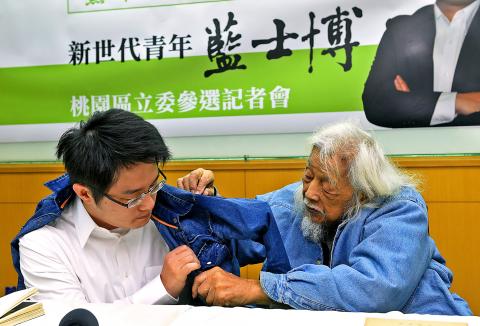
Photo: Chen Chih-chu, Taipei Times
“Young people are the masters of our society now; nobody talks about the world going backward,” Su said as he draped the denim jacket — similar to his own — over the shoulders of his younger compatriot.
Na also received a rare first edition of Su’s most renowned work, Taiwan’s 400-Year History (台灣人四百年史), initially published in 1962 during the leftist historian’s exile in Japan, where he founded several revolutionary organizations.
The two activists from different generations crossed paths in 2009 when Na launched an oral history project documenting Su’s life.
Over about 18 months, Na led a team of 10 college students in a series of 30 interviews with Su, which culminated with the Oral History of Su Beng (史明口述史), published in 2013.
The three-volume text, which won the Golden Tripod Awards for Publication last year, was instrumental in the production of a documentary on Su’s life — The Revolutionist (革命進行式) — which is in theaters now.
On Friday, Na announced his bid to enter the race in his hometown, Taoyuan’s Taoyuan District (桃園), which would pit him against Chinese Nationalist Party (KMT) Legislator Yang Li-huan (楊麗環), who clinched a decisive victory in 2012 with 58 percent of the vote.
While currently an independent, Na said he would not rule out “any forms of cooperation” with other like-minded parties, including the Democratic Progressive Party or recently launched smaller parties with progressive agendas.
Na has participated in efforts to ensure that Taiwanese history is included in high-school curricula and founded the Gongsheng Music Festival, an annual event aimed at raising youth awareness of the 228 Incident.
He also played a key role during the Wild Strawberries movement in 2008, in which thousands of students accused President Ma Ying-jeou’s (馬英九) administration of crushing dissent with police brutality during a visit from a delegation of Chinese officials.
Na said that Taiwan has yet to go through its first complete alternation in power, as the KMT has always held control of the legislature.
He urged opposition parties to join forces to prevent the KMT from retaining a majority.

LOUD AND PROUD Taiwan might have taken a drubbing against Australia and Japan, but you might not know it from the enthusiasm and numbers of the fans Taiwan might not be expected to win the World Baseball Classic (WBC) but their fans are making their presence felt in Tokyo, with tens of thousands decked out in the team’s blue, blowing horns and singing songs. Taiwanese fans have packed out the Tokyo Dome for all three of their games so far and even threatened to drown out home team supporters when their team played Japan on Friday. They blew trumpets, chanted for their favorite players and had their own cheerleading squad who dance on a stage during the game. The team struggled to match that exuberance on the field, with
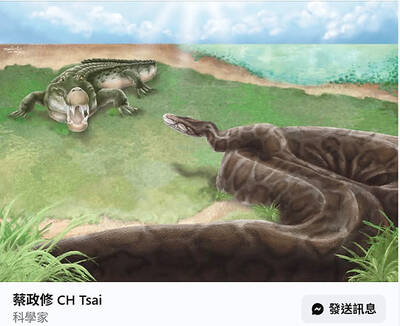
Taiwanese paleontologists have discovered fossil evidence that pythons up to 4m long inhabited Taiwan during the Pleistocene epoch, reporting their findings in the international scientific journal Historical Biology. National Taiwan University (NTU) Institute of Ecology and Evolutionary Biology associate professor Tsai Cheng-hsiu (蔡政修) led the team that discovered the largest snake fossil ever found in Taiwan. The single trunk vertebra was discovered in Tainan at the Chiting Formation, dated to between 400,000 and 800,000 years ago in the Middle Pleistocene, the paper said. The area also produced Taiwan’s first avian fossil, as well as crocodile, mammoth, saber-toothed cat and rhinoceros fossils, it said. Discoveries

Taiwanese paleontologists have discovered fossil evidence that pythons up to 4m long inhabited Taiwan during the Pleistocene epoch, reporting their findings in the international scientific journal Historical Biology. National Taiwan University (NTU) Institute of Ecology and Evolutionary Biology associate professor Tsai Cheng-hsiu (蔡政修) led the team that discovered the largest snake fossil ever found in Taiwan. A single trunk vertebra was discovered in Tainan at the Chiting Formation, dated to between 800,000 to 400,000 years ago in the Middle Pleistocene, the paper said. The area also produced Taiwan’s first avian fossil, as well as crocodile, mammoth, sabre-toothed cat and rhinoceros fossils, it said. Discoveries

Whether Japan would help defend Taiwan in case of a cross-strait conflict would depend on the US and the extent to which Japan would be allowed to act under the US-Japan Security Treaty, former Japanese minister of defense Satoshi Morimoto said. As China has not given up on the idea of invading Taiwan by force, to what extent Japan could support US military action would hinge on Washington’s intention and its negotiation with Tokyo, Morimoto said in an interview with the Liberty Times (sister paper of the Taipei Times) yesterday. There has to be sufficient mutual recognition of how Japan could provide


 RSS
RSS