


The National Security Bureau yesterday held a meeting attended by President Ma Ying-jeou (馬英九) and other national security agencies on the establishment of more effective methods to maintain national security in the wake of former Military Intelligence Bureau official Major Wang Tsung-wu’s (王宗武) detainment on charges of spying for China.
Wang and Colonel Lin Han (林翰) were detained and questioned on Thursday on suspicion of selling classified material to the Chinese, including lists of Taiwanese undercover agents and their activities in China.
Wang and Lin were released on bail of NT$500,000 (US$15,908) and NT$150,000 respectively. Both men are barred from leaving the country while investigations are ongoing.
According to the bureau, the meeting dealt with enforcing national security, how to conduct internal investigations, preventing leaks of confidential information, internal security management, information technology security and national security regulations.
The meeting’s purpose was to share information and practical experience between all national security and intelligence branches, as well as ensuring related agencies are capable of coming up with new ways of ensuring security and deterring espionage, the bureau said.
All national security and intelligence agencies should shift focus in accordance with the current situation and increase intelligence gathering efficiency, the bureau said.
We must ensure national security and social stability by effectively maintaining orderly cross-strait interactions, the bureau said.
Ma said during the meeting that the national security teams and intelligence agencies should focus on growing the nation’s anti-infiltration capabilities, as well as stepping up internal security management.
Such measures would effectively prevent foreign nations from infiltrating Taiwan, and support a capable national security system, Ma said, adding that it would also serve to protect national interests.

LOUD AND PROUD Taiwan might have taken a drubbing against Australia and Japan, but you might not know it from the enthusiasm and numbers of the fans Taiwan might not be expected to win the World Baseball Classic (WBC) but their fans are making their presence felt in Tokyo, with tens of thousands decked out in the team’s blue, blowing horns and singing songs. Taiwanese fans have packed out the Tokyo Dome for all three of their games so far and even threatened to drown out home team supporters when their team played Japan on Friday. They blew trumpets, chanted for their favorite players and had their own cheerleading squad who dance on a stage during the game. The team struggled to match that exuberance on the field, with
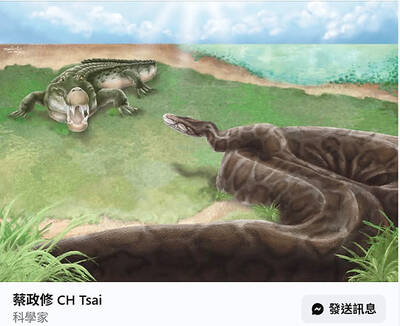
Taiwanese paleontologists have discovered fossil evidence that pythons up to 4m long inhabited Taiwan during the Pleistocene epoch, reporting their findings in the international scientific journal Historical Biology. National Taiwan University (NTU) Institute of Ecology and Evolutionary Biology associate professor Tsai Cheng-hsiu (蔡政修) led the team that discovered the largest snake fossil ever found in Taiwan. The single trunk vertebra was discovered in Tainan at the Chiting Formation, dated to between 400,000 and 800,000 years ago in the Middle Pleistocene, the paper said. The area also produced Taiwan’s first avian fossil, as well as crocodile, mammoth, saber-toothed cat and rhinoceros fossils, it said. Discoveries

Taiwanese paleontologists have discovered fossil evidence that pythons up to 4m long inhabited Taiwan during the Pleistocene epoch, reporting their findings in the international scientific journal Historical Biology. National Taiwan University (NTU) Institute of Ecology and Evolutionary Biology associate professor Tsai Cheng-hsiu (蔡政修) led the team that discovered the largest snake fossil ever found in Taiwan. A single trunk vertebra was discovered in Tainan at the Chiting Formation, dated to between 800,000 to 400,000 years ago in the Middle Pleistocene, the paper said. The area also produced Taiwan’s first avian fossil, as well as crocodile, mammoth, sabre-toothed cat and rhinoceros fossils, it said. Discoveries
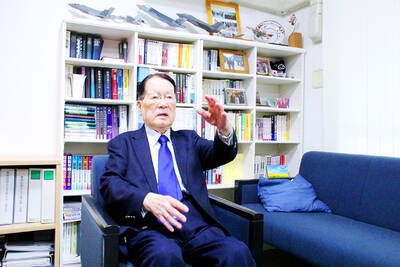
Whether Japan would help defend Taiwan in case of a cross-strait conflict would depend on the US and the extent to which Japan would be allowed to act under the US-Japan Security Treaty, former Japanese minister of defense Satoshi Morimoto said. As China has not given up on the idea of invading Taiwan by force, to what extent Japan could support US military action would hinge on Washington’s intention and its negotiation with Tokyo, Morimoto said in an interview with the Liberty Times (sister paper of the Taipei Times) yesterday. There has to be sufficient mutual recognition of how Japan could provide


 RSS
RSS