


China’s growing space warfare capabilities pose a fundamental threat to Taiwan, a US expert on Chinese weapons systems said.
Rick Fisher, a senior fellow on Asian military affairs at the International Assessment and Strategy Center in Alexandria, Virginia, was commenting on a report on China’s progress in space technologies released on Monday by the US-China Economic and Security Review Commission.
The report by the University of California Institute on Global Conflict describes China’s advancing space capabilities and was the subject of a news report in the Taipei Times yesterday.
Chinese military analysts believe that space-based information systems will be a deciding factor in future wars and space will be a dominant battlefield, the report said.
Fisher said that China now has the ability to target Taiwan’s satellites in low Earth orbits.
However, China’s fundamental space threat to the nation comes from its potential to delay or prevent the US and other countries from aiding Taiwan in the event of a Chinese attack, he said.
“By targeting key communication, surveillance and navigation satellites, China can make a US rescue mission far more difficult and costly to achieve,” Fisher said.
He said that space warfare capabilities could be useful in helping to achieve many Chinese objectives.
“China’s leadership understands that in order to ensure the success of its military endeavors on Earth, it has to control the high ground of space,” Fisher said.
“They also understand this pursuit does not end at low Earth orbit, but must continue to the moon and beyond,” he said.
“Chinese officials are already indicating that China’s projection to the moon and deep space will be dual use, or used to enhance the power of the People’s Liberation Army [PLA],” he said.
The report said that an earlier study established that China could image Taiwanese targets 35 times per day and that the PLA could use this capability to enable aircraft and missiles to pinpoint their fire, restrike targets or verify a target’s destruction.
According to the report, the Chinese Academy of Sciences operates satellite remote sensing data stations in Kashgar, Xinjiang; Beijing; and Sanya, Hainan.

LOUD AND PROUD Taiwan might have taken a drubbing against Australia and Japan, but you might not know it from the enthusiasm and numbers of the fans Taiwan might not be expected to win the World Baseball Classic (WBC) but their fans are making their presence felt in Tokyo, with tens of thousands decked out in the team’s blue, blowing horns and singing songs. Taiwanese fans have packed out the Tokyo Dome for all three of their games so far and even threatened to drown out home team supporters when their team played Japan on Friday. They blew trumpets, chanted for their favorite players and had their own cheerleading squad who dance on a stage during the game. The team struggled to match that exuberance on the field, with
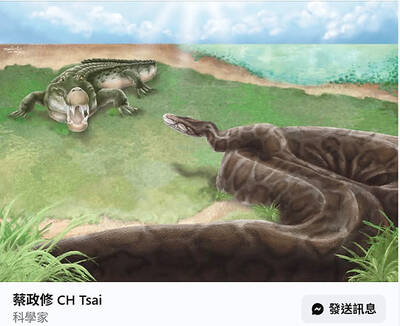
Taiwanese paleontologists have discovered fossil evidence that pythons up to 4m long inhabited Taiwan during the Pleistocene epoch, reporting their findings in the international scientific journal Historical Biology. National Taiwan University (NTU) Institute of Ecology and Evolutionary Biology associate professor Tsai Cheng-hsiu (蔡政修) led the team that discovered the largest snake fossil ever found in Taiwan. The single trunk vertebra was discovered in Tainan at the Chiting Formation, dated to between 400,000 and 800,000 years ago in the Middle Pleistocene, the paper said. The area also produced Taiwan’s first avian fossil, as well as crocodile, mammoth, saber-toothed cat and rhinoceros fossils, it said. Discoveries

Taiwanese paleontologists have discovered fossil evidence that pythons up to 4m long inhabited Taiwan during the Pleistocene epoch, reporting their findings in the international scientific journal Historical Biology. National Taiwan University (NTU) Institute of Ecology and Evolutionary Biology associate professor Tsai Cheng-hsiu (蔡政修) led the team that discovered the largest snake fossil ever found in Taiwan. A single trunk vertebra was discovered in Tainan at the Chiting Formation, dated to between 800,000 to 400,000 years ago in the Middle Pleistocene, the paper said. The area also produced Taiwan’s first avian fossil, as well as crocodile, mammoth, sabre-toothed cat and rhinoceros fossils, it said. Discoveries
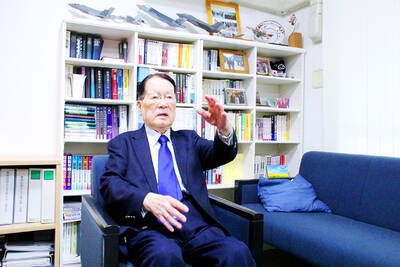
Whether Japan would help defend Taiwan in case of a cross-strait conflict would depend on the US and the extent to which Japan would be allowed to act under the US-Japan Security Treaty, former Japanese minister of defense Satoshi Morimoto said. As China has not given up on the idea of invading Taiwan by force, to what extent Japan could support US military action would hinge on Washington’s intention and its negotiation with Tokyo, Morimoto said in an interview with the Liberty Times (sister paper of the Taipei Times) yesterday. There has to be sufficient mutual recognition of how Japan could provide


 RSS
RSS